By James Alexander Dun
It was spring 2002 and I was entering what I thought—and hoped and needed to be—the final stages of my dissertation, a study of the ways in which the events that historians have since termed the Haitian Revolution were received, understood, and, crucially, used by contemporary Americans. To get after that, a big chunk of my research had involved reading and transcribing scads of newspaper reports. This was before widescale digitization. I got to know my university’s microfilm librarians so well that they eventually let me take one of the Pac-Man-sized machines home to our apartment where I plonked it down on our kitchen table. (Related sidenote: my wife is a very understanding person.) I had done a lot of reading. I had organized what I was seeing, and thought I saw some interesting patterns. I had begun to formulate the main themes. Chapters were forming, in my mind and increasingly on the page.
And then I had a little thought. It was tactical, not conceptual. What if I were able to bolster my claims about the news—how it moved, the words and themes by which it was relayed, the ideas it contained—with some quick observations about the trajectory of American commerce with Saint Domingue in the period? I had read Alan Pred’s Urban Growth and the Circulation of Information at an early stage. I was compelled by the idea that, in this pre-telegraph age, for information to move between disparate places human bodies had to travel across space. I had read the names of myriad sea captains and vessels in the newspapers. Why not zip into the archives and pick up some quick stats about those boats? In the midst of a project where I was trying to limn what people thought about things, this felt like something refreshingly concrete. I would count stuff. The outlines of a cool and pithy chart began to form in my head.
My study focused on Philadelphia, and I had already spent a lot of time in the city’s many wonderful archives. My little plan brought me to a new one—the Philadelphia regional branch office of the National Archives. When I popped in, I met a super helpful archivist named Gail Farr, who introduced me to the records of the U.S. Customs House. In a stroke of luck, the National Archives in Washington had just moved those records to the regional offices. In a stroke that was slightly less lucky, Gail explained that some of them had not been organized. The boxes of ship manifests were roughly collected by year, but that was it. No problem, I said, I’ll organize them into folders as I go. Gail agreed. I got to work, doing my counting. I remember thinking I bet this will take me a couple weeks.
Silly historian. The fates, or maybe Clio herself, chuckled from behind the branch office’s fluorescent lights. Counting stuff shifted from making rude hash marks in a notebook to notes in a Word doc, and then finally to records in a FileMaker database which I had to build, and then adapt, in order to capture the many bits of information about those boats one could aggregate across the various record groups—their captains (and sometimes their passengers and crew), their physical size and rigging, the timing of their movements, the stuff they ferried, how much, and on whose behalf. My couple of weeks turned into nearly a year. My adviser sighed. My friends shook their heads. My blessed wife put a patterned cloth on the microfilm reader and squeezed her own work—literally and figuratively—onto the table where it sat.
My counting was not for naught. I wrote an article that used its barest bones—the numbers of arrivals from Saint Domingue in Philadelphia—to help make a point about the ebbs and flows of the contact between the two places. The physicality of the commercial connections I had been able to see undergirded my eventual dissertation and sustained the deeper and more complete argument about Haiti and the nascent United States that I presented in my book. But, on the whole, these were only tips of what I suspect is an interesting and useful iceberg.
What follows is an introduction to that greater mass of information, and an invitation to others to take a look and use it. With lots of help, and trial and error, I’ve learned a bit about how to use ArcGIS software, and have crafted a story map that, I hope, introduces the data that I amassed all those years ago and suggests some further analysis that could be done. In addition to this access, you can find the full dataset online at the University of Pennsylvania’s Scholarly Commons. I hope users find this data useful, that it saves them some time and effort, and, ultimately, that it serves to stimulate their projects and studies. If folks use it and it helps them, I’ll be very grateful and happy.

James Alexander Dun specializes in early America with a particular interest in issues involving race, slavery, and revolution. He is the author of several essays and articles, as well as the 2016 book, Dangerous Neighbors: Making the Haitian Revolution in Early America.
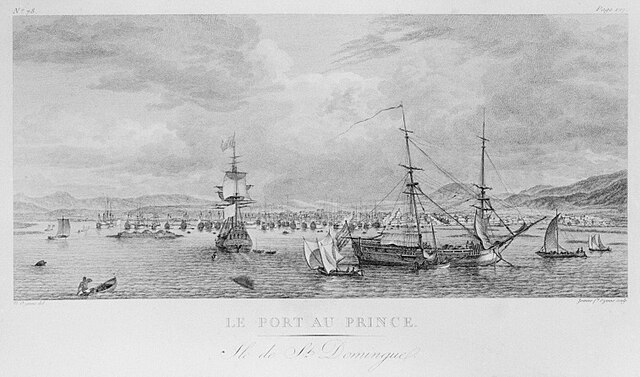
Title Image: A view of Port-au-Prince in the 18th Century. Source: Wikimedia Commons.

Leave a Reply