This post is a part of the 2025 Selected Papers of the Consortium on the Revolutionary Era, which were edited and compiled by members of the CRE’s board alongside editors at Age of Revolutions.
By Don Hickey
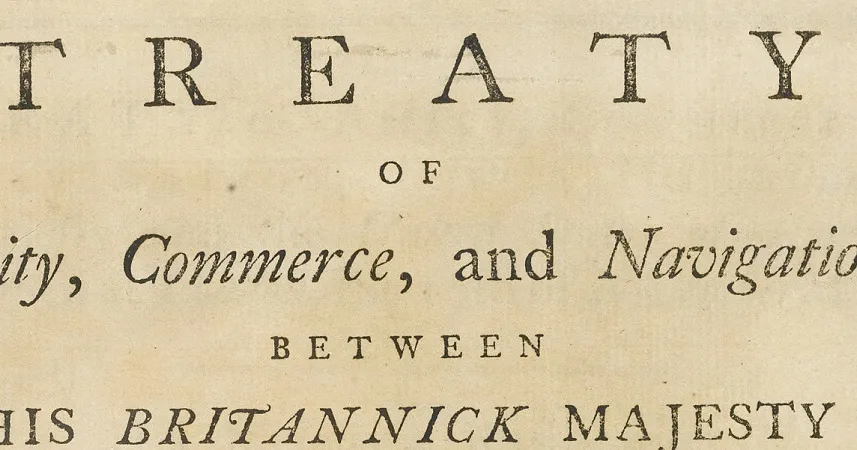
The Jay Treaty, known in Britain as the Treaty of London of 1794, was an Anglo-American agreement that dealt with trade, belligerent and neutral rights, and several other issues dating back to the peace treaty ending the American Revolution. The adoption of the Jay Treaty was a defining moment in the 1790s because it reordered the nation’s relationship with Britain and France, ensuring peace with the former and producing war with the latter, and in so doing solidified the emergence of the two-party system. To what degree the treaty was a good one for the United States has been subject to debate. At the time and ever since, the agreement has enjoyed a dubious reputation: mostly negative until World War II and only since then more positive or mixed.
The purpose of this essay is to offer a fresh appraisal of the treaty. Toward that end, we will first look at how the treaty has been viewed over time. We will then reexamine the international background, the negotiations and the terms that were agreed to, and then the response that the treaty received from contemporaries in America. Finally, and most importantly for the purposes of this reassessment, we will look at the impact of the treaty in the years that followed. Focusing on the consequences of the agreement suggests that it was far more beneficial to the United States than anyone has suggested and that it might be the most undervalued treaty in U.S. history.[1]
The Treaty Remembered
The traditional view of the treaty was shaped by Thomas Jefferson and James Madison, who headed the Democratic-Republican party that so vociferously opposed the agreement in the 1790s. Both men demanded much greater concessions from the British than the treaty offered and were prepared to employ trade restrictions to achieve their aims. Jefferson later called the treaty “a millstone round our necks,” and he rejected British overtures to renew the clauses governing trade and neutral rights when they expired in 1803.[2] He also rejected the Monroe-Pinkney Treaty of 1806, an agreement that was designed to be a successor to the Jay Treaty and actually included greater British concessions in those areas than Jay had secured in 1794.[3] The rising fortunes of the United States in nineteenth century, coupled with a surge in patriotism and nationalism, contributed to the notion that Jay surely could have secured a better deal. Pro-Federalist historian Richard Hildreth conceded in 1855 that “Jay was induced to sign a treaty, defective in some points and objectionable in others,” even though it was “the best that could be obtained.”[4] Henry Adams, one of the most influential scholars of the late nineteenth century and a master at presenting his opinions as facts, went much further in his criticism. Although he usually endorsed the policies of his great grandfather, John Adams, he parted company on this issue. “That Mr. Jay’s treaty was a bad one,” he wrote in 1879, “few persons even then ventured to dispute; no one would venture on its merits to defend it now.”[5]
The traditional view of the treaty was sealed by Samuel Flagg Bemis, arguably the nation’s preeminent diplomatic historian in the twentieth century. No study has done more to shape our understanding of this agreement than his book, Jay’s Treaty: A Study in Commerce and Diplomacy (1923; rev. ed., 1962). Based on extensive research in multiple North American and European archives, Bemis’ study has been the standard work on the subject for more than a century. By design, Bemis focused on the background and negotiation of the agreement. As he put it in the Preface to the Second Edition, “The subject of my investigation was not the political storm that followed publication of the convention but rather the background of the issues which led to the treaty, and the negotiation itself.”[6] Bemis’s appendices treat the work of the joint commissions that were created to address issues deemed too complicated to be resolved in the negotiations. But otherwise, he showed no interest in the consequences of the treaty, some of which (most notably, the Pinckney Treaty with Spain), he acknowledged in later works, were extraordinarily favorable to the United States. Thus, his judgment of Jay and of the agreement, based solely on the negotiations, was far from favorable. “Jay,” he concluded, “did not make the most of the advantages afforded by the European situation” and “was induced to accept terms which might have been bettered by an abler negotiator.”[7]
Criticism of Jay and his agreement softened after World War II, perhaps because of improved relations between the two nations. In 1940, Canadian historian A. L. Burt called the treaty “highly important” and “epoch-making” and credited the two nations with negotiating “a peace based on justice.” More than twenty years later, in 1963, Paul A. Varg called the agreement “a reasonable give-and-take compromise of the issues between the two countries.” Echoing this assessment in 1969 was Charles R. Ritcheson, who said: “The treaty was a fair, honorable, and reasonable settlement wrought by two fair, honorable, and reasonable men.” Most scholars now also concede that Jay probably got the best deal possible, and two decidedly pro-Federalist historians, Stanley Elkins and Eric McKitrick, insisted in 1993 that it is “likely that no other American could have got anything nearly as good.” Finally, in an article published in 2008, François Furstenberg claimed that given “the tenuous loyalties of American settlers across the trans-Appalachian West” and “the imperial adventures taking place throughout the region—Jay’s Treaty of 1794 emerges as a diplomatic triumph.”[8]
But even those assessments that have been more favorable have not been free of criticism of the treaty. In 1955, Bradford Perkins conceded that the treaty yielded “extensive material benefits” but also argued that it was “far from being completely satisfactory to the United States.” Likewise, in 1970, Jerald A. Combs credited the treaty with winning important concessions but insisted that they were “dearly bought” and that Jay had shown a “lack of vigor” in pursuing U.S. interests.[9] Thomas A. Bailey, on the other hand, praised Jay for securing both peace and a commercial treaty and thought the treaty with Spain that Jay’s agreement produced “was of such far-reaching significance as alone to justify the Jay Treaty.” But Bailey also called the treaty “Britain’s hard bargain” and suggested that it “was perhaps most noteworthy for its silences.”[10] Nor has the older negative assessment entirely disappeared. In 2006, Todd Estes claimed that “all in all, the Jay Treaty gained little for the United States.”[11] In sum, in spite of treating the Jay Treaty more favorably, modern scholars have nonetheless still have peppered their works with criticism.
The problem with these assessments is that they focus more on the terms than the results, on the concessions that Jay made or received rather than on how the agreement played out over time. But aren’t treaties more fairly judged by what they actually produce rather than what they promise? That is certainly how we judge most treaties. Witness, for example, American Indian treaties, which are almost always criticized for producing worse results than they promise. The impact of the Jay’s Treaty was just the opposite: it produced far more favorable results for the United States than the terms seemed to promise. This has largely escaped historians, and it is why the current reexamination and reassessment of the treaty is necessary.
The International Background
The United States had no commercial treaty with Britain in the decade after it achieved independence in 1783. Although John Adams, the U.S. minister in London, had been instructed to seek one in 1785, the British were unresponsive. They had no interest in granting commercial privileges to a nation that had so recently secured its independence from the mother country in a costly and (for Britain) a losing war. Nor did they have any faith in the U.S. government to uphold a treaty. The Articles of Confederation, after all, had created a confederacy of independent states with a weak central government that had no executive or judicial branches and little coercive power. With the sovereign states pulling in many different directions and secessionist movements in Vermont and the West, there was considerable doubt, both at home and abroad, about whether the United States could even survive as a nation. Already the southern states had adopted legislation that made it impossible for British merchants to recover debts owed to them from before the Revolution even though the peace treaty expressly guaranteed this right. The new nation’s dubious prospects were one reason the British government had not yet seen fit to dispatch a minister to represent its interests in the United States even though the Confederation government had sent Adams to represent the new nation in London.[12]
Without a commercial treaty, Anglo-American trade was either left unregulated or governed by executive orders issued by local officials in the far-flung British Empire or by the imperial government in London. While this policy served the immediate needs of both sides, it was hardly a good long-term solution for managing the growing trade between the two nations. Regulations could be withdrawn or modified on the whim of the officials who issued them and without any advance warning. Trade based on treaty provisions, by contrast, would rest on a much more dependable foundation that merchants could rely upon, at least for the duration of the treaty.
There was another problem that would probably have to be addressed in any trade negotiations. Commercial treaties usually defined not only the terms of trade between nations but also their rights as belligerents or neutrals in time of war. The British subscribed to the rules laid on in the Consolato del Mar (Consulate of the Sea),a 15th-century maritime code that favored large naval powers by holding that enemy property on a neutral ship could be confiscated and by recognizing a broad definition of contraband that was subject to seizure on a neutral commercial ship. This definition included not simply war matériel but at least implicitly just about anything else that might be used to support a war effort, such as ship timber and naval stores, foodstuffs, and on occasion even gold and silver or money.[13] The British also enforced another dictum known as the Rule of 1756, which prohibited any trade in time of war that was not permitted in time of peace. This rule was designed to prevent Britain’s enemies from opening trade to neutrals that was normally closed to them. Thus, if France’s own merchant fleet was driven from the high seas by the Royal Navy, Britain would not permit neutrals like the
United States to carry on this trade. Unlike the rules found in the Consolato Del Mar, this rule was simply a British maritime doctrine and had no standing under international law.[14]
The United States, by contrast, favored a doctrine developed by the Dutch in the seventeenth century that fostered what was known as “freedom of the seas.”[15] This doctrine held that neutral vessels might carry property of a belligerent (known by the catch phrase “free ships make free goods”) and supported a much narrower definition of contraband that was strictly limited to war matériel. Such a view favored small naval powers unlikely to carry on trade when they were at war and neutral powers that could profit by stepping into the breach. Although the Consolato del Mar was still the recognized standard under international law in Europe, the United States embraced the Dutch doctrine in the Model Treaty promulgated by the Continental Congress in 1776 and incorporated into commercial treaties signed with France in 1778, the Netherlands in 1782, Sweden in 1783, and Prussia in 1785.[16] Whether United States and Britain could reconcile their opposing views of belligerent and neutral rights in a treaty was unclear.
Further complicating any Anglo-American negotiations were several disputes dating back to the peace treaty of 1783. Both nations were in violation of the treaty. The British were required to withdraw from all U.S. territory, but they continued to occupy seven border forts.[17] Although mostly undermanned and in poor repair, these forts had strategic value because they could limit access to the waterways in the borderlands and serve as the first line of defense against any threat to Canada from the south. Of more immediate importance, they enabled the British to better manage the Indians, thus retaining their allegiance and as well as control over the fur trade.[18] The fur trade was then the single largest and one of the most profitable industries in North America, yielding £200,000-£250,000 a year in income and £40,000-£50,000 in tax revenue. [19] The British also refused to provide compensation for runaway slaves carried off when they departed at the end of the War of Independence even though the peace stipulated that no “property” would be taken.[20] The United States, for its part, was in violation of the Peace Treaty, because of the southern legislation blocking the collection of prewar debts. In addition, Loyalists claimed they were entitled to compensation for their estates that were confiscated during the war, although the peace treaty merely said that the Confederation Congress “shall earnestly recommend” that the state legislatures provide compensation.[21] Each side claimed that the other side violated the treaty first and that it was only retaliating to protect its interests in the matter.
Further heightening border tensions was the news of actions taken in February 1794 by Sir Guy Carleton (Lord Dorchester), the governor-general of Canada. Acting on his own authority, Dorchester told a group of visiting Indians that he would not be surprised if war between Britain and the United States broke out before the end of the year. Even more astonishing, he said that he considered all Indian land sales since 1783 “an Infringement on the King’s rights” and urged the Indians to draw the line against further American encroachments. “I believe our Patience,” he concluded, “is almost exhausted.” He wrote down his comments, and they were circulated among Indians throughout the Old Northwest and not surprisingly reached U.S. officials.[22]
A week later Dorchester added more fuel to the fire by ordering Lieutenant Governor John Graves Simcoe (the chief executive officer in Upper Canada) to establish a British post on the Maumee River in present-day northern Ohio to better protect the British-held fort at Detroit. Simcoe ordered the post, known as Fort Miamis, built and directed Colonel Richard G. England, who was in charge at Detroit, to send detachments of regulars and artillery to garrison it.[23] President Washington was stunned by this development. Calling it “irregular and high-handed,” he said: “This may be considered as the most open and daring act of the British agents in America.”[24]
The British continued their custom of supplying Indians in American territory with arms, ammunition, food, and other necessities, and this, coupled with the British control of the border posts, encouraged a continuation of the low-level warfare between Native Americans and settlers that persisted in the Old Northwest after the Revolution. British officials in this matter walked a fine line. On the one hand, they sought to retain the loyalty of the Indians (in case of another American war) and the profits from the fur trade, but on the other hand, they wanted to avoid precipitating a war with America. Local Indian agents, however, who were closely tied to the Native population by marriage and trade, often encouraged greater resistance to the United States than was officially warranted. Britain’s three principal Indian agents in the Old Northwest, Matthew McKee, Simon Girty, and Matthew Elliott, all fit this profile.[25]
To many Americans, especially in the West, British support of the Indians was their worst offense. Washington, who had been so exasperated by the decision to build Fort Miamis, said that this was not “the most hostile and cruel” act of British agents in America. Rather it was the support they gave to Indians. “All the difficulties we encounter with the Indians,” he said, “their hostilities, the murders of helpless women and innocent children along our frontiers, result from the conduct of the agents of Great Britain in this country.”[26] This warfare eventually erupted into a full-scale war, known variously as Little Turtle’s War or the Northwest Indian War (1790-1795), that pitted the United States against the Wabash Confederacy, a loose coalition comprised of the Miamis, Weas, Piankashaws, and some villages of Kickapoos, Potawatomis, Delawares, Shawnees, and Wyandots.[27]
Further affecting any Anglo-American relations was the outbreak of war in Europe. The French Revolution had erupted in 1789, sending shock waves across Europe that affected the entire Trans-Atlantic world. French leaders, determined to spread France’s influence, revolutionary ideals, and boundaries, met with resistance from Europe’s other powers. War erupted in 1792, and the following year Britain joined France’s enemies, which marked the beginning of a period of nearly continuous Anglo-French warfare that persisted until 1815. As a result, the fledgling United States found itself seeking to protect its interests in a world at war.
Although the new nation sought to remain neutral and maintain good relations with all the belligerents, this proved difficult for several reasons. First, Britain and France and their allies periodically encroached upon American rights and looted its lucrative and growing international trade. Secondly, the state of war made Britain less likely to make any concessions to the United States, particularly in the realm of neutral rights, that might undermine its war effort. And finally, American options appeared to be limited by a pair of treaties it had signed with France in 1778 during the American Revolution, one dealing with commerce and neutral rights and the other establishing an alliance. The two treaties contained the seeds of future discord because they had no expiration date, and Article 11 of the Treaty of Alliance bound the two nations to “guarantee mutually from the present time and forever, against all other powers,” their respective possessions “in America,” which was widely interpreted to mean principally France’s colonies in the West Indies but might also include its South American colony at Cayenne and two small islands, St. Pierre and Miquelon, off the coast of Newfoundland.[28] This meant that when France declared war on Britain on February 1, 1793, in the opening round of the Wars of the French Revolution, the United States was nominally bound to France. France did not expect the young republic to become an active belligerent. She was too dependent on American foodstuffs to run the risk that Britain might respond by blockading American ports. But France did expect the Washington administration to pursue a pro-French neutrality and to uphold a broad definition of neutral rights.[29]
Further muddling Franco-American relations were the widely different views that people in the two countries held on the source of American success in the Revolution. Americans believed that they were mainly responsible for their success and credited France only with an assist. The French, by contrast, considered their role decisive. At the end of 1796, Paul Barras, the President of the French Directory, told James Monroe, who had recently served as the U.S. minister to France, that “the French republic expects . . . that the successors of Columbus, Raleigh, and Penn, always proud of their liberty, will never forget they owe it to France.” “All parties in this country,” added Charles Cotesworth Pinckney, Monroe’s successor in Paris, “unite in thinking that we ought to act as if we were altogether their dependents, and indebted to them solely, and not to our own exertions, for our liberty and independence.”[30] This, coupled with the official U.S. policy of neutrality, could only heighten French resentment should any U.S. policy lead an Anglo-American rapprochement.
News arrived in 1793 that served to heighten American distrust of Britain. Portugal, an ally of Britain, had been using its navy to patrol the Straits of Gibraltar, which prevented predatory Algerian corsairs from threatening America’s growing trade in the Atlantic. In late 1793, however, Britain, eager to turn the Portuguese navy against France, negotiated a truce between Portugal and Algiers. The withdrawal of the Portuguese navy from the Straits opened the Atlantic to Algerian cruisers, which began preying on American merchantmen. Democratic-Republicans assumed the British aim was to disrupt American trade, and even Federalists were unhappy with the development. As one Federalist told Rufus King, then a U.S. Senator and later the U.S. minister to Britain, the British had “let the Algerians loose upon us.”[31]
Matters between the United States and Britain came to head in 1794, when news began to arrive in the United States that the Royal Navy and British privateers had seized some 250 American merchant ships in the Caribbean that were trading with the French West Indies. The seizures were made under the authority of a sweeping British order-in-council, based on the Rule of 1756, that had been issued in November 1793 but not made public until December to allow time for British cruisers to reach those waters and move in for the kill against unsuspecting merchantmen. By March 1, 1794, 150 of the ships had already been condemned by British admiralty courts in the Caribbean, leaving their crews abandoned and the ship-owners without enough time to appeal the verdicts to the courts in England.[32]
Reports of these seizures sent shock waves through the United States as many merchants faced heavy losses if not bankruptcy. This news was accompanied by reports of Lord Dorchester inflammatory address to Indians and the British construction of Fort Miamis in Ohio. All of this came on top of a widely held conviction in the United States that the British had no intention of relinquishing the western posts. The result was a genuine war scare even though war was the last thing either government wanted. The United States had no desire to take part in another war with Britain, nor did it have the necessary military power to seize the occupied posts or to force an end to British depredations in the West Indies. Britain, for its part, also had little interest in alienating its principal trading partner at a time when it was waging a large-scale war in Europe that extended into the wider world.[33]
In response to the crisis, the Democratic-Republicans demanded retaliation against Britain, preferably in the form of discriminatory commercial legislation, although any such legislation would likely cut both ways and do significant harm to the United States because the two nations were so closely tied commercially. The United States sent about 50 percent of its exports to Britain and its territories and received about 90 percent of its imports from the same source. This meant that at least 60 percent of its foreign commerce was with the British Empire, a trade that was facilitated by generous British credit terms.[34] Any interruption in this trade could not only produce an economic depression (much as Jefferson’s Embargo did in 1808) but also disrupt the nation’s public finances because close to 90 percent of the federal government’s revenue came from import and tonnage duties.[35] As counter-productive as economic sanctions might be, about all that Federalists could offer in response was support for defense measures—increasing the army and navy and strengthening coastal fortifications—coupled with a recommendation to work for a peaceful settlement. In the meantime, to protect U.S. ships and punish the British West Indies, which were dependent on America for provisions and timber products, Congress adopted a one-month trade embargo, later extended to two months.[36] It seems not to have much effect, perhaps because it was short-lived.[37]
Jay’s Mission
Instead of retaliating any further against Britain, President Washington decided in 1794 to take the advice of Alexander Hamilton and other Federalist leaders and send a diplomatic mission to London to try to resolve all outstanding differences. The British were now more receptive than they had been in the 1780s. They were reassured that a much stronger U.S. government was now in place and realized that they would probably do far better negotiating with the existing administration than any that might replace it. Hence, they sent word that they were interested in resolving their differences, and they now dispatched George Hammond to serve as their first minister to the United States.[38] Hamilton became Hammond’s confidant and advisor, and while Hammond wrestled with Secretary of State Jefferson over the issues in dispute, Secretary of the Treasury Hamilton assured the British minister that the United States was eager to find a solution.
The man that Washington chose for the special mission was John Jay, a 48-year-old New Yorker who was then at the height of a career that included extensive public service.[39] Jay had served in the Continental Congress (including a stint as president) and had drawn up New York’s first constitution and then served as its first chief justice. Dispatched to Europe in 1779, he had failed to persuade Spain to recognize American independence but then had served as the point man in the peace negotiations with Britain that brought the Revolutionary War to an end. The peace treaty, which recognized the Mississippi River as the western boundary of the United States, was generous, to say the least, because at the time there were fewer than 100,000 Americans living west of the Appalachians and Britain’s Indian allies in the west remained unbowed and thus uninterested in peace.[40]
While supporters of the administration who were part of the emerging Federalist party considered the diplomatic initiative well advised and Jay a good candidate for the job, opponents who were part of the nascent Democratic-Republican party took a different view. They regarded Jay as too pro-British to be trusted to negotiate the kind of treaty they thought the nation deserved, and many were against any negotiations at all with a nation that they still regarded as America’s principal foe. Moreover, they could remember in 1786 when Jay promoted a deal with Spain that would close the Mississippi, a vital outlet for western produce, for 25-30 years in exchange for Spanish commercial concessions. The Confederation Congress killed the deal, but to critics it looked like Jay was willing to sell out the West to enrich northern merchants.[41]
Hence, when President Washington submitted Jay’s nomination to the Senate on April 16, 1794, Democratic-Republicans worked to delay or defeat the nomination by offering resolutions that sought additional information from the administration, raised the issue of separation of powers (because Jay continued as Chief Justice), or suggested the nation’s regular minister in London could handle the negotiations. These proposals were easily defeated in the Federalist-dominated Senate, and Jay was approved by a vote of 18-8. Three anti-administration members joined the majority, but eight others held firm against the nomination.[42]
Although Jay’s appointment showed that the administration’s was committed to seeking a diplomatic solution to America’s problems with Britain, Democratic-Republicans in Congress, led by James Madison, nonetheless pressed ahead with a bill to restrict U.S. trade with Britain, while the Federalists, headed by William Loughton Smith of South Carolina, offered resistance. After an extended debate, the House passed a non-importation bill that targeted Britain. Although Federalists dominated the Senate, it took the deciding vote of Vice President John Adams to kill the measure.[43] Another bill, to extend the embargo for a month, failed by a large margin in the House because many Democratic-Republicans had concluded that it worked too great a hardship on the United States and France.[44] Hence, the two-month embargo expired on May 25, 1794. There were also several proposals to authorize the sequestration of British debts, but these went nowhere.[45] All of this meant that negotiations would go forward without the cloud of economic or financial sanctions hanging over them.
For his mission, Washington appointed Jay an “envoy extraordinary of the United States to His Britannic Majesty.” This was a special status for diplomatic assignments. A mission like Jay’s, Washington intoned, “corresponds with the solemnity of the occasion [and] will announce, to the world a solicitude for a friendly adjustment of our complaints, and a reluctance to hostility.”[46] Jay’s rank was the highest the United States employed since, in the interest of economy, Congress would not grant ambassadorial rank to anyone in the diplomatic corps. Instead, the ranking resident U.S. diplomat was an envoy extraordinary and minister plenipotentiary, who headed a legation rather than an embassy, and there were only five such U.S. ministers in 1794: in Britain, France, Spain, Prussia, and the Netherlands.[47]
The instructions that were to guide Jay were ambitious. Hamilton provided significant input, but they were drawn up by Jefferson’s successor in the State Department, Edmund Randolph, and were dated May 6, 1794. Randolph followed up with several letters, adding to the instructions and sending new information when it was pertinent. As was norm in instructions written to govern negotiations like this, the concessions sought represented what the United States wanted to gain rather than what it expected to gain.
Randolph told Jay that the aim of the special mission was “to repel war, for which we are not disposed” and yet “at the same time, to assert, with dignity and firmness, our rights, and our title to reparation for past injuries.” First and foremost, Jay was to demand compensation for the recent seizures committed by British cruisers in the West Indies, and agreement on the closely related issue that foodstuffs were not to be considered contraband unless headed to a port “under siege, blockade, or investment.”
Secondly, with respect to the Treaty of Peace from 1783, Jay was to demand that the British withdraw from the western posts and rein in their agents, who were “guilty of stirring up, and assisting with arms, ammunition, and warlike implements, the different tribes of Indians against us.” He was also to urge the British to use the newly created federal courts to secure the payment of their prewar debts and the interest that had accrued on them.
Thirdly, Jay was to seek a commercial treaty that put Anglo-American trade on a secure foundation and that recognized the principles of freedom of the seas. Randolph identified nineteen objectives and several more in subsequent paragraphs, all of which were deemed desirable but not essential. These called for Jay: (1) To secure the usual aims sought by neutrals at sea—the right to carry enemy property (that is, free ships-free goods), the exclusion of provisions from contraband, recognition of a clear definition of blockades, and limitations on searches at sea and on the activities of privateers and convoys. (2) To minimize trouble on the northern frontier by restricting supplies to Indians in time of war and prohibiting troops near the Great Lakes in time of peace. (3) To seek a broad range of commercial cessions that would open ports in the British Isles and the West Indies to American ships, put American trade with the East Indies on a sound footing, and eliminate most-favored nation status (“as being productive of embarrassment”) except to secure Americans access to ports in the British Isles. (4) To include assorted other stipulations that would permit the export from Britain of arms and war matériel, ensure the free emigration of people (especially with those with knowledge of manufacturing), and authorize American fishing in British waters off the coast of Canada. (5) And finally, to seek the usual stipulations governing pirates, shipwrecks, consular rights, and the sale of prizes. Nothing, however, was to be included in the treaty that was inconsistent with the nation’s French treaties.
Randolph told Jay that if he was unable to secure a treaty on satisfactory terms, he could discuss joining the Armed Neutrality with the northern powers (Russia, Denmark, and Sweden) in order to uphold a broad definition of neutral rights, and he was let the British know that joining this coalition was a possibility.
Finally, Randolph told Jay that because of the distance of the United States from London and “the present instability of public events,” the President could not lay down any hard and fast rules to govern his diplomacy. “You will therefore consider the ideas, herein expressed, as amounting to recommendations only, which at your discretion you may modify, as seems most beneficial to the United States, except in the two following cases, which are immutable.” He was to reject any British attempts to “detach” the United States from France, and he was to reject any stipulations in a commercial treaty that ran counter to U.S. obligations to France.[48]
Jay was given no instructions on the emerging issue of impressment, that is, the Royal Navy’s practice of stopping American merchant ships on the high seas or in British ports, mustering their crews, and conscripting those deemed to be British subjects into service. This practice sometimes left American ships dangerously short-handed and subjected U.S. citizens (who were mistakenly or intentionally targeted) to fight a war that was not their own and to endure all the horrors of British naval discipline enforced with the cat-of-nine tails. Jay did, however, raise this issue in the negotiations.
In emphasizing that his instructions represented nothing more than a wish list, Randolph assured Jay that he was free to agree to any terms that he considered beneficial to the United States so long as they didn’t violate American commitments to France. This latitude was common for American diplomats negotiating far from home and thus unable to conveniently seek guidance from the State Department. This kind of latitude worked well with the American system of government because no diplomat could bind the nation to any treaty that didn’t have the support of the President and two-thirds of the Senate.
The Negotiations
Jay departed for England on May 12, 1794. Randolph’s letters sent after his departure indicated there had been no letup in the arrival of news of British depredations in the West Indies and that American anger had reached a fever pitch against the former mother country. Given the mood in America, Randolph reported that the British minister anticipated “a rupture with the United States” and complained that the British consul in Baltimore had been threatened by a mob, that the consul and a British frigate captain in Norfolk had also been threatened, and that two British frigates had been denied access to the port of Charleston. “All these events,” Randolph added, “proceeding, as they do, from a state of inflammation, which the British government has it in their power to extinguish, manifest the necessity of an immediate adjustment of our disputes.”[49]
Arriving in Falmouth on June 8 after a quick voyage of just four weeks, Jay reached London a week later by stagecoach and opened negotiations shortly thereafter with William Grenville, who served as Britain’s Secretary of State for Foreign Affairs in the Tory government headed by William Pitt the Younger. Jay was eager for a settlement, and he found Grenville of a like mind. In fact, one scholar has characterized Grenville as “probably the major architect of the rapprochement between England and America.”[50] Like their U.S. counterparts, British leaders had no desire to go to war with their best commercial partner. They reprimanded Lord Dorchester for his incendiary speech to the Indians and for ordering the construction of Fort Miamis and instructed him to do nothing further to antagonize the United States.[51] British officials now believed—correctly, as it turned out—that, even without the forts, they could retain control of the Indians and the fur trade simply by building their own posts on the Canadian side of the border.
Changing conditions in America and Europe also influenced British thinking on U.S. relations. In America, the United States was now under a new constitution, one that provided for a stronger central government with executive and judicial branches better able to uphold the nation’s treaty rights and obligations. In Europe, the war appeared to be turning against Britain. The First Coalition, formed in 1792 to resist French expansion, lasted until 1797 but was already showing signs of strain. French forces had turned the tide against the Coalition with a decisive victory in Flanders in the Battle of Fleurus in June 1794. Moreover, the eastern powers—Russia, Austria, and Prussia—were already jockeying for position over the final partition of Poland, which took place in 1795. In addition, Spain, unable to beat back a French invasion, threatened to sign a separate peace. And finally, France had offered to bankroll a revival of the Armed Neutrality of 1780 with the expectation that it would promote a broad definition of neutral rights. None of this boded well for Britain’s aim to resist French pretentions on the Continent or to uphold its version of belligerent rights at sea.[52]
With both sides interested in peace, the time was ripe for an Anglo-American rapprochement, although it took some five months of bargaining to reach an agreement. This was the result of the myriad of issues that had to be addressed and of Britain’s preoccupation with the war in Europe. As Jay put it after the negotiations were under way, “Considering how many urgent affairs [in Europe], which cannot be postponed, daily call for the minister’s orders, we cannot expect that ours should proceed without some occasional delays. As yet, I have no reason to believe that any of them have been avoidable.”[53]
Jay didn’t say much about the details of the negotiations until they had reached the final stages of their agreement. This was not unusual. For someone in Jay’s position, it was not uncommon to report only the general course of the negotiations and perhaps a significant breakthrough or obstacle. Given the distance to the United States, usually six to eight weeks one-way in the Age of Sail, he could expect little guidance from home in a timely fashion on any issue that surfaced. In fact, to promote candor and avoid any public embarrassment that might undermine the negotiations, Jay and Grenville agreed to keep their conversations private. Even their private secretaries were excluded.[54] Jay also decided to keep his government in the dark about the many dinner parties hosted by British government officials that he attended. “I think it best,” he told Hamilton, “that they should remain unmentioned for the present.”[55] Grenville, by contrast, did not have to be so circumspect, and with his government colleagues near at hand, he could seek out their opinions on any issue that needed to be addressed. In fact, the British cabinet spent four hours going over the final draft of the treaty before approving it.[56]
By early July, Jay had been in England for a month, which was long enough for him to assess British opinion toward the United States, and all the signs were good. Having talked to “many successful and influential characters,” he had concluded that “war with us would be an unpopular measure.” He also had spoken to “certain persons attached to the administration,” and they seemed favorably disposed toward the United States. No one defended Dorchester’s or Simcoe’s actions, and “the general conduct of our Government received the most unreserved approbation, and the character of the President was spoken of in terms of the highest respect.” Jay was equally impressed by his treatment from King George III and Queen Charlotte when he was presented to them. “The reception I received from them both,” he said, “was affable and satisfactory, and perfectly calculated to create an opinion of the good will of this Government to the United States.” In sum, Jay had “neither heard nor seen any thing that looks like a hostile disposition in the mass of this nation toward ours.”[57]
Although others considered Grenville stubborn and dogmatic, Jay found him easy to work with.[58] Early on, he described Grenville as “liberal, candid, and temperate,” and he reciprocated, telling Hamilton, “I will endeavor to accommodate rather than dispute.”[59] The first issue the two men addressed was the British spoliations in the Caribbean, and while Grenville asked for more information on the individual cases, he conceded “that there might be such a state of things as to render the interposition of Government proper and necessary, to satisfy justice.”[60] The two sides agreed that they would maintain the status quo on their common border in North America, and after discussing the construction of Fort Miamis, they also agreed that “all encroachments on either side should be done away.” To emphasize the British commitment to this agreement, Grenville shared a letter to the British minister in America on the border problems, and Jay fully expected—correctly—that similar dispatches would be “expedited directly” to Dorchester and Simcoe.[61]
By early August, Jay and Grenville had found enough common ground to begin exchanging drafts of a treaty. After working out their differences, Jay on September 30 prepared a fresh draft for Grenville to consider.[62] This draft included not only the issues they had agreed upon but also a number that the British had already rejected or were likely to reject. Among them were the doctrine of free ships and a narrow definition of contraband that included war matériel but expressly excluded provisions, naval stores, and gold, although an exception was made for food under certain circumstances. This draft also barred both sides employing Indians in any war they waged against each other and provided for demilitarizing the Great Lakes and the Canadian-American border. Britain refused to bow to these demands because they would have undermined its ability to defend Canada or to wage war in Europe. In response, Jay dropped the objectionable issues, and he did not submit this draft to the State Department.
Bemis castigates Jay for not pressing harder on the objectionable issues, calling his decision “a stupendous retreat,” but surely this would have been fruitless.[63] By including such demands in his draft of the treaty, Jay, who was an experienced and knowledgeable diplomat, was simply being a good steward of American foreign policy aims. When diplomats are close to reaching agreement on a treaty, one side or the other will prepare a draft (commonly called “a project of a treaty”) that includes not only the terms they have agreed upon, but also others known to be unacceptable. The aim in doing so is two-fold: (1) to establish a written record of issues that their nation considers important; and (2) to take advantage of the possibility, however remote, that the other side might be willing to concede or compromise on a point that it was thought to oppose. In November 1814, for example, after the U.S. and British delegations at Ghent had agreed on the basic terms for ending the War of 1812, the American envoys submitted a “projet of a treaty of peace” that included British concessions on neutral rights and other issues that the Americans knew were unacceptable. The British simply marked each of these provisions as “inadmissible,” returned the draft, and the two sides then moved on to a draft that they could agree upon.[64]
There is no doubt that Jay expected his draft to elicit the response from the British that he got. Bemis makes much of Jay’s failure to include this draft in the documents that he submitted to the State Department. While this was indeed unusual, Jay realized that it would only give the Democratic-Republicans, who were unlikely to support any agreement that did not achieve British recognition of neutral rights, more ammunition against his treaty. In a private letter to the President in mid-September, he confided: “That attempts will be made in America to frustrate this negotiation, I have not the most distant shadow of a doubt.”[65]
On November 19, 1794, Jay and Grenville signed off on the final draft of their treaty.[66] Both sides had made concessions. Jay got almost nothing on neutral rights (free ships, contraband, and the Rule of 1756), gave up on compensation for the enslaved people carried off at the end of the Revolution, and secured no concessions on impressment. Grenville gave up a demand he had made for territorial concessions to close a boundary gap between Lake of the Woods and the Mississippi River so that British merchants would have access to that river, which was guaranteed by the Treaty of 1783. He also agreed to generous terms to compensate American merchants for their losses in the Caribbean, opened the British Empire to American trade, and gave up any compensation to Loyalists for the confiscation of their property during the Revolution.
The only major blunder that Jay made in the negotiations was to agree to a concession he made in Article 12 to secure access to the British West Indies for American ships of 70 tons or less. He seems to have thought, and some British officials agreed, this this crack in Britain’s imperial mercantile system would open the door to others. But to get this benefit, Jay agreed to a clause that prohibited the export of certain products from the United States, namely, molasses, sugar, cocoa, coffee, and cotton. This stipulation would have ended the re-export of these commodities not only from the British islands but also from French and Spanish territories as well. It also would have killed the export of cotton from that emerging domestic industry. Fortunately for the United States, Article 12 was dropped from the treaty in the ratification process, and the British, who had reservations about the provision anyway, accepted the change without protest. [67]
Ratification and Funding
It took nearly two and a half months for the treaty to cross the Atlantic against unusually stiff headwinds and another ten days traveling overland from Norfolk, Virginia, to reach the nation’s capital, arriving in Philadelphia on March 7, 1795.[68] President Washington kept the treaty under wraps until the Senate acted on it in a special executive session summoned for June. It didn’t become public until after the Senate had acted, when Senator Stevens T. Mason of Virginia sold a copy to the French minister, who in turn gave it to Benjamin Bache of the anti-administration Philadelphia Aurora. Bache published first an abstractand then a pamphlet with the full treaty.[69]
In the meantime, rumors of American concessions in the treaty circulated, and that increased the growing opposition of Jefferson and Madison and their Democratic-Republican allies. [70] That opposition was based on several broad considerations. First, Democratic-Republicans feared that the United States was abandoning its friendship with France, a nation that had helped win American independence and deserved support in its own bid to shatter Britain’s control of the high seas and its domination of international trade. Far from seeing Britain as a valued commercial partner, the Jeffersonians deeply resented what they considered a British stranglehold on American trade, a stranglehold that they thought threatened U.S. sovereignty and stunted American economic growth. In their eyes, just about any treaty with Britain was likely to undermine U.S. independence by putting the young republic squarely in Britain’s camp. The best way to counter this threat, they believed, was by pursuing a foreign policy that favored France.
The Senate met on June 8, 1794, and that same day Washington submitted a copy of the treaty. The Senate voted to keep the treaty secret until it had completed its deliberations, and it printed only enough copies for its members. Over the next two weeks, Democratic-Republicans did everything they could to kill the agreement, proposing postponement, adjournment, renegotiation, and lifting the veil of secrecy. They also sought to drive a sectional wedge between Federalists by zeroing in on the lack of any compensation for the removal of southern slaves at the end of the Revolution. The Federalists had a large enough majority to beat back these challenges and finally secured approval of the treaty on June 24, 1795, by a bare two-thirds majority, 20-10, with members voting strictly along party lines.[71]
Senate approval of the treaty excluded Article 12, which would have given American merchants limited access to the British West Indies. This exception created a problem for President Washington because the Senate urged him to reopen negotiations on the West Indian trade. Did this mean that he should withhold ratification until the issue had been addressed? In the rapidly changing conditions of a world at war, such a delay could be fatal to the treaty. There was also another British attack on American trade that gave Washington pause. Facing a food shortage, British warships seized American merchantmen headed for France with provisions, although British officials paid what they considered a fair price for the foodstuffs seized. Unbeknownst to American officials, these seizures were not made under a renewal of an order-in-council of June 1793 (based on the Rule of 1756), but under a new order (based on the doctrine that enemy property in neutral ships could be seized) that was consistent with the terms of the Jay Treaty even though the United States had not yet ratified it.[72]
In the end, however, Washington did not allow this to kill the treaty. After deliberating for more than seven weeks, the President followed the advice of his cabinet and on August 14, 1795, ratified the agreement with the exception. The British didn’t object, and when the two sides exchanged instruments of ratification of the modified treaty in London on October 28, 1795, the agreement went into effect. Washington proclaimed the treaty on February 29, 1796.[73]
Even though the treaty went into effect in the fall of 1795, Federalists faced another hurdle the following year. The Constitution put the President and Senate in charge of making and ratifying treaties, but it gave the House of Representatives exclusive responsibility for initiating appropriation bills, including those that funded the implementation of a treaty. The Democratic-Republicans had a 12-vote majority in the House, and the boisterous demonstrations against the treaty suggested that a House move to kill the treaty might be popular.[74] However, the tide of opinion turned after the treaty went into effect. A pamphlet war ensued over the merits of the treaty, and Alexander Hamilton, with an assist from Rufus King, silenced foes with a detailed analysis of the agreement. “Hamilton is really a colossus to the anti-republican party,” lamented Jefferson to Madison. “Without numbers, he is an host within himself.”[75] Jefferson pleaded with Madison to respond, but the latter did not relish a pamphlet war against such a prolific and able foe. Hence, he remained silent.
There were other developments that softened resistance to the Jay Treaty. Merchants across the country realized how valuable the British concessions on trade were, and even Americans without a direct interest in commerce could see the benefits. In Richmond, Virginia, in the heart of Jefferson’s home state, most people reportedly favored the treaty.[76] The unanimous approval of three other agreements by the Senate—the Treaty of Greenville with the Indians in the Old Northwest, the Pinckney Treaty with Spain, and a treaty with one of Barbary regencies—was a vote of confidence in the administration’s foreign policy, and there was a fear that the President or Senate might undermine implementation of one or more of these treaties if the Jay agreement were defeated. In addition, even some westerners, who despised Britain, reluctantly approved the Jay Treaty because they wanted the British out of the forts on U.S. territory in the hope of lessening British influence over the Indians.[77] Also affecting public opinion was the prosperity that the wartime trade brought, a trade that steadily increased under the Jay Treaty. “The affairs of Europe,” crowed a correspondent from Philadelphia in late April in 1795, “rain riches upon us; and it is as much as we can do to find dishes to catch the golden shower.”[78] “Our agriculture, commerce, and manufactures,” added President Washington in his annual message in December, “prosper beyond all former example; the molestations of our trade . . . being overbalanced by the aggregate benefits which it derives from a neutral position.”[79] Finally, the Federalists launched a major petition drive that proved remarkably effective in turning the tide in favor of the treaty and undermining opposition.
As a result of these developments, on April 29, 1796, when the House took up a resolution to fund the treaty in a Committee of the Whole, the Democratic-Republican chair, Frederick A. Muhlenberg of Pennsylvania, broke a 49-49 tie vote in favor of the measure, a vote that was probably influenced by Philadelphia’s booming trade. The next day, after some additional debate and maneuvering and another Democratic-Republican switching his vote, the House approved the resolution, 51-48.[80] This ended the matter. The Jay Treaty, already the law of the land, would be fully funded.
There was one final problem with the treaty that had to be addressed. Article 3 in the Jay Treaty guaranteed the Americans and British alike the right to trade freely with Indians on both sides of the Canadian-American border. However, Article 8 of the Treaty of Greenville, which ended Little Turtle’s War, required any trader residing with the Indians to secure a license from U.S. officials. When the British protested, representatives of the two governments signed an explanatory agreement that resolved the matter by giving priority to the Jay article, and this satisfied the British.[81]
Impact of the Treaty
It took time for the terms of the Jay Treaty to play out in the real world, but they were significant and mostly favorable to the United States. The agreement included both permanent and time-limited articles. The permanent articles (the first ten) included a novel device—joint commissions—for resolving issues that did not lend themselves to an easy solution in the normal course of negotiations. A. L. Burt credits Jay with the idea of employing commissions, which proved to be the wave of future for resolving complex international problems.[82] The treaty called for three commissions: one to fix part of the disputed boundary between Maine and New Brunswick by determining which of several possible rivers was actually the St. Croix River mentioned in the peace treaty of 1783; a second to determine the compensation due to British merchants for debts run up by Americans before the Revolution; and a third to determine the compensation owed to American merchants for the seizures by the Royal Navy and British privateers in the Caribbean in and to British merchants for seizures made by French armed vessels fitted out in American ports or operating in American waters.[83]
The first commission managed its business without difficulty, and the part of the Canadian-American boundary that was in dispute was fixed. The second commission deadlocked and stopped meeting when the American delegates withdrew, but the issue of the debts was resolved three years later when the U.S. government offered a lump sum that was accepted by the British. The third commission had the most time-consuming task of reviewing hundreds of claims, but it, too, suspended business when the debt commission shut down. It resumed business when the debts were settled and, although it took years, it eventually reached a decision on the myriad of claims that it reviewed. In the end, then, two of the three commissions completed their assignments, while the issue assigned to the third was addressed by a new bilateral agreement.[84]
In the permanent clauses, the British agreed to evacuate the posts they held in U.S. territory no later than June 1, 1796, which they dutifully did, and the United States agreed to settle the prewar debts. According to figures supplied by British merchants in 1791 that government officials of both nations agreed were inflated, Americans owed nearly £5,000,000 plus accrued interest, which could add as much as £2,000,000.[85] Given the customary semi-official rate of exchange, £1 = $4.44, the total was a staggering $31,000,000. Under the recently adopted Constitution, treaties were the supreme law of the land, and the new federal court system already gave British merchants an avenue for securing redress. Those who could not get satisfaction could appeal to a bilateral commission, with the U.S. government being explicitly responsible for seeing that the merchants got paid. When the commission deadlocked, the federal government offered to settle the claims for a lump sum (paid in three installments) of £600,000 or $2,664,000. Although this was less than 10 percent of their 1791 claims, the British government accepted the offer, and with much grumbling the merchants had little choice but to accept it as well. This resolved what had been a particularly contentious issue.
As a result of the work on the commission to settle maritime claims, Britain shelled out $10,345,000 to American merchants. This was a huge sum of money, equal to about a third of the value of American imports or exports in 1794 and roughly twice the income of the U.S. government at the time. This money went directly into the pockets of American merchants, and there is little doubt such a huge infusion of capital contributed to the explosive growth of American trade that followed. The United States, for its part, shelled out $2,807,000 to settle claim of British merchants. For the United States, the net gain from all the payouts (to American merchants and to British merchants and creditors) was $4,874,000.[86]
The non-permanent clauses (Articles 11-28), which expired in 1803, established the terms of trade between the two nations and spelled out belligerent and neutral rights.[87] The United States gave up the doctrine of free ships—free goods and accepted a narrow definition of contraband, but in exchange the British put American trade with the British Empire on a sound treaty-based footing. Of special importance, the increasingly lucrative U.S. trade with British India, which had surpassed $1 million by 1790, was now protected by treaty even though this violated the monopoly that the East India Company was supposed to enjoy by virtue of its charter.[88] Before the Jay Treaty stipulation, the trade was carried on, in the words of one contemporary, by “a gratuitous license, revokable at pleasure.”[89] Moreover, ignoring the explicit language of the treaty, British officials allowed American merchants to participate in the coasting trade of India and to ship India goods not only to the United States but to ports in other parts of the world. Protests of the East India Company to the British government fell on deaf earns[90]
There were other commercial benefits of the treaty. In 1798, when Britain planned to adopt a bill that modified convoy and tonnage duties, Rufus King, the U.S. minister in London, protested that these changes violated the Jay Treaty, a claim the British contested. Nevertheless, they subsequently modified the bill so that it lessened the tonnage duty, eliminated the transit taxes on coffee and sugar trans-shipped from the United States through Britain to other markets, lowered the import tax on American cotton, and completely eliminated an export tax on cloth from Britain to the United States (a trade that accounted for fully half of all British exports to the new nation). A British treasury official told King that he didn’t think the original bill violated the treaty, but “if the Sacrifice we have made of [government] Income shall tend to prevent Mis-conceptions or Mis-representations in America, I shall rejoice that you succeeded” in changing the bill.”[91]
American merchants also found a way around the Rule of 1756 that prohibited transporting cargoes between France and its colonies by making a stop in the United States. This transformed a direct trade that violated Britain’s rule into two separate voyages that were permitted in time of peace and thus did not violate the rule. This indirect trade in French goods produced such a huge increase in re-exports that by 1798, the United States was exporting more foreign goods than domestic goods.[92] And as a bonus to merchants engaged in the trade, normal import duties were either rebated or waived altogether. The High Court of Admiralty sanctioned the American practice in the Polly decision in 1800, although this was significantly modified five years later in the Essex decision.[93]
By dropping Article 12, the United States gave up limited access to the British West Indies but retained the right to export and reexport tropical products, and this proved to be a real boon. Because the British could not meet the needs of their West Indian colonies for food, lumber products, and other essentials during the Anglo-French war, local officials opened this trade by decree to American ships of any size. British officials in London made no attempt to shut down this traffic, and as a result American merchants continued to supply the British West Indies. In return, those merchants brought back tropical products, particularly sugar and coffee, both for American consumption and for re-export to profitable foreign markets. American ships from the British West Indies also brought back Spanish gold and bills of exchange drawn on British firms that were comparable to modern checks and passed from person to person at a modest discount, thus serving as money. All of this fueled the growing American prosperity after 1794, and incidentally helped combat a shortage of hard money in the United States.[94]
Signing off on Britain’s interpretation of belligerent rights and sacrificing the Dutch doctrine of free ships caused considerable outrage in the United States. This doctrine was included in every other U.S. commercial treaty of the period, and sacrificing it was expected to have an adverse effect on American trade, but it actually had the opposite effect. Already by the mid-1790s American merchants were accumulating enough capital that they could purchase at least some of the enemy goods that they wished to transport. This Americanized the goods and protected them from seizure even under the Consolato del Mar. In fact, this growing practice enhanced American profits because it enabled U.S. merchants to earn money from buying and selling goods as well as shipping them. After the turn of the century, this practice became the norm. “We are no longer mere freighters for foreigners,” reported Democratic-Republican Barnabas Bidwell in 1806, “but have become the carriers of foreign as well as native produce, on our own capital, and for our own account.” Although the Dutch doctrine remained an article of faith of the U.S. government, interest in defending it faded. “If any of our ships are found carrying the property of the enemies of Great Britain,” said Democratic-Republican merchant and power broker Samuel Smith of Baltimore in 1806, “let them be punished, we mean not to defend them.” By the time of the War of 1812, even President James Madison conceded that the issue had lost its urgency. Whatever the merits of the principle of free ships, he told a fellow Democratic-Republican in 1814, “it seems to have been generally understood that the British doctrine was practically admitted.”[95]
All in all, the Jay Treaty was a remarkably good deal for the United States. The net gain of nearly $4,900,000 in payments was probably the largest transfer of money from one nation to another to settle claims up to that point in history. In addition, the United States secured an array of commercial benefits and protections for much of its trade. As the two English-speaking nations moved closer together, the Royal Navy treated American ships around the globe with greater restraint, and this, coupled with other wartime commercial opportunities, contributed to a significant expansion in U.S. trade. Total American foreign commerce (imports and exports combined) more than tripled from $68 million in 1794 to $247 million in 1807, and no small amount of this soaring trade was with ports in the British Empire. This boost, in turn, led to a corresponding increase in receipts for the Treasury Department from the taxes on trade. In this same period, 1794-1807, revenue from that source more than tripled from less than $5 million to nearly $16 million.[96] With both the Pitt ministry in Britain and the Washington and Adams administrations in America eager to cultivate the bi-lateral accord, concludes the leading student of the subject, “the economic bonds which tied the two peoples together were allowed to grow with little interference.”[97] And this trajectory of the U.S. economy continued until the end of 1807, when Jefferson’s embargo charted a new, and far less prosperous, course for the nation.
Besides boosting prosperity and government revenue, the Jay Treaty had an impact on the end of Little Turtle’s War in the Old Northwest. In August 1794, Anthony Wayne had defeated the Wabash Confederacy in the decisive Battle of Fallen Timbers in northern Ohio. Fleeing Indians sought sanctuary in nearby Fort Miamis, which the British had just built and was garrisoned by 200 troops under the command of Major William Campbell. But Campbell, fearful of touching off an Anglo-American war, denied them access. “I cannot let you in,” he told the Indians; “you are painted too much [for war].[98]
This lack of support demoralized the Indians almost as much as the military defeat. A year later, at a peace conference with the Indians in Greenville, Ohio, Wayne publicly read the first two articles of the Jay Treaty to show that the British had agreed to “a firm inviolable and universal Peace, and a true and sincere Friendship” with the United States and that they had agreed to surrender the eight posts (including Fort Miamis) that they occupied inside the United States.[99] This strengthened the conviction among Indians that the British had abandoned them and could no longer be counted on to supply food, munitions, and other goods. As if to prove them right, during the Anglo-American accord that ensued, the British cut back on the budget and operations of their Indian Department in Canada and only began cultivating the Indians again in 1897, when the Chesapeake affair precipitated a fresh crisis in Anglo-American relations.[100]
The Indian leaders present at Greenville signed an agreement, known as the Treaty of Greenville, which not only restored peace but also surrendered to the United States two-thirds of present-day Ohio as well as slivers of land in present-day Indiana. Many of these Indians—including the Miami leader Little Turtle, the Wyandot leader Tarhe (“The Crane”), and the Shawnee leaders Black Hoof (Catecahassa) and Captain (or Colonel) Lewis (Quatawapea)—moved into the American camp and remained allied to the new nation when a new conflict, Tecumseh’s War, erupted in the Old Northwest at Tippecanoe in 1811.[101]
The Jay Treaty also had a favorable impact on American relations with Spain. At the time, the United States was pressing Spain for three concessions in the Old Southwest: surrender of its claims to 40,000 square miles of disputed territory north of Spanish Florida; guaranteed access to the lower Mississippi River, a vital outlet for western commodities that ran exclusively through Spanish territory; and the right of deposit in the port city of New Orleans to ensure that those commodities brought down the river in flat boats and barges could be transshipped to ocean-going vessels and thus reach markets around the world. Spanish officials resisted these demands until learning of the Jay Treaty, which they feared might be the prelude to an Anglo-American alliance to force open the lower Mississippi or even strip them of their colonies in America. Accordingly, Spain signed the Pinckney Treaty in 1795, which conceded all three U.S. demands.[102] The leading student of this treaty—none other than Samuel Flagg Bemis—called it “one of the great successes in American diplomacy” and acknowledged that it was a direct byproduct of the Jay Treaty.[103]
Despite this multitude of benefits, the Jay Treaty could not protect American merchants from all the problems caused by Britain’s participation in the European war. Impressment remained an issue, and although U.S. consuls in British ports enjoyed some success in securing the release of American victims, far too many American tars remained in forced service aboard British warships. Moreover, there was a particularly notorious incident when the British ship-of-the-line Carnatic, commanded by a hard-nosed officer named John Loring, removed 55 seamen from the U.S. navy’s sloop Baltimore. All but five of the men were quickly returned, but Democratic-Republicans had a field day decrying the arrogance of British naval officers, and many Federalists shared their anger. Although the British government recalled Loring, it did not renounce the right to search neutral warships for British tars until the Chesapeake affair in 1807 nearly provoked war.[104]
Nor could U.S. officials get the British to narrow their definition of contraband that was both indefinite and expansive and subject to the whims of commanders of Royal warships and privateers. Seizures on the high seas by the Royal Navy and even more so by British privateers under color of a myriad of pretexts still took a toll on American commercial profits. Judges in the vice admiralty courts in the British West Indies lived off their fees, and their decisions reflected a bias in favor of the captors. Relief was available on appeal to the High Court of Admiralty in London, but this was an expensive process that could take years. British officials in London were sympathetic to American complaints and occasionally recalled abusive naval commanders. They also closed down corrupt vice admiralty courts and ultimately reformed the whole court system to cut down on the abuses.[105]
The Quasi-War
Despite its many benefits, the Jay Treaty produced a major foreign problem: France’s response. Although efforts to derail the treaty failed in both houses, this opposition convinced French leaders that the treaty was deeply unpopular in the United States, and this, in turn, contributed to their response. Throughout the 1780s, they had always assumed that in the event of another Anglo-French war, the treaties with the United States would guarantee at the very least a U.S. policy of benevolent neutrality. As early as 1787, when war threatened between France and Britain, the Marquis de Lafayette wrote Hamilton that he preferred “active cooperation” with the United States but realized that was not in the new nation’s interest. “It seems to me,” he said, “that a friendly, Helping Neutrality would Be Useful to France, profitable to the United States, and perfectly safe on the footing of the treaties.”[106]
Washington’s Neutrality Proclamation in 1793 and the Neutrality Act passed by Congress the following year was the first blow to French expectations. The Jay Treaty delivered a final, and more crushing, blow. The French considered the agreement a betrayal of the Franco-American treaties and the joint commitment made by the two republics to freedom of the seas. According to Pierre Adet, the French minister to the United States from 1795 to 1797, the Jay Treaty was not only “a violation of the treaty made with France in 1778,” but also “equivalent to a treaty of alliance with Great Britain.”[107]
Jay had included a clause that suggested that if anything in his treaty conflicted with any earlier treaty, the older agreement took precedence. According to Jay, the British agreed to this stipulation “without hesitation; not an expectation, nor even a wish, has been expressed that our conduct toward France should be otherwise than fair and friendly.”[108] Unfortunately, the clause was less explicit than it might have been, and it was unaccountably buried in Article 25, which dealt with the how warships and privateers and their prizes would be managed in one another’s ports. The clause read as follows: “Nothing in this treaty contained shall, however, be construed or operate contrary to existing or former public treaties with other sovereigns or states.” Within ten days of signing the treaty, Jay sent three letters to James Monroe, the U.S. minister to France, outlining this provision in the hope of deflecting French criticism. Several months later, even though the treaty remained under seal, he sent the actual language of the clause to Monroe.[109] The French, however, paid no attention to this provision, and in truth they had good reason to complain. After all, the language of the clause was pretty general, and in any case if American merchant ships were subject to different rules when searched by British cruisers than French cruisers, it might put France at a disadvantage that could affect its war effort.
In response to the Jay Treaty, the French severed diplomatic relations at the highest level, refusing to replace their minister in Washington or to accept the newly appointed U.S. minister to France. They also repudiated their commitment to freedom of the seas. Worse yet, they unleashed a war on American commerce with their warships and privateers. The French had no desire to precipitate a war with the United States. They simply expected to force the new nation into compliance, much as they did with the lesser powers of Europe who defied them. Their aim was nothing less than to bully the United States into repudiating the Jay Treaty and in the meantime to loot American trade to finance their war against Britain. Unlike the hapless powers of Europe, however, the United States enjoyed two advantages that made it possible to resist France: the Atlantic Ocean and the British navy, both of which made it difficult for France to pose much of a threat to the U.S. homeland.
When the United States sent a special mission to Paris in 1798 to try to resolve matters, they were greeted by French agents who demanded an apology, a $12 million loan, and a bribe of £50,000 (about $220,000) simply to gain access to the French government to open negotiations. Known as the XYZ affair, this episode created outrage in the United States, and on top of France’s depredations at sea, led to the Quasi-War, American’s undeclared naval war with France (1798-1801).[110] This response was wholly unexpected in France and almost immediately led to a diplomatic retreat.
Ironically, French hostility drove the two English-speaking nations even closer together into what was in effect a de facto alliance. The British gave the United States some cannons and round shot that were lying unused in Halifax and authorized the sale and export of considerable additional war matériel from Britain. In fact, it seems likely that most of the big guns of armed American vessels came from British sources because so many armed American merchantmen fitted out in British ports. In addition, the Royal Navy covered the American coast while the small U.S. Navy was suppressing French depredations in the Caribbean, and British warships offered protection and convoy service to American merchantmen in all waters where French cruisers were active. Since warships at the time often flew false colors, the two English-speaking navies developed a common signal system to avoid incidents. Both nations also restored merchantmen recaptured from French armed vessels. Finally, the two nations shared intelligence, not only on France but also on threats posed to Canada or the American West by filibustering expeditions. There was even talk of a formal alliance, but it did not materialize because the United States never declared war against France and the informal cooperation worked just as well. In any case, there is no doubt that the fledging new nation had powerful and valuable assistance from its former enemy in resisting French aggression during the Quasi-War.[111]
There was a final area of cooperation between the United States and Britain that proved profitable to both nations. This was re-opening trade with the former French colony of Haiti, also known as St. Domingue. Haiti had once been the crown jewel of France’s empire in the Antilles, producing more sugar and coffee by 1791 than any other colony and accounting for a third of France’s external trade. Because France opened her colonies in the West Indies to American merchants, U.S. trade with Haiti soared and ranked second only to its trade with Britain. Conditions on the island changed in 1791 when Toussaint L’Overture led a slave revolt that broke France’s power. Haiti thereafter was consumed by a vicious civil war that pitted Blacks, free mulattos, and whites, against one another in ever-changing alliances. Despite the chaos, American trade with the island increased because arriving merchants simply struck their deals with whoever happened to control the port they entered.
As a result of the Quasi-War, Congress barred all trade with France and its territories in mid-1798 but later made an exception for Haiti. Representatives of the United States and Britain struck a deal with Toussaint to re-open the trade, which in truth had never entirely ceased despite the congressional prohibition. As a result, American merchantmen re-appeared in large numbers at several designated ports to drop off provisions and arms and return home with sugar. This lucrative trade continued after Haiti proclaimed its independence in 1803. It ended in 1806, when the Jefferson administration, responding to France’s hostility to the trade and fearing the prospect of servile rebellion spreading to America, persuaded Congress to shut it down. American trade with the Black republic remained officially closed until 1862.[112]
Conclusion
Despite all the benefits that the Jay Treaty yielded to the United States—including perhaps averting war with Britain—there is no denying that it precipitated war with France. That France would be unhappy with the agreement was no surprise; that she would go to war against American trade was more difficult to anticipate. This response took a toll on American prosperity, but in the end, American resistance to French pretensions—which included a powerful assist from Britain—induced France to suspend its war on American trade and sign a treaty that ended the Quasi-War. In this treaty, the United States waived its claims for compensation for millions of dollars in French depredations, but in exchange it was released from the two French agreements signed in 1778 that had been a source of trouble from the beginning of the Anglo-French war in 1793. The Quasi-War ended well enough for the United States to suggest that, even though it was still a second-rate power, given the right conditions it could face down one of the preeminent powers in Europe. For a new nation seeking to make its way in a world at war, this was an important accomplishment.
No one should underestimate the cost in blood, treasure, and distress of any war, even a limited conflict like the Quasi-War, but war with Britain in the 1790s (as the War of 1812 later showed) would have been far more costly. Even if the United States had been able to maintain an uneasy peace with both nations without the Jay Treaty, one can argue that the agreement marked an important step in Britain’s recognition of U.S. sovereignty and an equally important acknowledgment that the new nation was here to stay. Even more important, however, were the extraordinary dividends that the new nation enjoyed from the treaty in the years that followed. Among the most significant were a tripling of American trade and public revenue, the benevolent attitude of the Royal Navy in waters around the world, and the influence that the treaty had on Native Americans in the Old Northwest and on Spain in the Old Southwest. Given the Jay Treaty’s impact, one could reasonably conclude that it was not simply a very good deal for the United States but arguably the most underappreciated treaty in American history.
Don Hickey is a historian and award-winning author who spent fifty years teaching in higher education. The author of twelve books and more than a hundred articles, he has been called “the dean of 1812 scholarship” by the New Yorker. He is best known for The War of 1812: A Forgotten Conflict (Bicentennial edition, 2012) and Don’t Give Up the Ship! Myths of the War of 1812 (2006). Don consulted and lectured extensively in the United States, Canada, and the British Isles during the bicentennial of the war. For promoting public interest in history, Don received the Samuel Eliot Morison Award from the USS Constitution Museum in 2013, and while consulting with the U.S. Post Office during the bicentennial, he was quoted by name in 2015 on the sheet of stamps commemorating the Battle of New Orleans.
An abbreviated version of this paper was presented at the 55th Annual Conference of the Consortium on the Revolutionary Era, 1750-1850, in Auburn, Alabama, on March 1, 2025. The author is indebted to the session chair, Rafe Blaufarb, and commentator, Wayne Hanley, for especially helpful suggestions and to an engaged audience that presented much food for thought. The author would also like to thank Charles Berthold and Chris Young for reading earlier drafts of the manuscript, Alex Mikaberidze for help on the European background, and Karyn Bijlsma, Wayne State College’s interlibrary loan librarian, for tracking down sources. Finally, the author would like to thank the two anonymous referees for their thoughtful suggestions.
Endnotes:
[1] All citations to the Jay treaty in this work are to the copy that appears in Samuel Flagg Bemis, Jay’s Treaty: A Study in Commerce and Diplomacy (New York. 1923; rev. ed., New Haven, 1962), Appendix 6B, pp. 453-87. All citations to Bemis’s work are to the 1962 ed.
[2] For Jefferson’s refusal to renew the non-permanent clauses of the Jay Treaty, see Donald R. Hickey, “The Monroe-Pinkney Treaty of 1806: A Reappraisal,” William and Mary Quarterly, 3rd ser., 44 (January 1987), 73. The quotation is in Thomas Jefferson to James Madison, April 27, 1809, in Robert A. Rutland et al., eds., The Papers of James Madison: Presidential Series, 11 vols. (Charlottes, VA, 1984-2020), 1:139.
[3] For details, see Hickey, “Monroe-Pinkney Treaty,” 65-88.
[4] Richard Hildreth, The History of the United States of America, 6 vols., rev. ed. (New York, 1856-60), 4:541.
[5] Henry Adams, The Life of Albert Gallatin (Philadelphia, 1879), 158.
[6] Bemis, Jay’s Treaty, vii-viii.
[7] Bemis, Jay’s Treaty, 369-70.
[8] A. L. Burt, The United States, Great Britain, and British North America, From the Revolution to the Establishment of Peace After the War of 1812 (New York, 1940), 156-57; Paul A. Varg, Foreign Policies of the Founding Fathers (East Lansing, MI, 1963), 95; Charles R. Ritcheson, Aftermath of Revolution: British Policy toward the United States, 1783-1795 (Dallas, 1969), 357; Stanley Elkins and Eric McKitrick, The Age of Federalism: The Early American Republic, 1788-1800 (New York, 1993), 410; François Furstenberg, “The Significance of the Trans-Appalachian Frontier in Atlantic History,” American Historical Review 113 (June 2008), 668 and 668n40.
[9] Bradford Perkins, The First Rapprochement: England and the United States, 1795-1805 (Berkeley, CA, 1955), 5, 42-43. Gerald A. Combs, The Jay Treaty: Political Background of the Founding Fathers (Berkeley, 1970), ch. 9, esp. pp. 150-58. Quotations from pp. 152, 157.
[10] Thomas A. Bailey, A Diplomatic History of the American People, 7th ed. (New York, 1974), 76-81. Bailey’s text evolved over time from the first edition in 1940 to the 8th in 1980. I used the 7th edition, but the treatment of the Jay Treaty is identical in the 8th. In his own U.S. diplomatic history text, Bemis softened his assessment of Jay, conceding that his treaty had “saved American nationality in an hour of crisis” and acknowledging that it had produced the immensely favorable Pinckney Treaty. See Samuel Flagg Bemis, A Diplomatic History of the United States (New York, 1936), 1-3. His treatment changed little in later editions published in 1942, 1950, 1955, and 1965.
[11] Todd Estes, “Shaping the Politics of Public Opinion: Federalists and the Jay Treaty Debate,” Journal of the Early Republic 20 (Autumn 2000), 399.
[12] For European views of America in the 1780s, see Vincent T. Harlow, The Founding of the Second British Empire, 1763-1793, 2 vols. (London, 1952-64), 2:603; George C. Herring, From Colony to Superpower: U.S. Foreign Relations since 1776 (New York, 2008), 35, 48-51; and Alan Taylor, American Revolutions: A Continental History, 1750-1804 (New York, 2016), 347.
[13] I could find no good study of the Consolato del Mar. My understanding has been pieced together from state papers, diplomatic documents, and secondary sources. We could use a modern history of this code and how it was applied, particularly by the British in the Great Age of Sail.
[14] Herbert Whittaker Briggs, The Doctrine of Continuous Voyage (Baltimore, 1926), ch. 1.
[15] The general principle that underlay this doctrine was formulated by Hugo Grotius, whose Mar Liberum (Freedom of the Seas) was published in 1609, but the law was more fully developed by Emmerich de Vattel in les Droit des gens (The Law of Nations) in 1758.
[16] Samuel Flagg Bemis, The Diplomacy of the American Revolution (Bloomington, IN, 1957), 45-47.
[17] See Article 7, Preliminaries Articles of Peace, in Bemis, Diplomacy of the American Revolution, 262. Two of the posts were in the Old Northwest: Fort Mackinac on Mackinac Island in the Upper Lakes and Fort Detroit on the Detroit River; and four were in upper New York: Fort Niagara on the Niagara River, Fort Oswegatchie at Ogdensburg on the St. Lawrence River, Fort Oswego on Lake Ontario, and a blockhouse at Dutchman’s Point and the “White House” at Pointe-au-Fer, both on Lake Champlain. Bemis, Jay’s Treaty, 3.
[18] Combs, Jay Treaty, 91-92, 138.
[19] Bemis, Jay’s Treaty, 6-7; and Inglis Ellice Co. to Lord Bathurst, May 7, 1814, in Gordon Charles Davidson, The North West Company (Berkeley, CA, 1908), 297.
[20] Article 7, Preliminary Articles of Peace, in Bemis, Diplomacy of the American Revolution, 262.
[21] Article 5, Preliminary Articles of Peace, in Bemis, Diplomacy of the American Revolution, 261.
[22] Speech of Lord Dorchester to the Seven Villages of the Indians of Lower Canada, February 10, 1794, in E. A. Cruikshank, ed., The Correspondence of Lieut. Governor John Graves Simcoe, 5 vols. (Toronto, 1923-26), 2:149-50.
[23] Dorchester to John Graves Simcoe, February 17, 1794, Simcoe to Robert G. England, April 18, 1794, and Simcoe to Dorchester, April 29, 1794, in, Cruikshank, Correspondence of John Simcoe, 2:154-55, 211, and 220-22; Burt, United States, Great Britain, and British North America, 133-36.
[24] George Washington to John Jay, August 30, 1794, in Henry P. Johnston, ed., The Correspondence and Public Papers of John Jay, 4 vols. (1890-93), 4:55.
[25] For details, see Donald R. Hickey, Tecumseh’s War: The Epic Conflict for the Heart of America (Yardley, PA, 2023), 51.
[26] George Washington to John Jay, August 30, 1794, in Johnston, Correspondence of John Jay, 4:55.
[27] For details of this conflict, see Wiley Sword, President Washington’s Indian War: The Struggle for the Old Northwest, 1790–1795 (Norman, OK,1985); Alan D. Gaff, Bayonets in the Wilderness: Anthony Wayne’s Legion in the Old Northwest (Norman, OK, 2004); and William Hogeland, Autumn of the Black Snake: The Creation of the U.S. Army and the Invasion that Opened the West (New York, 2018).
[28] Article 11, Franco-American Treaty of Alliance, February 6, 1778, at: < https://founders.archives.gov/documents/Franklin/01-25-02-0476 >.
[29] Both Edmond Genet and Pierre Fauchet, the French ministers to the U.S. from 1793 1o 1795, told the United States that they did not expect the nation to abandon its neutrality because it would threaten their use of U.S. ports for prize ships captured at sea and reduce French access to American grain. See [Edmund Randolph] to James Monroe, June 10, 1794, in U.S. Congress, American State Papers: Foreign Relations, 6 vols. (Washington, DC, 1833-59),1:668 (hereafter cited as ASP: FR).
[30] President of French Directory to James Monroe, [December 30, 1796], and Charles C. Pinckney to Timothy Pickering, [January 26, 1797], in ASP: FR, 1:747 and 2:18.
[31] John Alsop, quoted in Combs, Jay Treaty, 116. For details of the truce and its impact, see David Humphreys to Thomas Jefferson, October 8, 1793, and Edward Church to Jefferson, October 12, 1793, in ASP: FR, 1:295-96.
[32] Bemis, Jay’s Treaty, 214-16.
[33] See Bemis, Jay’s Treaty, 239-47.
[34] Perkins, First Rapprochement, 11.
[35] For the trade figures, see Bemis, Jay’s Treaty, 44-50; for the figures on public finance, see Curtis P. Nettels, The Emergence of a National Economy, 1775-1815 (New York, 1962), 385.
[36] The embargo and its extension were adopted by joint resolutions rather than by acts of Congress. See U.S. Congress, Annals of Congress: Debates and Proceedings in the Congress of the United States, 1789-1824, 42 vols.(Washington, DC, 1834-56), Third Congress, 1st session, 75-76, 84, 529-30, 597-98, 600, 1482-83 (hereafter cited as AC,3-1, and similarly for other sessions).
[37] Combs, Jay Treaty, 146-47.
[38] For details, see Bemis, Jay’s Treaty,ch. 4.
[39] The best biography of Jay is Walter Stahr, John Jay: Founding Father (New York, 2005).
[40] The standard work on this treaty is still Bemis, Diplomacy of the American Revolution.
[41] There is a good discussion of the matter in Samuel Flagg Bemis, Pinckney’s Treaty: America’s Advantage from Europe’s Distress, 1783-1800, rev. ed. (New Haven, CT, 1960), chs. 2-4. To protect its weakly held New World colonies, Spain actually proposed an alliance.
[42] See President to Senate, April 16, 1794, followed by proceedings and the vote on April 19, all in Journal of the Executive Proceedings of the Senate of the United States of America [from 1789 to 1827] (Washington, 1828), 150-52.
[43] For the proceedings and debate, see AC, 3-1, 89-90, 155- 606, passim. This debate is loaded with statistics on American trade not readily found elsewhere.
[44] See debate and vote in AC, 3-1, 675-83.
[45] AC, 3-1, 94, 535-55. See also Rufus King, Account of Senate Debate, May 6, 1794, in Charles R. King, The Life and Correspondence of Rufus King, 6 vols. (New York, 1894-1900), 1:525-27.
[46] George Washington to Senate, April 16, 1794, in ASP: FR, 1:447.
[47] The United States did not send an ambassador abroad until 1893, when it dispatched Thomas F. Bayard to London.
[48] John Randolph, Instructions to John Jay, May 6, 1794, in ASP: FR, 1:472-74.
[49] Edmund Randolph to John Jay, May 27, 1794, in ASP: FR, 1:474-75.
[50] Perkins, First Rapprochement, 19.
[51] Dorchester was unrepentant and resigned. Rafe Blaufarb,“The French Revolutionary Wars and the Making of American Empire, 1789-1796,” in Suzanne Desan et al. eds., The French Revolution in Global Perspective (Ithaca, NY, 2013), 159.
[52] For an illuminating discussion of the shifting European situation, see Blaufarb, “French Revolutionary Wars and the Making of American Empire,” 148-62. For additional details, see Alexander Mikaberidze, The Napoleonic Wars: A Global History (New York, 2020), chs. 3-4; and Charles J. Esdaile, The Wars of the French Revolution: 1792–1801 (New York, 2018), chs. 5, 8-9.
[53] John Jay to Edmund Randolph, August 21, 1794, in ASP: FR, 1:483.
[54] Combs, Jay Treaty, 151.
[55] John Jay to Alexander Hamilton, July 11, 1794, in Johnston, Correspondence of John Jay, 4:30.
[56] Perkins, First Rapprochement, 3-5.
[57] John Jay to Edmund Randolph, July 6, 1794, in ASP: FR, 1:476-78.
[58] For Grenville’s reputation, see Perkins, First Rapprochement, 18.
[59] John Jay to Edmund Randolph, July 6, 1794, in ASP: FR, 1:476; Jay to Alexander Hamilton, July 11, 1794, in Johnston, Correspondence of John Jay, 4:30.
[60] John Jay to Edmund Randolph, July 6, 1794, in ASP: FR, 1:476.
[61] William Grenville to George Hammond, July 17, 1794, and Duke of Portland to Lord Dorchester, July 15, 1794, in Cruikshank, Simcoe Papers, 2:321-23; John Jay to Edmund Randolph, July 12 and 16, 1794, in ASP: FR, 1:479; Perkins, First Rapprochement, 2-3.
[62] This draft can be found in Bemis, Jay’s Treaty, Appendix 3. Bemis helpfully uses underlining to show which parts of the draft made it into the final treaty.
[63] Bemis, Jay’s Treaty, 334. Combs, Jay Treaty, 156, says that it would have been fruitless to pursue these aims, and Elkins and McKitrick, Age of Federalism, 411, agree that Britain was “unlikely” to agree to them.
[64] See Project of a Treaty of Peace, with British Alternations and Propositions, November 1814, in ASP: FR, 3:735-40.
[65] John Jay to George Washington, September 13, 1794, in Johnston, Correspondence of John Jay, 4:59.
[66] John Jay to Edmund Randolph, September 18, October 29, and November 5, 17, and 19, 1794, in ASP: FR, 1:497, 500-3. The treaty is printed ibid., 520-25. Jay’s explanatory note, in a letter to Randolph dated November 19, 1794, is printed ibid., 503-4.
[67] For an analysis of this provision, see Bemis, Jay’s Treaty, 355; and Elkins and McKitrick, Age of Federalism, 412-14.
[68] Hunter Miller, ed., Treaties of Other International Acts of the United States of America, 2 vols. (Washington, DC, 1931-48), 2:268.
[69] Combs, Jay Treaty, 160;Elkins and McKitrick, Age of Federalism, 420.
[70] The most thorough account of the American response to the treaty is Todd Estes, The Jay Treaty Debate, Public Opinion, and the Evolution of Early American Political Culture (Amherst, MA, 2006). For additional information, see Perkins, First Rapprochement, ch. 3; Combs, Jay Treaty, chs. 10-11; and Elkins and McKitrick, Age of Federalism, ch. 9.
[71] AC, 3-1, 853-63.
[72] The new order-in-council didn’t come to light for nearly a century and a half. See Josiah T. Newcomb, “New Light on Jay’s Treaty,” American Journal of International Law 28 (October 1934), 685-92.
[73] Miller, Treaties of Other International Acts, 2:269.
[74] For party affiliation in this Congress, see Kenneth C. Martis, The Historical Atlas of Political Parties in the United States Congress, 1789-1989 (New York, 1989), 73.
[75] Quoted in Elkins and McKitrick, Age of Federalism, 435.
[76] Perkins, First Rapprochement, 40.
[77] For these developments, see Elkins and McKitrick, Age of Federalism, 444-47.
[78] Letter from Philadelphia, April 27, 1795, in Springfield (MA) Hampshire Chronicle, May 18, 1795.
[79] Speech of George Washington, December 8, 1795, in AC, 4-1, 12.
[80] AC, 4-1, 1280 and 1291. A half dozen contemporary reporters took turns reporting the House debates. The man who reported these House proceedings was probably a Jeffersonian since he felt obliged to add that the measure would have failed had absent Democratic-Republicans who opposed the measure been present to vote. Ibid., 280.
[81] The explanatory article is printed in ASP: FR, 1:552-53.
[82] Burt, United States, Great Britain, and British North America, 157.
[83] Articles 5, 6, and 7, Jay Treaty.
[84] The history of the work done by the three commissions can be followed in Bemis, Jay’s Treaty, Appendices 4 and 5; Perkins, First Rapprochement, 48-56, 116-20, 138-43; and Burt, United States, Great Britain, and British North America, 161-65.
[85] Bemis, Jay’s Treaty, 140n18.
[86] For figures, see Bemis’ Jay’s Treaty, 441; and Nettels, National Economy, 385-86.
[87] For the expiration of the non-permanent clauses, which has been subject to some confusion, see Hickey, “Monroe-Pinkney Treaty, 66n.
[88] Perkins, First Rapprochement, 5.
[89] Quoted in G. Bhagat, “The Jay Treaty and Indian Trade,” Essex Institute Historical Collections 108 (April 1972), 157.
[90] For more details on the India trade, see Holden Furber, “The Beginnings of American Trade with India, 1784-1812,” New England Quarterly 11 (June 1938), 235-65; G. Bhagat, “Jay Treaty and Indian Trade,” 153-72; and Perkins, First Rapprochement, 70-73.
[91] Perkins, First Rapprochement, 77.
[92] See table in Nettels, National Economy, 396.
[93] These developments are treated in Perkins, First Rapprochement, ch. 7: Britannia’s Rule of the Waves.
[94] Perkins, First Rapprochement, 73-76.
[95] Speeches of Barnabas Bidwell, March 8, 1806, and Samuel Smith, March 10, 1806, in AC, 9-1, 168 and 653; James Madison to Charles J. Ingersoll, July 28, 1814, in Gaillard Hunt, ed., The Writings of James Madison, 9 vols. (New York, 1900-10), 8:283. The United States has continued to uphold the doctrine of free ships ever since, and it is now considered part of international law, although it impact has been largely nullified by the adoption of a much broader definition of contraband. See Charles H. Stockton, “The Declaration of Paris,” American Journal of International Law 14 (July 1920), 356-68; and Robert W. Tucker, The Law of War and Neutrality at Sea (Washington, 1957), 99-102.
[96] See figures in Nettels, National Economy, 385 and 396. For the growing Anglo-American economic and financial ties, see Perkins, First Rapprochement, 10-16.
[97] Perkins, First Rapprochement, 79.
[98] William Campbell, quoted in Speech of Blue Jacket, September 13, 1807, reproduced in Benjamin Drake, Life of Tecumseh, and His Brother the Prophet (Cincinnati, 1841), 95. See also Campbell to Robert G. England, August 20, 1794, in Cruikshank, Simcoe Papers, 2:395-96.
[99] Speech of Anthony Wayne, July 14, 1795, in U.S Congress, American State Papers: Indian Affairs, 2 vols. (Washington, 1832-34), 1:573; and Articles 1 and 2, Jay Treaty.
[100] For the vagaries—and nuances—of British Indian policy during this interregnum, See Timothy D. Willig, Restoring the Chain of Friendship: British Policy and the Indians of the Great Lakes, 1783-1815 (Lincoln, NE, 2008), chs. 2,3, and 8.
[101] For those Indians who remained pro-American in Tecumseh’s War, see Hickey, Tecumseh’s War, ch. 6: The Black Sun.
[102] For details of this agreement, see Bemis, Pinckney’s Treaty.
[103] Bemis, Pinckney’s Treaty, 312. For the influence of the Jay Treaty on the Pinckney Treaty, see ibid., chs. 11-12.
[104] For details of this affair, see documents in Dudley W. Knox, ed., Naval Documents related to the Quasi-War between the United States and France: Naval Operations … February 1797-December 1801, 7 vols. (Washington, DC, 1935-38), 2:26-34; Alexander De Conde, The Quasi-War: The Politics and Diplomacy of the Undeclared War with France, 1787-1800 (New York, 1966), 202-3; and Perkins, First Rapprochement, 99. For the British response to the Chesapeake affair, see Bradford Perkins, Prologue to War: England and the United States, 1805-1812 (Berkeley, CA, 1961), 190-94.
[105] Perkins, First Rapprochement, 84-86.
[106] Marquis Lafayette to Alexander Hamilton, October 15, 1787, in Harold C. Syrett et al., eds, The Papers of Alexander Hamilton, 27 vols. (New York, 1961-87), 4:282.
[107] Pierre Adet to Timothy Pickering, November 15, 1796, in ASP: FR, 1:582.
[108] John Jay to Edmund Randolph, November 19, 1794, in ASP: FR, 1:504.
[109] John Jay to James Monroe, February 5, 1795, in Johnston, Correspondence of John Jay, 4:158.
[110] For details, see William Stinchcombe, The XYZ Affair (Westport, CT, 1980), and De Conde, Quasi-War, chs. 1-2.
[111] For Anglo-American cooperation during the Quasi-War, see Perkins, First Rapprochement, ch. 8: Foes of France.
[112] Perkins, First Rapprochement, 106-11; Donald R. Hickey, “America’s Response to the Slave Revolt in Haiti, 1791-1806,” Journal of the Early Republic 2 (Winter 1982), 361-79. Timonthy Pickering, who as Secretary of State had overseen the deal to re-open the trade with Haiti in 1798, delivered an eloquent appeal to Jefferson to veto the trade bill even though he knew that the President would not do so. See Hickey, “Timothy Pickering and the Haitian Slave Revolt: A Letter to Thomas Jefferson in 1806,” Essex Institute Historical Collections 120 (July 1984), 149-63.
Leave a Reply