By Jack Zapotochny
Part 1: Burke and Scriblerian Satire
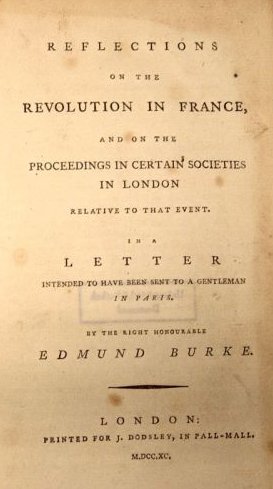
In the late eighteenth century, ideologues sought to shape public opinion with short polemical pamphlets. Perhaps more than any other work in the English-speaking world, Edmund Burke’s Reflections on the Revolution in France exemplifies the popularity and lasting reach of pamphlet culture. The Reflections presents a denunciation of the French Revolution comprising devices of historical rhetoric and eighteenth-century literature to evoke public interest in Burke’s political stance against the revolution. Burke appealed to sentiments of nostalgia and nationalism among his audience in the British public as he argued that the institutions of democracy in Britain depend on historical traditions of hereditary authority in contrast to the corrupt state of revolutionary France. The rhetoric of Burke’s Reflections disseminated the idea of preserving a benevolent “national spirit,” an ethos comprising patriotism and stewardship which underlies Burke’s opposition to radicalism and vindication of ordered liberty.
William St. Clair, describing the abundance of political pamphlets in 1790s, observes that the Reflections, with the possible exception of Paine’s Rights of Man, was printed in far larger numbers than any of the others—20,000 during its first fifteen years, compared with 500 or 700 each for most of the others.”[1] St. Clair posits that it is “likely that the many tens of thousands of influential readers who discussed the implications of the French Revolution did so on the basis of having read Burke’s Reflections and of no other pamphlet.”[2]
In the Reflections, Burke asserts that the French Revolution would devolve into a historical exemplar of corruption, in contrast with the progressive history of Britain. In “Burke’s Vehemence and the Rhetoric of Historical Exaggeration,” Steven Stryer examines Burke’s illustration of an idealized past in contrast to a corrupt present that is anomalous to historical progress. Stryer contends that Burkes’ “notorious sweeping generalizations about the evils of his own time tend to arise from explicit or implied contrasts with earlier periods of English history.”[3]
Burke’s depiction of an idealized British history as an antithesis to the French Revolution influenced the nostalgic undercurrent of Romantic poetry at the turn of the nineteenth century. William Wordsworth’s poetry from the early 1800s echoes Burke’s idealization of history in contrast to the corrupt present. Wordsworth’s political views also notably shifted from radical sympathy for the French Revolution to concur with Burke’s condemnation of the revolution in the 1790s. In “Wordsworth’s ‘Sonnets Dedicated to Liberty’ and the British Revolutionary Past,” Philip Connell examines the shift in Wordsworth’s disposition toward the French Revolution. He argues that Poems Dedicated to National Independence and Liberty, a collection of sonnets and odes Wordsworth published between 1802 and 1803, reveal the author’s admiration for the innovations of liberty and constitutionalism in English history following the Glorious Revolution in contrast to the “despotic, morally impoverished”[4] state of revolutionary France. Connell argues that Wordsworth’s poems “draw rhetorical strength from Burke’s critique of French Revolutionary ideology.”[5] Sonnet XVI in this collection describes “the Flood / Of British freedom, which to the open Sea / Of the world’s praise from dark antiquity hath flowed.”[6] Though Wordsworth refers to the obscurity of “dark antiquity,” before the longstanding institutions of British governance, his image of the flow of British liberty throughout modern history conveys a nostalgic view of liberty as an inherited privilege. Connell describes this sonnet by saying “There is a general concern here, shared with Burke, to privilege the customary and the heritable elements of English national identity.”[7]
By contrast, Wordsworth’s sonnet XIV (titled “London, 1802”), in an address to John Milton as an exemplar of the achievements of English history, expresses sorrow over the corrupt present The speaker invokes Milton, saying “England hath need of thee: she is a fen / Of stagnant waters: altar, sword, and pen […] Have forfeited their ancient English dower / Of inward happiness.”[8] Wordsworth’s valorization of history and reference to Milton reflect the rhetoric of civic virtue underlying Burke’s commentary on the French Revolution in the previous decade. In his article “Placing the Places in Wordsworth’s 1802 Sonnets,” Stephen C. Behrendt argues that Wordsworth “reverts back to the model provided by Milton […] in grounding his uneasy optimism about the future in a faith in an informed and appropriately self-aware British citizenry.”[9]
Stryer argues that Burke embeds this historical dichotomy into the syntax of his publications. He argues that “these contrasts are expressed within a topos which employs a series of syntactical patterns in order to push apart past and present through the rhetoric of exaggeration.”[10] For example, in the Reflections Burke presents a syntactic contrast between history and the present by illustrating benevolent hereditary authority in Britain and the abandonment of historical security in France. Burke cites constitutional examples within his generalized history of England by saying “You observe that from Magna Charta [sic] to the Declaration of Right it has been the uniform policy of our constitution to claim and assert our liberties as an entailed inheritance.”[11] Burke expands this statement of historical rhetoric by conflating English institutions of hereditary authority and democracy. He states, “We have an inheritable crown, an inheritable peerage, and a House of Commons and a people inheriting privileges, franchises, and liberties from a long line of ancestors.”[12] This description of British society characterizes liberty and democracy as benefits of history, yoking democratic values to a history of hereditary authority. Burke’s association of the House of Commons with the hereditary institutions of monarchy and peerage characterizes the liberty and freedom of a democratic society as inherited values because they depend on historical progress.
Burke cites this example from British history as an instructive repudiation of the French Revolution. In the Reflections, Burke addresses revolutionary France, writing, “You had all these advantages in your ancient states, but you chose to act as if you had never been molded into a civil society and had everything to begin anew. You began ill, because you began by despising everything that belonged to you.”[13] Burke asserts that the rebels have forsaken the benefits of history and progress by attempting to fabricate a new society. These successive avowals of Britain’s inherited democratic freedoms and the abandonment of established society in revolutionary France compose a syntactic denunciation of the French Revolution exemplary of Burke’s historical rhetoric. Burke describes the history of Britain as one of progress towards a democracy necessarily retaining the institutions of monarchy and peerage. He asserts that the democratic rights of British citizens are an inheritance of their history and describes the unjust present of the French Revolution as a relinquishment of the parallel inheritance of French history in favor of the illicit contrivance of a new society.
In the last year of Burke’s life and the penultimate year of the French Revolution—1796—Burke published Letters on the Proposals for Peace with the Regicide Directory of France, a series of four letters deterring conciliation with the state of revolutionary France. Franz De Bruyn describes the Letters as “the final notes of a dying man beset by personal bereavement and public despair […] and deeply disturbed with the troubled course of the anti-revolutionary struggle against France.”[14] Burke published the Letters shortly after his son, Richard, succumbed to tuberculosis in 1794. Near the end of his life, Burke also became alienated from the Whigs. Jesse Norman cites the summer of 1791 as the beginning of the dissolution of the Rockingham Whigs, whom he describes as a “proto-political party […] intellectually and organizationally shaped by Burke.”[15] As Charles James Fox emerged as the leading Whig, Norman recounts that Burke was “[n]ow in a minority of one, exiled from his own party.”[16] Burke’s Letters on a Regicide Peace presented a capstone to his opposition to the French Revolution, as he experienced personal and political turmoil. Despite their tragic context, De Bruyn observes that the Letters display the resonance of Scriblerian satire, a style of early eighteenth-century humorists such as Alexander Pope and Jonathan Swift. He argues that “Burke’s rhetorical strategy in Letters on a Regicide Peace is deeply indebted to the satiric discourse of his illustrious predecessors [Pope and Swift].”[17] Burke’s writing, influenced by the previous generation of English poets, influenced Wordworth, who revolutionized English poetry in the late eighteenth century.
We may observe the influence of Scriblerian satire upon Burke as he echoes the apocalyptic condemnation of declining culture and morality in Pope’s mock-epic The Dunciad, in which boring literature causes the end of the world. De Bruyn asserts that “in drawing on the apocalyptic idiom of The Dunciad, with its gloomy prophecy of the return of Chaos […], Burke is groping for a language adequate to express his sense of the unprecedented, unassimilable character of the historic events in France.”[18] Burke uses syntactic devices such as the chiasmus to lament the overwhelming corruption of the French Revolution, declaring his fear that the tyrannical state of revolutionary France projects the corruption of Jacobinism into Britain. Burke asserts that “[t]o a people who have once been proud and great, and great because they were proud, a change in the national spirit is the most terrible of all revolutions.” The sardonic chiasmus in this statement indicates the frailty of a great society by suggesting that greatness relies on pride and dissipates when a people no longer take pride in their society. Here, Burke uses the literal definition of revolution to describe the turning of a society from liberty to tyranny.
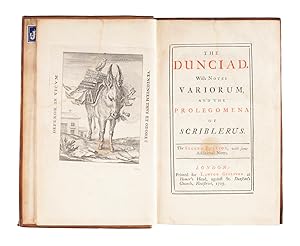
Throughout The Dunciad, Pope presents chiastic associations of high and low culture to satirize the popular verse of his time. However, Pope’s satire in The Dunciad extends beyond targeting poetastery (dilettantish publications by the eighteenth-century bored upper class) to evoke political implications. The poet-speaker criticizes the political culture of his time, dominated by Prime Minister Walpole and the favoritism of George II. An exemplary chiasmus satirizing political favoritism asserts that “princes are but things / Born for first ministers, as slaves for kings.”[19] Like Burke’s chiasmus presenting pride as the foundation of greatness, this statement undermines political authority by associating positions of authority with favoritism, using the metaphor of slavery. The speaker indicates the power of ministers to manipulate their royal patrons, asserting that princes are the playthings of first ministers. The voice of Scriblerian satire echoes in Burke’s chiasmus conflating greatness and pride. As Burke presents this sardonic conflation, he affirms the need to safeguard a “national spirit” which may revolve toward corruption and tyranny. This statement characterizes the satire of the Letters as a Juvenalian lamentation against pervasive corruption. Burke describes the transformation of French governance as an unnatural revolution and gestures toward the implication of Jacobinism in Britain by mentioning “a change in the national spirit” without referring explicitly to France.
According to De Bruyn, Burke’s “recourse to the themes and imagery of metamorphosis, unnatural transformation, and the monstrous”[20] further exemplifies his translation of Scriblerian satire into the context of the French Revolution. Burke presents a macabre description of the radical transformation of the state of France leading to a looming threat of revolution throughout Europe in a statement that displays the Juvenalian tone of finality which pervades Scriblerian satire:
deprived in all manner of government, France fallen as a monarchy, to common speculation might have appeared more likely to be an object of pity or insult, according to the disposition of the circumjacent powers, than to be the scourge and terror of them all: but out of the tomb of the murdered monarchy in France has arisen a vast, tremendous, unformed spectre, in a far more terrific guise than any which ever yet have overpowered the imagination, and subdued the fortitude of man.[21]
As Burke indicates the threat of revolution emanating from the French Revolution, he uses sublime imagery and the Scriblerian theme of unnatural transformation. Burke’s description of the scourge of the Jacobins reflects the apocalyptic depiction of the triumph of Chaos in Pope’s Dunciad as Pope’s speaker recounts “drowned was sense, and shame, and right, and wrong— / O sing, and hush the nations with thy song.”[22] The speaker is describing the abandonment of reason and morality, setting a precedent of chaos for other nations. This lamenting satire against the world surrounding Pope’s poet-speaker resonates in Burke’s portrayal of the fall of the French monarchy as a threat surpassing anything “yet to have overpowered the imagination, and subdued the fortitude of man.”[23]
Click here for part 2.
Jack Zapotochny completed a PhD in English at York University in 2022, in the field of Restoration and 18th-century literature. His doctoral research analyzed the expression of opposition in various publications by Whig MPs in the late 18th century. Jack is an instructor at Ontario College of Art and Design University, teaching English courses with cultural and historical focuses. He has also taught writing and communications at several Canadian universities and colleges. Jack’s current research examines the development of Enlightenment thought in 18th-century literature, including fiction, drama, and poetry.
Title Image: A Portrait of Edmund Burke by Sir Joshua Reynolds. Source: Wikimedia Commons.
Further Readings:
Binney, Matthew W. “Edmund Burke’s Sublime Cosmopolitan Aesthetic.” Studies in English Literature, 1500-1900. Vol. 53, No. 3, (2013): 643-666.
Bourke, Richard. “Party, Parliament, and Conquest in Newly Ascribed Burke Manuscripts.” The Historical Journal. Vol. 55, No. 3 (2012): 619–652.
Bromwich, David. The Intellectual Life of Edmund Burke. The Belknap Press of Harvard UP, 2014.
Browne, Stephen H. “Edmund Burke’s ‘Discontents’ and the Interpretation of Political Culture.” Quarterly Journal of Speech. Vol. 77, No. 1 (1991): 53-66.
Crowe, Ian. “Patriotism and Public Spirit: Edmund Burke and the Role of the Critic in Mid-Eighteenth-Century Britain. Stanford UP, 2012.
Dickinson, H.T. Liberty and Property: Political Ideology in Eighteenth-Century Britain. Methuen, 1977.
Fabricant, Caroline. “Pope’s Moral, Political and Cultural Combat.” Pope. Edited by Brean Hammond, Routledge, 1996.
Kramnick, Isaac. The Rage of Edmund Burke: Portrait of an Ambivalent Conservative. New York: Basic Books, 1977.
Endnotes:
[1] William St. Clair, The Reading Nation in the Romantic Period (Cambridge University Press, 2007), 257.
[2] St. Clair, 257.
[3] Steven Stryer, “Burke’s Vehemence and the Rhetoric of Historical Exaggeration,” Rhetorica, vol. 30, no. 2 (2012), 178.
[4] Philip Connell, “Wordsworth’s ‘Sonnets Dedicated to Liberty’ and the British Revolutionary Past,” ELH 85, no. 3 (2018), 749.
[5] Connell, 760.
[6] William Wordsworth, Sonnets Dedicated to Liberty. Poems in Two Volumes, 1807. Edited by Helen Darbishire, (Clarendon Press, 1914), XVI, 1.
[7] Connell, 759.
[8] Wordsworth, XVI, 2-6.
[9] Stephen C. Behrendt, “Placing the Places in Wordsworth’s 1802 Sonnets,” Studies in English Literature, 1500-1900, vol. 35, no. 4 (1995), 641.
[10] Stryer, 178.
[11] Burke, 29.
[12] Burke, 29.
[13] Burke, 31.
[14] Franz De Bruyn, The Literary Genres of Edmund Burke: The Political Uses of Literary Form (Clarendon, 1996), 209.
[15] Jesse Norman, Edmund Burke: The Visionary Who Invented Modern Politics (HarperCollins, 2014), 145.
[16] Norman, 146.
[17] De Bruyn, 211.
[18] De Bruyn, 213.
[19] Alexander Pope, The Dunciad. The Major Works. Edited by Pat Rogers (Oxford UP, 2008), 4.602.
[20] De Bruyn, 213.
[21] Edmund Burke, Letters on a Regicide Peace. Reflections on the Revolution in France and Other Writings. Edited by Jesse Norman (Knopf, 2015), 834.
[22] Pope, 4.625.
 Age of Revolutions
