By Daniel Runnels
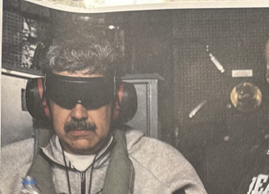
The photo of a detained Nicolás Maduro circulated worldwide on the morning after his capture is visual evidence of the definitive end of what was once called the Pink Tide in Latin America. Importantly, this photo depicts the end of the Pink Tide as having been imposed from without – from the US – as opposed to its weakening as the result of electoral processes as has happened in other nations. In the era of near ubiquitous AI slop imagery, the importance of a viral photo like the one taken of Maduro can hardly be overstated.
The Pink Tide was a contested descriptor for several reasons, not the least of which being that it was a phrase more often employed in English-speaking academic contexts than Spanish (in Spanish, la marea rosada), but it signaled a general leftward shift in the electoral politics of countries such as Argentina, Uruguay, Venezuela, Ecuador, Chile, and Bolivia during the 2000s.[1] To varying degrees of success, leaders in these countries implemented left-of-center policies and employed increasingly sharp rhetoric, often aimed at the United States as former and contemporary imperial power as well as capitalism itself as a mode of production. These governments placed rhetorical emphasis on breaking from neoliberal models implemented in the late decades of the twentieth century, and some rooted their governance strategies in the insurgent indigenous social movements of the late 1990s and early 2000s.

Pink Tide Maps, UN University: Institute on Comparative Regional Integration Studies[2]
As any cursory look at the contemporary Latin American political landscape reveals, the Pink Tide has not maintained the command it once had over the direction of the continent. In fits and starts, these left-wing governments have waned, being replaced by right-wing governments in several countries. On this point, Venezuela has remained somewhat of an outlier, no doubt at least partly due to the authoritarian nature of the ruling class, but the events of January 2026 have punctured a serious hole into whatever might have been said to remain of the energy that once animated the Pink Tide. What we witnessed in January was the closure of a historical time in the way Italian historian Furio Jesi described in Spartakus: The Symbology of Revolt. In Spartakus, Jesi distinguishes between revolt and revolution. For him, revolt is best understood as a suspension of historical time (the opening of an interregnum with no guarantee of closure), but revolution is “wholly and deliberately immersed within historical time.”[3] In this case, the closure of historical time is the real and material end of the Pink Tide, and the photo of a captured Maduro serves as a visual archive of the shift.

Donald J. Trump Mugshot, NBC News[4]
The photo of Maduro is stunning in its own right, and even more so when contrasted with the images of US President Donald Trump that seem to have a special grip on the contemporary political right. Consider the now infamous mug shot taken when Trump surrendered to the authorities at the Fulton County Jail in Atlanta, Georgia in August 2023. The photo was historic for being the first mugshot of a former US President, but it also quickly took on a life of its own among his supporters. In this image, Trump supporters saw strength and defiance, two of the qualities that generate much of the admiration they feel for him. The mugshot then found its way onto t-shirts and other products, regularly showing up at rallies and in online spaces. The most important characteristic of the mugshot is the fact that Trump is staring directly into the camera; he looks right at us, and we can almost feel the defiance. In another example, an AI-generated image shared by White House social media accounts on May 4th, 2025 – “Star Wars Day” – shows Trump, flanked by American flags and bald eagles, depicted as a bodybuilder holding a lightsaber.[5] Importantly, here he (or rather, the AI-generated image of him) also looks directly into the camera. As viewers we are, again, directly interpellated by the president.
Photographers know that the act of looking directly into the camera can serve the function of heightening whatever feeling is being depicted. In a photo of a vulnerable subject, the vulnerability is heightened; in a photo of a frightened subject, the fear is heightened, etc. The 1984 photo of Sharbat Gula in National Geographic is probably the most famous example of precisely this function of the subject’s gaze into the camera.[6] Photos of politicians are subject to the same logic, but in these cases, what is most often at stake is the assertion of power. When a political sovereign looks into the camera, they almost invariably aim to assert their presence and agency, almost as if they were challenging the viewer to look away. This is precisely what Trump aims for in the photos of himself that he is fond of uploading to his social media site.

An assertion of power is, however, decidedly not what is at stake in the photo of a captured Maduro. In this photo, Maduro cannot project power; he is draped in an iconography of submission. He is dressed in casual clothing, the kind a sovereign might wear after having retreated momentarily into private life where their public position is neutralized. He grasps awkwardly at a single water bottle, a gesture that shows his desire reduced to biological necessity, which is not fit for a powerful sovereign. His ears are covered with noise-canceling headphones, meaning he cannot be aware of what his new guardians may be saying about him. But most importantly for the visual composition of this photo is the fact that his gaze is covered by dark sunglasses. This is a subject who cannot project power via his gaze as Trump is wont to do. Maduro cannot interpellate the viewer; he cannot see us seeing him and attempt to arrest our gaze in his. This was surely part of the appeal for the Trump administration, perhaps the reason this was the first photo of Maduro that the world saw the morning after his capture.
The photo thus serves as an example par excellence of what Roland Barthes wrote about in his seminal essay “Myth Today.” Barthes draws on Saussurean linguistics to discuss the arbitrary nature of signs – the fact that there is no natural relationship between signifier and signified. What is important for Barthes, however, is that in “myth,” we have not simply an arbitrary collection of signs but rather what he calls “a second-order semiological system.”[7] This second-order system is not fueled by the arbitrary nature of the signs but is, rather, motivated. It is constituted by “a chain of causes and effects, motives and intentions. Unlike the form, the concept is in no way abstract: it is filled with a situation.”[8] Taken in isolation, the signified of the various elements that make up the photo of Maduro are, indeed, arbitrary – sunglasses can mean different things in different contexts. But in this case, the collection of signs is “filled with a situation.” The situation here is the definitive collapse, imposed from without, of what was once a continent-wide left-of-center political bloc.
The collapse of the Pink Tide as depicted in this photo does not mean that left-oriented energy in Latin America has been wholly shattered. Those who find inspiration in the political left through electoral politics will surely locate sources of hope. But the historical closure we witnessed in the capture of Maduro marks the end of something real, and it is a moment now immortalized in the iconic image. This marks it as a historically important photo – it is tied to a world historical conjuncture in a way that the flood of AI slop cannot be. In this way, the photo might prompt us to revisit Walter Benjamin’s famous description of aura as a quality integral to an artwork that cannot be communicated through mechanical reproduction. We can accept Benjamin’s assertion that “even the most perfect reproduction of a work of art is lacking in one element: its presence in time and space”[9] while at the same time noting a qualitative distinction in our current moment. If there is anything that lacks an aura it is precisely the AI slop that is so ubiquitous. Against this backdrop, then, images like the photo of a captured Maduro increasingly assert their importance.
Daniel Runnels is Assistant Professor of Global Studies at Texas A & M University. He has published research on topics including architecture, film studies, literature, social movements, and political thought. He has also translated poetry and short stories from Spain and Latin America and is the English language translator for Argentine philosopher Jorge Alemán. He is working on a book on anti-state cultures from Latin America, a book which puts political cultures from contemporary Latin America into conversation with strands of thought emanating from critical theory and continental philosophy.
Title Image: https://truthsocial.com/@realDonaldTrump/posts/115832088990838303
Further Readings:
Barthes, Roland. Mythologies. Translated by Richard Howard and Annette Lavers. Hill and Wang, 2013.
Bruhn, Kathleen. Politics and the Pink Tide: A Comparative Analysis of Protest in Latin America. University of Notre Dame Press, 2024.
Jesi, Furio. Spartakus: The Symbology of Revolt. Translated by Alberto Toscano. Seagull Books, 2014.
Endnotes:
[1] For English-language scholarship on the Pink Tide, see for example Kathleen Bruhn, Politics and the Pink Tide: A Comparative Analysis of Protest in Latin America (University of Notre Dame Press, 2024); Steve Ellner, Latin America’s Pink Tide: Breakthroughs and Shortcomings (Rowman and Littlefield Publishers, 2020); and Franck Gaudichaud, Massimo Modonesi, and Jeffery Webber, The Impasse of the Latin American Left (Duke University Press, 2022).
[2] Maria Martins, “Towards a Comeback of Regionalism? Prospects for Latin American Integration during the New Tide of Leftist Governments,” Connecting Ideas Blog, May 12, 2023. https://unu.edu/cris/blog-post/towards-comeback-regionalism-prospects-latin-american-integration-during-new-tide
[3] Furio Jesi, Spartakus: The Symbology of Revolt, trans. Alberto Toscano (Seagull Books, 2014), 45.
[4] Blayne Alexander and Sarah Mimms, “Trump’s Mug Shot Made Public by Fulton County Jail after Arrest,” NBC News, August 24, 2023, https://www.nbcnews.com/politics/donald-trump/donald-trump-mugshot-georgia-jail-fulton-county-arrest-rcna101664.
[5] https://x.com/WhiteHouse/status/1919053040734072844
[6] Nina Strochlic, “Famed ‘Afghan Girl’ Finally Gets a Home,” National Geographic, December 12, 2017, https://www.nationalgeographic.com/pages/article/afghan-girl-home-afghanistan
[7] Roland Barthes, Mythologies, trans. Richard Howard and Annette Lavers (Hill and Wang, 2013), 223.
[8] Barthes, Mythologies, 228.
[9] Walter Benjamin, “The Work of Art in the Age of Mechanical Reproduction,” in Illuminations, trans. Harry Zohn (Mariner Books, 2019), 169.
Leave a Reply