By Marlon Londoño
Reporters have written much about the so-called “Donroe Doctrine” in the wake of the January 3, 2026, U.S. military kidnapping of Venezuela’s president Nicolás Maduro. Observers have denounced the U.S. strike as an attack on the sovereignty of a Latin American nation, but the Trump administration has partially justified the military intervention by alleging that Maduro oversees the Cartel de los Soles (“Cartel of the Suns”). Experts have refuted this characterization, asserting that the phrase refers not to an organized trafficking group but instead to an unofficial network of corruption and patronage among Venezuelan officials.
The U.S. government’s distortion of Latin American political culture to legitimize intervention in Latin America bears echoes of the Theodore Roosevelt administration’s military actions against Venezuela’s neighbor Colombia in 1902, shortly before proclaiming the Roosevelt Corollary to the Monroe Doctrine. Where the 1823 Monroe Doctrine demanded that European powers refrain from interfering in the Western Hemisphere, aspiring to place Latin America under the U.S. sphere of influence on the world stage, the 1904 Roosevelt Corollary argued that the U.S. reserved the right to intrude into Latin American affairs “in flagrant cases of […] wrongdoing or impotence.”[1] It remains to be seen whether the Trump administration’s portrayal of the Cartel of the Suns stems from an intentional manipulation of facts, but it shares that cynical strategy of distorting Latin American geopolitics under the guise of regional policework with the Roosevelt administration.
Colombia was the unfortunate target of U.S. policing in 1902 amid the Thousand Days’ War, a civil war between the Conservative government and the rebellious Colombian Liberal Party. For the Liberals, the war was a rebellion for political enfranchisement and civil rights; for the Conservatives, it was a holy crusade to defend the Catholic Church and its alliance with the government. Liberal governments in nearby countries, including Venezuela, Ecuador, and Nicaragua, covertly supported the rebellion, making the war a major international conflict.
When an assassin shot William McKinley in September 1901, former Rough Rider Edwin Emerson Jr. was in Venezuela and Panama, fighting alongside the Liberals under General Rafael Uribe Uribe while he reported on the conflict for Collier’s Weekly. As an active participant, Emerson should have understood the political context of the Thousand Days’ War better than most Americans. However, in a handwritten letter from Caracas to still-Vice President Theodore Roosevelt dated September 7, Emerson called the Thousand Days’ War a “silly war and revolution which is now turning everything upside down.” (Before he settled on “silly war,” he also considered writing “uncalled for” before striking that out.)[2] With this dismissive attitude, Emerson demonstrated the mindset many Americans held toward Colombia and Latin America more generally: its violence was never political, verging instead on the ridiculous.
Figure 2: Charles “Bart” Bartholomew’s front-page cartoon in The Minneapolis Journal, February 15, 1902. His caption minimizes the Thousand Days’ War as “a little war” fought “every three weeks.” Accessed April 29, 2025, via Chronicling America: Historic American Newspapers, Library of Congress. <https://chroniclingamerica.loc.gov/lccn/sn83045366/1902-02-15/ed-1/seq-13/>.
Americans of all stripes lacked even the most basic grasp of the major war raging across Central and South America, so U.S. observers interpreted the violence in Colombia and its department of Panama as a collapse of law and order. For instance, American rail and steam companies operating in Colombia issued repeated complaints to the U.S. State Department that the Colombian government was conscripting their employees (who were, of course, Colombian citizens). U.S. corporations cared little about the Thousand Days’ War until it affected their bottom line, through the loss of labor to the Colombian Army or the temporary requisitioning of steamboats and rail lines for military purposes.[3] American missionaries complained that the Conservative government infringed on the religious liberties guaranteed U.S. citizens in Colombia by the 1846 Mallarino-Bidlack Treaty because the Conservatives refused them permission to establish a Protestant school in Barranquilla, a hotbed of anti-government espionage.[4] In fact, the treaty said nothing about the freedom to establish a religious school, nor anything about instructing Colombian children in said religion, but by July 1902, pressure from the U.S. State Department compelled the Colombian government to allow the Presbyterian school’s operation.[5] Disputes like these led the Theodore Roosevelt administration to view the Colombian government as a dictatorial danger to civilization and progress.
Amid the flood of complaints from Americans in Colombia to the U.S. government, the Roosevelt administration ignored reports from Navy officials who contextualized the military and political situation of the Thousand Days’ War. In late 1902, Commander William P. Potter, aboard the U.S.S. Ranger off Panama’s Pacific coast, pushed back against bad faith interpretations of Colombian behavior. He told Secretary of the Navy William H. Moody that “[t]he reports of interference with foreigners appear to be much exaggerated” and that Liberal commanders had assured him “that there would be no interference with the persons and property of Americans.”[6] Despite Potter’s assessment, State Department officials did not change their tone concerning Colombia and its war. Most dismissively, Assistant Secretary of State David J. Hill told U.S. Ambassador to Colombia Arthur M. Beaupré that “[a] state of public war does not exist in Colombia.”[7] This statement was blatantly untrue, as the Thousand Days’ War was in its third year, tens of thousands were dead, the Colombian government had long established a state of emergency across the country, and a multinational Liberal army was waging a successful campaign in Panama.

Figure 3: Liberal rebels in Panama, ca. 1901, pose for a photo by Edwin Emerson Jr. in Collier’s. The caption dismissively describes their army as “nondescript.” Collier’s XXVII, no. 25 (September 21, 1901).
But the point in denying Colombia’s war was to paint the Colombian government as tyrannical and illegitimate—not due to any of its oppressive actions against Colombian Liberals, as the rebels saw it, but because it was appropriating the property of foreigners to sustain the war effort. “[T]he belligerent right of expropriation which may sometimes be lawfully exercised does not exist,” concluded Hill. “But even if the measure were defensible, which is not conceded, the discrimination alleged to be practiced by the seizure of private property of citizens of the United States, while property of ‘amigos’ or friends of the titular Government […] is untouched, could not be characterized otherwise than as odious and intolerable.”[8] By refusing to entertain the Thousand Days’ War as a legitimate war, the U.S. government reframed all of the Colombian government’s wartime measures as corrupt, criminal acts against foreign business interests and private property.
In October 1902, the U.S.S. Wisconsin arrived in Panama City and Admiral Silas Casey seized control of railroads on the isthmus, impeding both Liberal rebel and Conservative government use of these vital lines of travel and communication. The following month, Liberals and Conservatives signed the Treaty of Wisconsin aboard the vessel, ending the Thousand Days’ War in an exhausted stalemate. In November 1903, scarcely a year later, Panamanian separatists broke away from Colombia under the protective gaze of the U.S. Navy, and the fledgling Panamanian government signed over generous concessions to the Roosevelt administration for the future canal zone. Colombia, drained by the Thousand Days’ War, could offer no serious challenge to the loss of Panama.
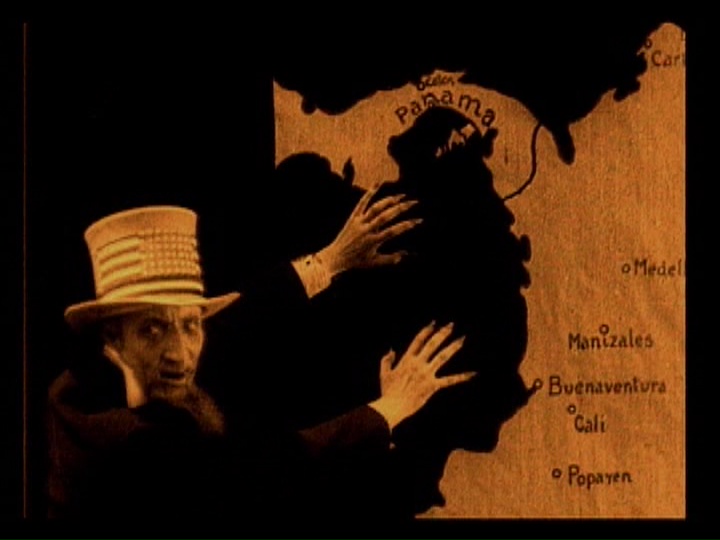
The intensity of intervention in Latin America differed in 1902 and 2026, but the parallels reveal continuity in the U.S. government’s willingness to justify invasion and occupation by distorting political reality. Beyond violating the sovereignty of Latin American nations, this attitude damages relations with the targeted nations. Anti-American sentiment simmered for decades in Colombia after Panamanian independence, perhaps best represented by the 1927 silent film Garras de oro, in which a vampiric Uncle Sam creeps toward a map of Colombia, sharpened claws outstretched toward the Panamanian isthmus. Uncle Sam gives a paranoid glance over his shoulder, implying guilt and dishonesty, before lunging toward Panama. American diplomats in Bogotá attempted to block the film’s screening, finding limited success before deciding that further attempts at censorship would, counterproductively, bring Garras de oro increased attention.[9] But the diplomatic response indicated real concern over lingering Colombian resentment toward the United States. Venezuelans today have plenty of reason to harbor bitterness toward their northern neighbor, and continued falsehoods about Latin America’s political reality will do little to ease these tensions.
Marlon Londoño is a PhD candidate in history at the University of North Carolina at Chapel Hill, specializing in Latin American history and military history. He was a 2022 Fulbright-Hays fellow in Bogotá, and he has work published in The North American Congress on Latin America and The Latin Americanist.
Title Image: Uncle Sam reaching with monstrous claws towards Panama in the 1927 silent film Garras de oro.Dir. Jambrina, P.P. [pseud]. Garras de oro (The Dawn of Justice—Alborada de justicia).Cali: Cali Films, 1927.
Further Readings:
Bergquist, Charles W. Coffee and Conflict in Colombia, 1886-1910. Duke University Press, 1978.
Demarest, Geoffrey. “War of the Thousand Days,” Small Wars & Insurgencies 12, no. 1 (2001): 1-30.
Lael, Richard L. Arrogant Diplomacy: U.S. Policy Toward Colombia, 1903-1922. Scholarly Resources Inc., 1987.
Plazas Olarte, Guillermo. La separación de Panamá desde el punto de vista militar. Editorial ABC, 1987.
Ropp, Steve C. “Beyond United States Hegemony: Colombia’s Persistent Role in the Shaping and Reshaping of Panama,” The Journal of Caribbean History 39, no. 2 (2005): 140-172.
Endnotes:
[1] National Archives, Theodore Roosevelt’s Annual Message to Congress for 1904, Records of the U.S. House of Representatives, Record Group 233, House Records HR 58A-K2.
[2] Library of Congress (LOC), Theodore Roosevelt Papers: Series 1: Letters and Related Material, 1759-1919; 1901, Aug. 23-Sept. 15, reel 18, 525-526.
[3] Papers Relating to the Foreign Relations of the United States, With the Annual Message of the President Transmitted to Congress, December 2, 1902 (Washington: Government Printing Office, 1903), Documents 236-243.
[4] Papers Relating to the Foreign Relations of the United States, With the Annual Message of the President Transmitted to Congress, December 2, 1902, Documents 250-252.
[5] Papers Relating to the Foreign Relations of the United States, With the Annual Message of the President Transmitted to Congress, December 2, 1902, Document 252, 300.
[6] Papers Relating to the Foreign Relations of the United States, With the Annual Message of the President Transmitted to Congress, December 2, 1902, Document 258, 308.
[7] Papers Relating to the Foreign Relations of the United States, With the Annual Message of the President Transmitted to Congress, December 2, 1902, Document 257, 306.
[8] Papers Relating to the Foreign Relations of the United States, With the Annual Message of the President Transmitted to Congress, December 2, 1902, Document 257, 306-307.
[9] Juana Suárez and Ramiro Arbeláez, “Garras de Oro (The Dawn of Justice—Alborada de Justicia): The Intriguing Orphan of Colombian Silent Films,” trans. Laura A. Chesak, The Moving Image 9, no. 1 (Spring 2009): 58.
Leave a Reply