By M.A. Davis
It’s 1972.
Amid ratcheting global tension, everyone is worried the next world war will turn nuclear. In North America, tensions are high between the Confederation of North America and the United States of Mexico.

This is the world Robert Sobel (1931-1999) created in his 1973 novel For Want of a Nail: If Burgoyne Had Won at Saratoga, the most famous counterfactual fiction about the American Revolution. Upon publication, Kirkus Reviews called FWOAN “quite brilliantly done” and this book “for both amateurs and practitioners of historiographic folderol” has prospered as a classic of a genre of fiction recently repopularized by TV shows like The Man in the High Castle and For All Mankind. FWOAN even has an active online fan community, as seen in the For All Nails fan timeline that migrated from Usenet to alternatehistory.com.[1]
Counterfactual fiction about the American Revolution tends to fall into two camps. There are utopias like Turtledove and Dreyfuss’s 1995 The Two Georges, which sees British North America as a ‘super-Canada’ of slower technology but settled social relations. There are dystopias like Richard Meredith’s 1973 At the Narrow Passage in which the failure of the American Revolution significantly retards the spread of liberal democracy. These camps are both Americentric – the American Revolution is key to world history, diverting its course leads to profound change for better or worse. But FWOAN is neither utopia nor dystopia – merely different. By doing so, Sobel makes profound arguments about contingency, change, and the overall importance of the US War of Independence within the “Age of Revolution.”
With this in mind, FWOAN shines as a worthy subject of historical analysis. Historical fiction is a way of talking about history at least as important as academic historiography, as M.J Rysza-Pawlowska recently showed in their look at how Alex Haley’s Roots and its subsequent TV adaptation shaped historical understanding in the 1970s. Sobel’s novel is a work of “fictional non-fiction” – written as a general survey of North American history from the end of the Seven Years’ War in 1763 to the then-present. The American Bicentennial decade, the 1970s saw many counterfactuals about the American Revolution published, such as the aforementioned Meredith book, Gordon Eklund’s 1975 Serving in Time, and Robert W. Russell’s 1974 play: Washington Shall Hang: A Drama of Lost Revolution. But these works of science fiction and stagecraft have very little in common with Sobel’s work.[2]
A historian, Sobel produced a work of historiography – albeit a largely fictional one. FWOAN has a fifteen-page selected bibliography, with ample footnotes, along with appendices, maps, and other accoutrements, almost all of them invented by Sobel for the book. Sobel even provides the reader with a “Reviewer 2,” an in-universe historian who criticizes Sobel-the-author, lamenting that a scholar who seemed ready for “serious, scholarly work” has failed so utterly.
Much of the criticism the real Robert Sobel puts in the mouth of “Frank Dana,” his fictional “Reviewer 2” would have been familiar to him. Though Sobel was the subject of several friendly obituaries upon his death, most of the contemporary scholarship about Sobel’s bibliography was negative. Reviewers saw his works as “superficial…poorly explained,” with even positive reviewers remarking that his latest work was “disappointing in several respects.” The Bronx native taught at Hofstra from 1956 to 1999, and in his lifetime authored twenty-three books on American history. He was a “character” in the classroom, with a mind “running at double or even triple speed” compared even to other academics. He was primarily a historian of American capitalism, who in academic circles today is remembered largely for his 1998 Calvin Coolidge hagiography An American Enigma. Sobel was an unabashed popularizer who wrote for general audience, much to the chagrin of many of his contemporaries. Thus, it’s an interesting irony that his only work of fiction is deliberately written as a semi-impenetrable American history textbook.[3]
Sobel’s narrative is too vast to summarize more than generally. But the start of the book, Sobel tells us (speaking as “Dana”) “contain[s] the key to Sobel’s thinking.” After defeat at Saratoga, the American Revolution fails, and many Patriot leaders are put to death. Yet liberty in British North America does not die. Under the postwar “Brittanic Design” and successive leadership of John Burgoyne and John Dickinson, British North America becomes the Commonwealth-style Confederation of North America. Meanwhile, many Patriots such as Benedict Arnold and Nathanael Greene undertake a voortrek called the Wilderness Walk that sees them migrate to the Spanish province of Tejas.
Some of Sobel’s love of historical irony can be seen in the above summary. John Burgoyne and John Dickinson, relatively minor figures in the real history, are in FWOAN the great statesmen who brought peace and self-government to postwar North America. Benedict Arnold, who never met Peggy Shippen, dies in exile as an unreconstructed Patriot rather than a traitor to the cause of US independence. Sobel’s histories often focused on those he thought neglected by historiography – he thus does the same in his fiction.[4]

Joshua Reynolds, John Burgoyne, 1766

In Tejas, the Patriots take advantage of Spain’s distraction by European conflicts to found a republic called Jefferson. (It seems that in any history, Hispanophone governments in North America must be wary of Anglo settlers west of the Mississippi!) A generation later, Sobel’s Andrew Jackson will use Jefferson as a springboard to create the United States of Mexico. By the late 20th century, Mexico is an industrial Pacific power that stretches from Alaska to Central America. But this Jacksonian birth, in which a new nation is founded by a charismatic enslaver on a white horse, one who promotes a vision of Mexican identity founded on the exclusion of Black people, will have lasting consequences. Even as a world power, Sobel’s Mexico is beset by caudillismo (for example, they are governed by a Napoleon III-style Emperor from 1881-1901) and a lingering African slavery that lasts until the 1920s.

Ralph E. W. Earl, “Tennessee Gentlemen” (portrait of Andrew Jackson)

In another one of Sobel’s ironies, slavery in the USM endures into the 20th century because of its cultural, not economic importance, though cotton cultivation is a major underpinning of its early economy in the Jeffersonian period. In a nation founded by a Jacksonian revolution, with class and ethnic equality built on the back of Black inferiority, anti-manumissionists in Sobel’s Mexico fear race mixing and social unrest far more than the economic consequences of liberty and see emancipation as a plot by Protestant do-gooders and international capital to change the country’s character. Here Sobel is speaking to his own late 20th century audience, and those who feared Black equality because of the threat of social change and urban unrest.
In the rest of the world, the absence of the American Revolution is far less noteworthy than the absence of the French and Haitian. Continuing Sobel’s love of ironic “great men (and women),” Queen Marie Antoinette (regent for her infant son after his husband’s death in a freak accident) survives the crisis at the end of the 18th century, France never having gone into debt supporting the American revolutionaries. Still, the turn of the 19th century sees another round of global European conflict whose aftermath sees a wave of successful revolutions across Latin America. Sobel mentions, in passing, a series of slave uprisings in the Caribbean in the same era that end with republics dominated by white planters. Sobel’s love of irony again – what’s significant is the failure of Patriot armies rather than the failure of the American Revolution itself, as here the Bourbon state has enough financial resilience to survive the era of crisis.
But even though the French Revolution is delayed a century, taking place in the context of a mass uprising after the last Bourbon king loses a war against a newly unified Germany, France seems in Sobel’s narrative to eventually assume a familiar geopolitical shape, a republic dependent on help from Britain to protect itself from a rising German power. Thus, even where differences are great, Sobel’s history is hard to change. Speaking of the new German state, in Sobel’s narrative there is a major world war in the mid-20th century that sees Germany become the dominant power in Europe, but Sobel-the-author does not seem to see this as a victory of totalitarianism – and atomic weapons were not developed until after that war was over.
The world of FWOAN is one where names and nations are different, but the overall course of history remains largely the same. The 1970s are eerily similar to our own, including a multipolar cold war between superpowers that threatens to turn nuclear, a Europe and Asia recovering from a devastating global conflict, and a North America trying to balance dreams of democratic freedom with legacies of oppression, even amid their many differences. He even gives us a world with its eyes turning to rising powers in Asia, reflecting both American anxieties of the Vietnam era and the decade to come.
My read of Sobel is at odds with Gavriel Rosenfeld’s view of Sobel’s overall narrative as dystopian, which rests on how Rosenfeld interprets Sobel’s version of the 20th century. In the Global War of 1939-1948, Sobel has combined all the horrors of the 20th century into one bloody conflict – WWI and WWII happen together, even followed by a devastating flu epidemic. Naturally it is a gruesome conflict – but less than one might think. There are no Hitlers or Stalins here. There are ‘only’ a million civilian deaths in German-occupied Europe, and democracy returns after the war. Similarly, it is true that Sobel’s United States of Mexico has far more issues with civil violence and lingering racism than the contemporary United States. But that should be read against Sobel’s Confederation of North America, which for all its sclerotic democracy, sees slavery end in the 1840s and has a Black head of government by the mid-20th century. In the United States of Mexico, its fusion of Jacksonian Anglo-Hispanic racial dynamics produces a society where mestizo and Indian people enjoy significant cultural power – albeit at the expense of their Black neighbors.
Sobel’s imagined modernity had its share of tragedies and horrors; but then, hasn’t ours?
This is Sobel’s fictional history; one that speaks to genuine historiography. Sobel-the-character speaks with the voice of the imperial school of the early 20th century, blaming the Revolution on inept leadership in London as much as the Patriots he dislikes, a reader familiar with Sobel-the-historian’s work on land speculation in Vandalia will recognize his Charles Beard-infused perspective on the influence of western land hunger in the minds of Patriot leaders. But these are questions of specifics.[5]
FWOAN is a marvel of metahistory – a work that argues for deep structural trends in the guise of an old-fashioned political narrative, a work whose author-in-universe believes in Great Man Theory but whose real author loves to twist the principle to unrecognizability, a work by an Americanist written within a few years of the US Bicentennial that poo-poos the importance of the Revolution altogether. A minor historical contingency in upstate New York in 1777 completely reshapes the globe – but also gives us a world all too like our own.
Fifty-three years after its publication, the most important work of Robert Sobel’s “200-mile-an hour-mind” remains both a rewarding puzzle and a historiographic marvel that deserves deeper investigation.[6]
Dr. M.A. (Mike) Davis is an Adjunct Professor of History at Lees-McRae College in Banner Elk, North Carolina. He was a recent guest on NPR’s “On Point,” where he discussed the historic origins of government shutdowns. He is currently working on a monograph about the production and fandom of The Andy Griffith Show.
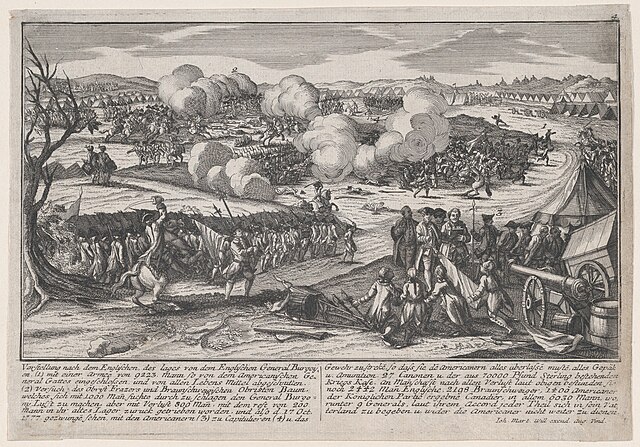
Title Image: Battle of Saratoga by Johann Martin Will.
_MET_DP876929.jpg)
Further Readings:
Paul, Aron “If the British Won…” Commonplace, Spring 2014. https://commonplace.online/article/if-the-british-won/
Rosenfeld, Gavriel. “Why Do We Ask ‘What If?’ Reflections on the Function of Alternate History.” History and Theory41, no. 4 (2002): 90–103.
Shea, Ryan. “Our Other Modernity: Robert Sobel Remembered.” 2026. Decadent Serpent. March 6, 2026. https://decadentserpent.com/2026/03/06/our-other-modernity-robert-sobel-remembered/.
Sobel, Robert, For Want of a Nail …; If Burgoyne had won at Saratoga. New York: Macmillan. 1973.
Sobel, Robert Coolidge: An American Enigma. Washington, D.C.: Regnery Pub. 1998.
Endnotes:
[1]“For Want of a Nail: A Dual History of the Confederation of North America and the United States of Mexico.” Kirkus Reviews. Macmillan. February 1972. https://www.kirkusreviews.com/book-reviews/a/robert-sobel-2/for-want-of-a-nail-a-dual-history-of-the-confed/. Aron Paul, “If the British Won…” Commonplace, Spring 2014. https://commonplace.online/article/if-the-british-won/ Ryan Fleming “Book Nook: For Want of a Nail,” April 10, 2024. https://www.sealionpress.co.uk/post/book-nook-for-want-of-a-nail “For All Nails.” Sobel Wiki. Fandom, Inc. 2026. https://fwoan.fandom.com/wiki/For_All_Nails. (This author contributed to “For All Nails” as a student.) “For All Nails by QuantumBranching on DeviantArt.” 2009. Deviantart.com. DeviantArt. October 21, 2009. https://www.deviantart.com/quantumbranching/art/For-all-Nails-141013761.
[2]M. J. Rymsza-Pawlowska, History Comes Alive: Public History and Popular Culture in the 1970s (UNC Press Books, 2017), 30-37. Comparable works in the context of fictional universes are Chris Kempshall’s Star Wars tie-in The Rise and Fall of the Galactic Empire and John Concagh’s Star Trek fanwork The Edge of Midnight.
[3]Glenn Porter, The Age of Giant Corporations: A Microeconomic History of American Business, 1914-1970, by Robert Sobel. Technology and Culture 15, no. 1 (1974): 119–21; and Dean J. Kotlowski, Coolidge: An American Enigma, by Robert Sobel. Indiana Magazine of History 96, no. 1 (2000): 100–101. D. Henriques “Robert Sobel, 68, A History of Business, Dies,” The New York Times, June 4, 1999, C18. David B. Sicilia, “Remembering Robert Sobel (1931—1999).” Enterprise & Society 1, no. 1 (2000): 182–87; and Delbert Myer, 1999, “Coolidge — an American Enigma,” Accessed March 14, 2026, https://www.jpands.org/hacienda/sobel.html.
[4]Maury Klein, Giants of Enterprise: Seven Business Innovators and the Empires They Built, by Richard S. Tedlow. The Business History Review76, no. 3 (2002): 590–92.
[5]Sobel, Robert. The Money Manias: The Eras of Great Speculation in America, 1770-1970 (Weybright and Talley, 1974), 1-11. Money Manias is the only one of Sobel’s non-fiction books that deals with the American Revolutionary era.
[6]Sicilia, “Remembering Robert Sobel (1931—1999),” Enterprise & Society, 182–87.
Leave a Reply