By Roxanne Panchasi
Any instructor or student can tell you what an entirely bonkers time the first year and a half of the COVID-19 pandemic was for teaching and learning.[1] At the end of the Fall 2020 term, after several months of the radical remaking of everyday life that included university and broader societal shutdowns, I, like so many of my colleagues, had another remote teaching term to plan. Instead of reworking a class I had taught previously, I decided to do something completely different.
In addition to everything else it ended up holding, the Spring 2021 term coincided with the 150th anniversary of the Paris Commune, the 10+-week revolutionary period from March through May 1871 when the French capital’s working and poorer classes rose up against their national government. After months of war and siege, the city’s inhabitants resisted the state’s attempt to disarm Paris and suppress political opposition; held elections; and formed their own government. By the time the forces of the new French Third Republic violently crushed the revolution two and a half months later, the Commune had enacted broad political and economic reforms. It also pursued a program of universal public education, the separation of Church and state, and the promotion of a radical public culture.[2]
I had planned for years to mark the Commune’s 150th in some way. A decade earlier, in 2011, I organized a series of events in and around Simon Fraser University. La Commune de Vancouver had included: a spontaneous group performance of “L’Internationale” in a government building downtown, public lectures, walking tours, a film screening, and a poetry reading. Lasting several weeks, the program brought together academics and activists, writers, artists, and musicians, all of them interested in thinking through and with the Paris Commune and its legacies.
The fourth-year undergraduate seminar I ended up teaching years later featured synchronous and asynchronous online content and discussion exploring the history of the Paris Commune and the significance of that revolutionary past for our present. A final course project got students working individually and collectively to research and write entries for Commun-opédie, a set of informative essays focused on different themes (democracy, women, monuments, the view from Versailles, etc.).[3] That assignment in turn became one of several elements of La Commune 2021, an online, public “free school” I coordinated in collaboration with UNIT/PITT: Society for Art and Critical Awareness, a non-profit artist-run organization in Vancouver.[4] From mid-March to June 2021, following the dates of the 1871 Commune, the free school offered weekly online installments of open-access course readings and audiovisual content to anyone who was interested, at no cost. An anchoring element each week was radio 1871, an audio series featuring discussions with ten special guests. Each episode focused on a different aspect of the Commune’s history and legacies, pursuing key figures, events, themes, and debates. The free school also hosted four public events online: a listening party, a poetry reading, a video screening, and a book discussion.
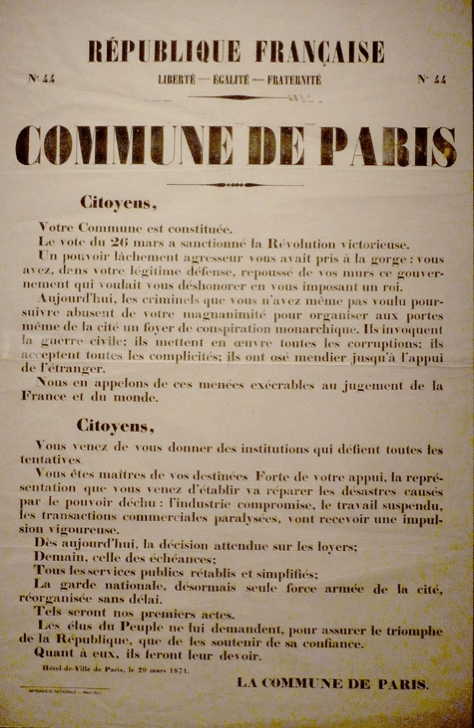
Fig. 1: Proclamation de la Commune de Paris, 29 March 1871. Fonds de la Bibliothèque historique de la Ville de Paris. Public domain.
Finally, La Commune 2021 invited a group of nine artists-in-residence to participate in the project. In the spirit of the nineteenth-century affiches (posters), public notices that appeared on walls throughout the city announcing the 1871 Commune’s ideals, aims, and acts, these artists responded to the interrogations at the heart of the free school: What was the Paris Commune and why does it still matter? Like all other La Commune 2021 participants, the artists were free to take in as much of the free school’s content as they wished, taking up whatever themes and questions intrigued them using the medium of their choice.
Drawing on the “useable archive” [5] of 1871, La Commune 2021’s artists-in-residence created their own affiches pulling together historical and contemporary actors, spaces, and timelines at an unprecedented moment of collective isolation, distance, and uncertainty across the globe. In different ways, they conjured the “communal luxury” called for by the Commune’s Fédération des Artistes de Paris, including the conviction that art and education should be accessible to the broadest possible public. [6] While there is much more to say about each individual artist’s response, I bring them together here to highlight what connected them to one another, and to the aims of La Commune 2021.[7]
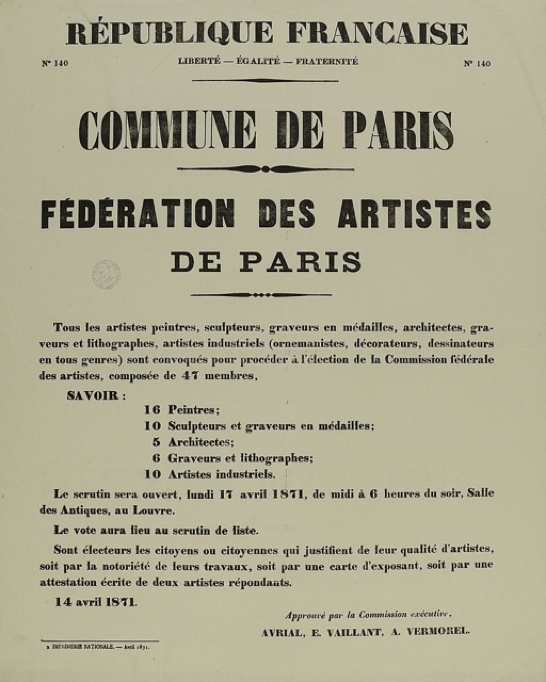
Fig. 2: Federation of Artists of Paris call to election, 14 April 1871. Fonds de la Bibliothèque historique de la Ville de Paris. Public domain.
Occupying & Reimagining Space
Inevitably, questions of space—who takes it up for what purposes, who controls or represents it, and how—permeated the free school’s mission and content. Zoning, fabricating, collaging, erecting, and demolishing, the artist responses to La Commune 2021 incite and honor different forms of occupation: filling a bigger canvas or miniaturizing a monument; leaving or documenting physical traces and digital footprints; making, holding, and representing spaces of truth, feeling, memory, and protest.
Alysha Seriani’s speculative evidence for a children’s autonomous zone staged a collaborative “unhappening” at a local school. Inviting a group of children to create a temporary “body/zone” of disorder, the project reimagined pedagogy, presence, and play. Kara Stanton’s how the city gets made traces the arteries of nineteenth-century Paris in embroidery on white cloth (“plain like a sheet or would be protest banner”), mapping historical terrain and the practices of colonialism, resistance, and everyday life. Pippa Lattey’s Homage to the Vendôme Column re-topples the monument Communards destroyed on 16 May 1871, recalling that historic marker’s multiple iterations while “mock[ing] its material status, by simplifying its form and shrinking it in size.” Working with double-exposed photographs captured on “long COVID walks,” the sound and other effects of an old projector, bricks, and a close-captioned poem, Ada Dragomir’s video performance, the brick in question, is a slow, provocative slideshow, a reading, the building of a barricade, and more.
Communal Luxury vs. Austerity
Inspired by and developed in collaboration and shared with a wider community beyond the free school, the artist responses also interrogated the politics of creative practice and/as labor. Rhys Edwards’s painting, Luxury Fissure ’71, is perhaps the most materially explicit in its engagement of “communal luxury” as an antidote to aesthetic and other forms of austerity. Opting for the “decadence” of oil-on-canvas on a grander scale than most of his previous work (3’ x 4’ vs. 12” x 18”), the piece is, in Rhys’s words, “a history painting, a puzzle, a still life, an homage to the Commune’s creativity and contradictions, and to the impossibility of representation.”[8] Photographer and printmaker Mary Rusak’s Shifting is an artist’s book involving multiple participants. Attentive to mental health struggles and strategies in and beyond the pandemic, Rusak gathered these voices in forms intended for online and print publication and dissemination. Luxury in this instance means making the words of several contributors accessible to different potential readers.
1871 + 150 = 1871 x 2021
Two films by Ryan Ermacora and Stephanie Gagne move between spaces and temporalities, extending and deepening the conversation between past and present so central to the free school project. Ryan’s short film, Blockade, documents sites of local and regional resistance and oppression at the Port of Vancouver and Fairy Creek. The film’s editing, filtering, and splitting renders the screen itself a space of political and representational struggle. Stephanie’s Shipping Fees rushes together and in tension images and sounds across times and geographies. The resulting frenzy of weapons, bodies, and eruptions points up the violent spectacle of a history always already crashing into today. A different kind of stream, of associations and politics, runs though Emily Guerrero’s textual meditation, Harm reduction, mothering, abolition every day. Considering the 1871 Commune in 2021 brought Emily to “what it means to truly, deeply, fervently know that the State is not the answer. And what it means to then continue forward, to create and remember ways of being and working and struggling, of partying and caring and mothering and surviving.”
During the free school’s final days, UNIT/PITT organized a postering campaign around Vancouver. Each artist’s affichewas featured on an 11” x 17” poster including a QR code leading to a digital version of the work online at the La Commune 2021 website. At a time of limited possibilities for social gathering, we pulled others into the project by borrowing from the Commune’s own communication strategy, a mode of public outreach that has not gone out of style since.
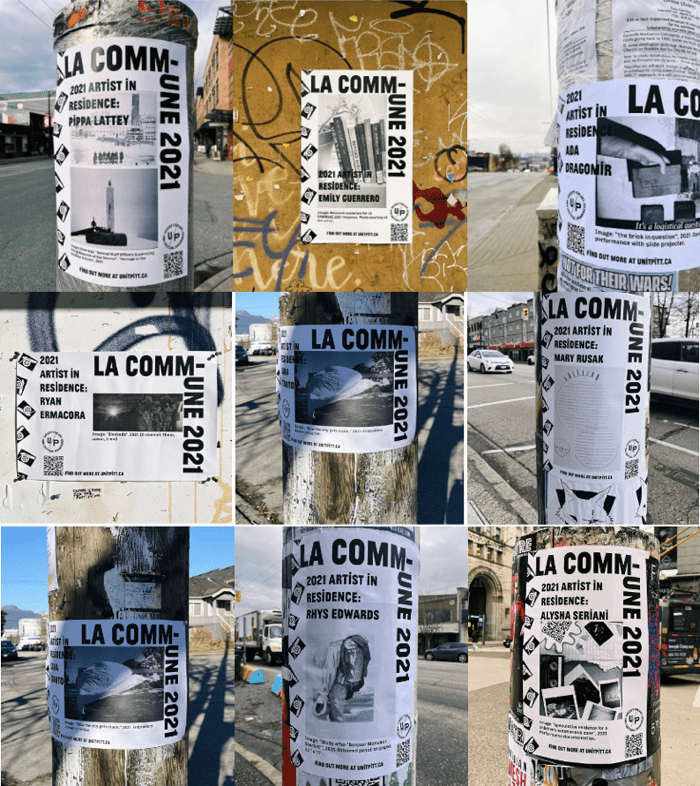
Fig. 3: Images of all nine posters for the artist response to La Commune 2021. Courtesy of UNIT/PITT: Society for Art and Critical Awareness.
For the artists of La Commune 2021, as for all of us who lived and continue to live through a scary, alienating, impossible-but-also-not moment in the world, analogies between past and present have been disturbing to see, hear, and feel. Covid, the 2020 murder of George Floyd in the United States and the global responses it provoked, a heightened awareness of climate emergency—these not altogether “new” crises opened up old wounds and anticipated more to come: wars, revolutions, catastrophes. The readings, conversations, and art of La Commune 2021 remain accessible online. It is my sincere hope that this new “useable archive” will continue to be a source of inspiration (and action!) to anyone who wishes to explore and learn from what we all made together. The ambition of the free school, including its program of artists-in-residence, was to incite us, then as now, to be critical and resist.
Roxanne Panchasi is Associate Professor of History at Simon Fraser University in Vancouver, Canada. She is the author of Future Tense: The Culture of Anticipation in France Between the Wars (Cornell University Press, 2009) and the founding host of New Books in French Studies, a podcast channel she launched on the New Books Network in 2013.
Title Image: A barricade from the Paris Commune, located at the corner of Boulevards Voltaire and Richard-Lenoir. Source: Wikimedia Commons.
Further Reading:
Carolyn Eichner, The Paris Commune: A Brief History (New Brunswick, NJ: Rutgers University Press, 2022).
Kristin, Ross, Communal Luxury: The Political Imaginary of the Paris Commune (New York: Verso Books, 2015).
La Commune 2021 free school, weekly readings and episodes of radio 1871 available via SoundCloud.
Endnotes:
[1] I am grateful to Meghan Roberts and the Age of Revolutions editors for their thoughtful readings of this essay and suggestions for revision.
[2] For a concise and compelling historical introduction, see Carolyn Eichner, The Paris Commune: A Brief History (New Brunswick, NJ: Rutgers University Press, 2022).
[3] Shout-out to the students enrolled in HIST 417: The Paris Commune-150th Anniversary ed. in the Department of History at Simon Fraser University from January to April 2021.
[4] My sincere thanks to everyone who made the free school a success. Brit Bachmann, Stacey Bishop, Lauren Lavery, and Rachel Lau contributed their expertise and creativity in more ways than I can enumerate here.
[5] Kristin Ross attributes the phrase “useable archive” (preferring it to the notion of historical “lessons”) to Andrew Ross’s comments regarding her book, Communal Luxury: The Political Imaginary of the Paris Commune (New York: Verso Books, 2015) in “The Meaning of the Paris Commune,” an interview by Manu Goswami published in Jacobin, 4 May 2015, https://jacobin.com/2015/05/kristin-ross-communal-luxury-paris-commune/ [Accessed 10 December 2023].
[6] In addition to Ross’s in-depth discussion in Communal Luxury, see ROAR Collective’s “Manifesto of the Federation of the Paris Commune’s Artists” in ROAR Magazine, 18 March 2021, https://roarmag.org/2021/03/18/april-15-manifesto-of-the-federation-of-artists/ [Accessed 10 December 2023].
[7] Many thanks to the eight artists who met with me via Zoom to discuss their work in August and September 2022. Unfortunately, I was not able to speak with Kara Stanton. Unless otherwise specified, all quotations are drawn from the artists’ own work and accompanying statements online. See the links provided above.
[8] Interview with Rhys Edwards, 3 August 2023.
 Age of Revolutions
This is amazing. Full stop. What a gift, not least to my students.
LikeLiked by 1 person
Thank you so much for these kind words!
-rp
LikeLike