This post is a part of the 2023 Selected Papers of the Consortium on the Revolutionary Era, which were edited and compiled by members of the CRE’s board alongside editors at Age of Revolutions.
By Hannah Nolan
In 1818, former United Irishmen Thomas Addis Emmet decided he owed one of his daughters an apology. Writing to Jane Erin “Jeanette” Emmet, Thomas begged for forgiveness if his previous comments on her “Scottish partialities” – apparently resulting from her birth in Fort George during his imprisonment there – had offended her. Stating, “for my wish to have you entirely Irish (except so far as you ought to be American) may have made me treat those partialities without mercy. I meant to make you Irish, in spite of your place of birth,” Thomas asserted a vision of identity which stood in contrast to the more ideological definitions embraced by his fellow republicans and radicals during the late eighteenth and early nineteenth century. In fact, his assertion of Jeannette’s Scottishness directly contradicted his own claims to an American identity by tying nationality solely to place of birth. While he claimed he had “no prejudices against Scotland, so … we can easily make friends,” he denied Jeannette the cultural belonging available to her Irish- and American-borne siblings, even as he apologized for othering her.[i]
As James Kettner and Douglas Bradburn have shown, the Age of Revolutions reformulated how Americans conceived of nationality through the creation of citizenship. Standing in opposition to the eternal allegiance mandated by British subjecthood, citizenship in a republic was a volitional choice – at least, theoretically – and both parties agreed that American identity was synonymous with republicanism. Building on this argument, Irish radical men like Thomas insisted that their revolutionary activity abroad proved their republican masculinity and thus made them both Irish and American, even as they awaited naturalization. In doing so, these men asserted an Irish identity defined by ideology during an era of growing sectarianism and affirmed an American identity rooted in principle over place.[ii] However, acceptable republican behavior was informed by gender – with distinct expectations for men and women in Irish and American societies – and circumstances. The success of the American Revolution and the failure of the United Irishmen’s 1798 uprising created divergent republicanisms: the former was tasked with maintaining a nation-state, while the latter remained committed to armed resistance. Caught in between due to her birth in Scotland, Jeanette was unable to claim the mantles of either American republican motherhood or Irish republican womanhood in 1818, denying her a place in either community. In her father’s eyes, the two months she spent in Fort George as a newborn outweighed an entire adolescence spent in the United States and within Irish American communities. Jeanette’s imposed Scottishness reveals the staggered evolution of republicanism across the Atlantic, particularly in relation to the construction identity and nation-building in the aftermath of revolution.
Her father, Thomas Addis Emmet – along with much of the United Irish leadership – was arrested in March of 1798, and transferred to Fort George, Scotland to await exile. Fearing he would be transported to Australia with little notice, Thomas’ wife Jane soon followed, moving herself and her eldest three children into the prison.[iii] On April 18, 1802, Jeanette was born within Fort George. Two and a half months later, the family left Scotland for continental Europe, before finally moving to New York City. As a child, she had a quick wit and was close with her elder brother John, father of the family’s biographer Dr. Thomas Addis Emmet. In 1825, she married Bache McEvers, and the couple remained in the city until McEvers’ health began to decline. In 1851, he and Jeannette traveled to Europe, in hopes the climate would improve his condition. He died shortly after, but she would spend the rest of her life moving between the United States and the United Kingdom, before passing in 1890.[iv]
The details of Jeanette’s life are scarce, despite her longevity. This is, in part, due to her decision to burn most of her personal letters towards the end of her life, as her mother had done – though she did give a few to her nephew Dr. Emmet, out of fondness for his father. As such, she received her most substantial examination within her nephew’s family history The Emmet Family, which dedicated six out of the almost four hundred pages exclusively to her – most given to any of the Emmet women. She is also one of the only Emmet children to be directly discussed within R. R. Madden’s The United Irishmen, Their Lives and Times, the first formal history of the organization. This discussion, however, is limited strictly to her birth and used to highlight her mother’s insistence on remaining in Fort George. Likewise, while Jeanette appears within the American press about a dozen times, her birth and her father’s exile dominate this coverage – so much so that it’s discussed in her sister’s obituary.[v]
Jeanette typically operated more as a prop than as a person within the historical record. Rhetorically, she existed to highlight the republican principles of her parents: Thomas’ imprisonment in Scotland served as a reminder of his commitment to an Irish republic, while Jane’s insistence on giving birth in prison rather than abandon her husband was a model for other Irish republican women. Together, they represented two sides of virtuous resistance, with their differing reasons for being in Fort George highlighting the gendered expectations of republicanism within eighteenth century Ireland. Essentially, their Scottish daughter emphasized their Irishness.
As Nancy Curtain has noted, Irish republicanism has traditionally expected men to commit “patriotic self-immolation on the altar of the nation.” While Thomas had not literally risked bodily harm during the Uprising of 1798, his arrest and imprisonment proved his commitment to Irish independence and republican governance. While his resentment of Jeanette’s supposed Scottishness could hint at regret, his desire for her to be Irish – as well as his insistence that he “will hold no situation that is not Irish or obviously directed to the emancipation of that country” – reveals the persistence of his Irish republican masculinity within his new American context.[vi] American men’s republicanism was similarly rooted in the citizen-soldier ideal, though the “citizen” half of that equation rose in prominence after Independence. The success of the Revolution allowed American men to envision less violent methods of showing civic virtue and patriotism, but the persistence of militant-minded “herculean masculinity” amongst Democratic-Republicans maintained continuity between pre- and post-revolutionary republicanism within partisan circles. As such, while Irish and American republican masculinities were beginning to diverge at the turn of the century, transatlantic radicals like Thomas could still easily claim that their Irish identity complimented and even strengthened an American identity.[vii]
Republican women, on the other hand, were expected to demonstrate their virtue through the men in their lives. For Irish women, republican womanhood tasked them with gladly sacrificing their male relatives on Ireland’s behalf and with making the “right” decision easy for republican men. In the elder Jane’s case, this resulted in elective imprisonment in Fort George, ostensibly to prevent her husband from abandoning the republican cause in hopes of returning to his family. Despite British fears she would pass information between the state prisoners and radicals still in Ireland because she had “imbibed his principles,” Jane’s republicanism was centered on her husband.[viii] While this vision of republican womanhood persisted in Ireland through the early twentieth century, it transformed into “republican motherhood” in the United States. Within this framework, women were not supposed to just care for the home but were also tasked with raising republican sons in service of the national good; these boys could be citizen-soldiers, but women were no longer expected to sacrifice them on the altar of the nation. “Republican motherhood” still recognized a political dimension to women’s work, but it “domesticated” women’s political participation and facilitated their removal from both public life and partisan discourse.[ix]
While both Irish and American republicanism was gendered at the turn of the century, Irish republican womanhood did not transform into the less militaristic republican motherhood as it had in the United States, meaning ethnically Irish women had fewer opportunities to show their civic virtue and exercise their identities within Irish America than their American or male counterparts. This gendered conception of republican duty excluded women like the Scottish-borne Jeanette from the ethnic group, despite being raised in Irish republican families. Removed from the political circumstances of Ireland and placed in an independent United States, Jeanette had no opportunity to prove her Irish republican womanhood as her mother had done; she had no sons or husbands to stoically sacrifice in the fight against British tyranny. Likewise, in 1818, she had no children to raise into good little republicans as a sign of her virtue and ideological commitment.
Within her few remaining letters, Jeanette never refers to herself as Scottish, Irish, or American nor does she engage with republican politics, making it impossible to discern her self-identification. While her Irish- and American-born brothers frequently asserted their Irish-American identities through their private correspondence and participation in partisan and ethnic societies, Thomas’ assertion of Jeanette’s Scottishness stands as the only contemporary testament of her ethnic identity. This is also the case for her sisters. Neither the Irish-born Margaret and Elizabeth nor the American-born Mary Ann self-identified within their existing writings. Thomas referred to the eldest two as his “fellow prisoners” and deemed them Irish, while he saw his youngest daughter as his “brave American girl,” situating all three as either Irish or American as opposed to both. Despite Thomas’ insistence that he raised his children to be both Irish and American, his daughters were denied the hyphenate identity so easily claimed by their brothers as a result of the growing divide between Irish and American republican womanhood.[x]
If membership was voluntary within a republic, the ethnic identities of Thomas Addis Emmet and his daughters reveal the limitations of choice during the late eighteenth and early nineteenth centuries. While male radicals like Thomas Addis Emmet were able to choose to be both Irish and American and forge hyphenate identities in the early American Republic, Jeanette’s identity was entirely dependent on her father’s actions. She was only Scottish because he was imprisoned for his involvement with the United Irishmen. Her relationship with the imagined Irish republic and the realized American one was experienced through her father, as opposed to a choice on her part. For Jeanette, this resulted in Scottishness as opposed to the Irishness of Elizabeth and Margaret or the Americanness of Mary Ann, but in each case, the gendered expectations of republicanism – and the indirect relationship women held with a republic – placed them outside the rhetorical bounds of Irish America.
Hannah Nolan is a Ph.D. candidate at the University of Maryland, College Park. Her dissertation, tentatively titled “’Who Fears to Speak of Ninety-Eight?’: The United Irishmen and the Legacy of Revolution in Irish America,” examines collective memories of the United Irishmen and their usage as political and ethnic organizing tools during the early American republic.
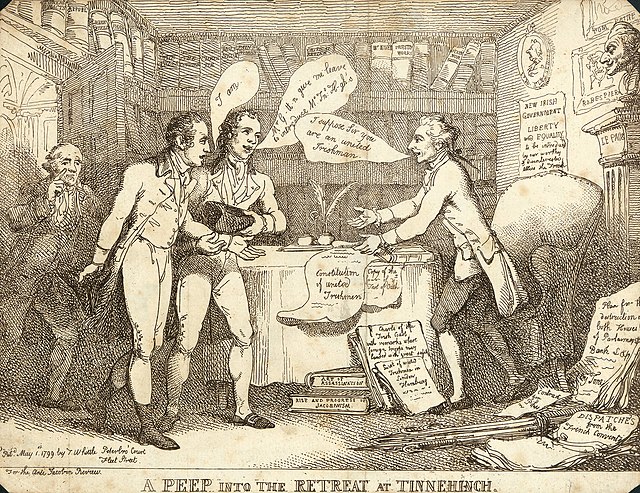
Title Image: “A Peep Into the Retreat at Tinnehinch,” by Thomas Rowlandson. The political cartoon inveighs against Henry Grattan, a supporter of an independent Irish Parliament, accusing him of republican sympathies. Source: Wikimedia Commons.
Further Readings:
Brundage, David. “Matilda Tone in America: Exile, Gender, and Memory in the Making of Irish Republican Nationalism,” New Hibernia Review / Iris Éireannach Nua 14 no. 1 (Earrach / Spring 2010): 96-111.
Curtin, Nancy J. “‘A Nation of Abortive Men’: Gendered Citizenship and Early Irish Republicanism” in Reclaiming Gender: Transgressive Identities in Modern Ireland. Edited by Marilyn Cohen and Nancy J. Curtin. New York: St. Martin’s Press, 1999.
Kennedy, Catriona A. “‘What Can Women Give But Tears’: Gender, Politics, and Irish National Identity in the 1790s” PhD dissertation. University of York, 2004.
Keogh, Dàire and Nicholas Furlong. The Women of 1798. Dublin, IE: Four Courts Press, 1998.
Kerber, Linda K. No Constitutional Right to Be Ladies: Women and the Obligations of Citizenship. New York: Hill and Wang, 1998.
Ward, Margaret, The Missing Sex: Putting Women into Irish History. Dublin, IE: Attic, 1991.
Wilson, David A. United Irishmen, United States: Immigrant Radicals in the Early Republic. Ithaca, NY: Cornell Univeristy Press, 1998.
Endnotes:
[i] Thomas Addis Emmet to Jane Erin Emmet, March 2, 1818. MS 2893, Whitlock Family Papers, New-York Historical Society.
[ii] James Kettner, The Development of American Citizenship, 1608-1870 (Chapel Hill: University of North Carolina Press, 1978); Douglas Bradburn, The Citizenship Revolution: Politics and the Creation of the American Union, 1774-1804 (Charlottesville: University of Virginia Press, 2009); Douglas Bradburn, “‘True Americans’ and ‘Hordes of Foreigners’: Nationalism, Ethnicity, and the Problem of Citizenship in the United States, 1789-1800,” Historical Reflections / Réflexions Historiques 29 no. 1 (2003): 19-41.
[iii] Duke of Portland to the Honorable Lt. Governor Stuart in Dr. Thomas Addis Emmet, The Emmet family, with some incidents relating to Irish history and a biographical sketch of Prof. John Patten Emmet, M.D., and other members (New York: Bradstreet Press, 1898).
[iv] Emmet, The Emmet family.
[v] Emmet, The Emmet family; R.R. Madden, The United Irishmen, their lives and times. With Several Additional memoirs, and authentic documents, heretofore unpublished; the whole matter newly arranged and revised. 2d series.(Dublin: J. Duffy, 1858), 99; Times-Picayune (New Orleans, LA: March 9, 1883).
[vi] Nancy J. Curtin, “Matilda Tone and Virtuous Republican Femininity” in The Women of 1798, eds. Dáire Keogh and Nicholas Furlong (Dublin: Four Courts Press, 1998): 31-32; Matthew Rainbow Hale, “American Hercules” in Between Sovereignty and Anarachy: The Politics of Violence in the American Revolutionary Era, ed. Patrick Griffin et al. (Charlotteville: University of Virginia Press, 2015); Thomas Addis Emmet to William James MacNeven letter, April 19, 1804, MS 873.560, Madden Papers, Trinity College, Dublin.
[vii] Hale, “American Hercules”.
[viii] Curtin, “Matilda Tone and Virtuous Republican Femininity”; Curtin, “Women and Eighteenth Century Irish Republicanism”; Nancy J. Curtin, “‘A Nation of Abortive Men’: Gendered Citizenship in Early Irish Republicanism” in Reclaiming Gender: Transgressive Identities in Modern Ireland (Dublin: Four Courts Press, 1999); Emmet, The Emmet family, 99; Madden, The United Irishmen.
[ix] Linda Kerber, Women of the Republic: Intellect and Ideology in Revolutionary America (Chapel Hill: University of North Carolina Press, 1980); Rosemarie Zagarri, Revolutionary Backlash: Women and Politics in the Early American Republic (Philadelphia: University of PA Press, 2007); Linda Kerber, No Constitutional Right to Be Ladies (MacMillan Publishers, 1998).
[x] Thomas Addis Emmet to Robert Simms in Emmet, The Emmet family.
Leave a Reply