By Scott Kaufman
More than a century ago, Sydney G. Fisher charged fellow historians with mythologizing the American Revolution. The colonists debated for years over whether to seek freedom from Great Britain and its king, George III, and literally fought one another during that conflict, he explained. Yet, those who wrote about the war for independence sought “to make it appear that the Revolution had been a great spontaneous uprising of the whole American people without faction or disagreement among themselves.”[1] Numerous historians since have met the challenge, publishing works that demonstrate how divided the colonists were over seeking independence, and how those divisions played their part in what amounted to America’s first civil war.[2] Still, criticisms persist. For instance, one of the foremost scholars of the Revolution, Gordon Wood, has been taken to task for ignoring the role of common individuals in that conflict. Gary Nash, another leading American Revolutionary War historian, fills the void Wood left, yet in elevating commoners, he passes over their faults, such as their aspirations to enslaved peoples of African descent or seize Native Americans’ land.[3]
The invention of motion pictures in the late 1800s and television in the 1920s offered new mediums to present the American Revolution, starting with the short film Declaration of Independence in 1911. Since then, dozens of films and TV programs on that war have appeared.[4] Some, including the History Channel’s The Revolution (2006) and Ken Burns’ recent The American Revolution (2025) use archival materials and the guidance (and appearance) of professional scholars, to remain as loyal as possible to the historical record. To varying degrees, the majority tend to sideline accuracy in favor of narrative and drama, including the numerous films in which George Washington is a major figure, the HBO series John Adams (2008), and the forty-part PBS children’s series Liberty’s Kids (2002-3).[5] This lack of factuality can be problematic. There is evidence that most Americans realize TV programs about medicine or law enforcement, such as Grey’s Anatomy and the various CSI series, are meant more to entertain than present stories based on genuine medical or police work.[6] However, a number of studies have found that when it comes to misinformation, including that presented in reputedly-historical accounts, people are more likely to accept the factual inaccuracies presented over what is actually true.[7]
One figure of the American Revolution who has been depicted on both the big and small screens is General Francis Marion, a partisan fighter in South Carolina whose exploits, according to one historian, “saved the American Revolution.”[8] Marion’s use of guerrilla tactics to help secure the colonists’ victory over the British made him a hero in the South, so much so that in the antebellum era, southerners drew an analogy between his determination to stand up to London’s oppression and their own resistance to what they regarded as a despotic North.[9] Interest in Marion declined after the American Civil War, but he began drawing attention again in the twentieth century, and particularly following World War II. This was due in part to a renewed interest in the Revolution by so-called “Consensus historians,” who argued that unlike Great Britain, the history of the United States witnessed little social or economic conflict.[10] Aside from some lengthy biographies,[11] the TV and film industries took note of him. The first program to make him the main figure was Walt Disney’s eight-part series, The Swamp Fox. For Disney, Marion’s story reflected Americans’ longstanding commitment to “democracy and freedom,” and, in turn, hopefully would draw a wide audience. Produced with the help of Robert Bass, a historian and expert on the American Revolution who published a full-length biography of Marion, the The Swamp Fox ran on television between 1959 and 1961.[12] Forty years later, Hollywood producer Mark Gordon and screenwriter Robert Rodat, both of whom had collaborated in producing the Oscar-winning movie Saving Private Ryan in 1998, saw in Francis Marion a hero around whom they could create yet another smash hit.[13] The result was The Patriot, which made over $200 million at the box office in 2000. In 2015, Fox News commentator Bill O’Reilly, who had received a bachelor’s in History, began producing a series entitled Legends and Lies. The program, which aired weekend evenings, and relied on reenactors and professional historians, had two purposes. The first was to debunk myths about the past. The second was to draw viewership (and advertising revenue) at a time of the week when there was less likelihood of breaking news.[14] One of the episodes, on General Marion, appeared on the Fox News Channel in 2016.


Whether they seek to discover the truth or not, all these productions make a mistake from the get-go: none of the actors who portray Marion look like him. Certainly, a reason for this is because there are no contemporary portraits of the ex-general. Consequently, those interested in Marion have had to rely on written descriptions, such as those found in William Gilmore Simms’ 1845 biography of the revolutionary war officer. Simms, a South Carolina-born novelist, historian, and poet, penned that Marion was of “slight figure”—at least one later account suggests an individual who stood about five feet tall and weighed about 110 pounds—who walked with a limp, and who had a high forehead, “black and piercing” eyes, “badly formed” ankles and knees, and a hooked nose.[15] Paintings, all of them created years after Marion’s death, show a man with the described proboscis, oftentimes wearing a hat that covers his forehead, and sometimes on a horse or wielding a sword. Probably the most famous of them—and one that also suggests his diminutive height—is John Blake White’s General Francis Marion Inviting a British Officer to Share His Meal, which White completed sometime around 1810, or fifteen years after Marion passed away. He drew a thin man, shorter than the British officer standing next to him, with facial features like those described by Simms.

John Blake White’s General Francis Marion Inviting a British Officer to Share His Meal
Simms’ description and these paintings look nothing like the actors who portrayed Marion. In The Swamp Fox, it is the 6’ 2” Leslie Nielsen, while The Patriot chose 5’ 10” tall Mel Gibson. While it is not entirely clear, Timothy Eric Hart, who assumed the lead role for Legends and Lies, probably stands somewhere around the same height as Nielsen and Gibson. Moreover, in The Patriot, the main character, Benjamin Martin, never walks with a limp. In Legends and Lies and The Swamp Fox, Marion does have a limp, but it is depicted as only temporary.
Why select such individuals to play Marion? For one, both Nielsen and Gibson had already established themselves as Hollywood leads with sex appeal, while Hart had experience both on and off Broadway.[16] But it is also likely because a short, thin, hobbling man belies the expectation that a military leader is a physically imposing individual. George Washington, for instance, was tall, standing 6’ 2.” Joseph Ellis described him as “the epitome of a man’s man: physically strong, mentally enigmatic, emotionally restrained.”[17] Similarly, Ron Chernow penned that Washington was “powerfully rough-hewn and endowed with matchless strength.”[18]
One’s shape, size, or physical condition, however, does not determine their leadership abilities. Born in the South Carolina colony in 1732, Marion was the sixth and last child of Gabriel Marion and Esther Cordes, themselves the offspring of French Huguenot immigrants. He grew up near the port of Georgetown, and the idea of working at sea attracted him. Around age 15, he got a job on board a schooner, but he nearly died after the ship sank. Following his rescue at sea, he decided that a life on land made more sense. Over the next decade or so, he moved several times, ultimately taking up residence on property owned by his oldest brother, also named Gabriel, at a place called Belle Isle (today located in the town of Pineville).[19]
During the Seven Years’ War (1756-1763), Marion joined a unit of British cavalry sent to subdue the Cherokee Indians in the southwestern corner of North Carolina. The experience was important to his future exploits. First, he learned how the British army trained its troops and engaged in battle. Second, the Cherokee fought his unit with hit-and-run guerrilla tactics. Finally, the Cherokee used long rifles, a weapon that had the ability to strike a target accurately at 200 yards, or about four times as far as the smoothbore muskets the British assigned their troops. With the war’s end, Marion returned to civilian life. He acquired more land and made enough money to buy a plantation at Pond Bluff, located near Eutawville. He and his brothers Job and Gabriel garnered enough respect from members of their local communities to win seats in South Carolina’s First Provincial Congress in 1774.[20] The Swamp Fox omits these parts of Marion’s life. Legends and Lies makes brief mention of the general’s military service for the British and his combat with the Cherokee but says nothing about his political career. Only The Patriot does both, offering a scene early on of him partaking in a debate in the colonial assembly, during which two members refer to his experiences in the Seven Years’ War.
A year after Marion’s election to South Carolina’s legislature, the first shots of the Revolution rang out in Massachusetts. According to The Patriot, Marion was a veteran of the Seven Years’ War whose wife had died, leaving him in charge of their seven children and a plantation worked by free Blacks. Desirous to keep his family safe, he opposes war with Great Britain. It is only after a British officer, Colonel William Tavington, kills one of his sons and burns down his home that he takes up arms against King George. Beyond Marion’s veteran status, none of these scenes from The Patriot are accurate. The Swamp Fox does a better job, making clear that Marion was a bachelor who had no children and a determined opponent of British rule. Likewise, Legends and Lies introduces Marion as a champion of independence. But Marion was also an enslaver, a fact that both The Patriot and Legends and Lies ignore. Disney, for its part, acknowledges that slavery existed, but it turns a blind eye to the racism Black people faced or that as much as two-thirds of South Carolina’s population was enslaved. Instead, it, as well as The Patriot and Legends and Lies, portray Black people not just as socially equal to Whites but as committed as Caucasians to the rebel cause.[21] The truth is that rather than supporting the rebellion, many enslaved people joined the British, who promised them freedom if they joined them, or ran away. With his decision to fight, Marion received an appointment as captain in the Continental Army’s Second Regiment, under the command of Colonel William Moultrie.
It is necessary at this point to take a brief detour and address two matters that are important to Marion’s story. The first is the difference between militia and regular troops. The Continental Army was made up of regulars, who signed up for extended periods of service, while militia were freer to come and go as they pleased. Second, regulars had much more training than the militia. These differences oftentimes led Continental soldiers to look down upon the militia, for they saw the militia as less disciplined and less well trained than themselves. Second, the American Revolution, as historians have made clear, was not just a fight for independence. It was indeed Americans’ first civil war. John Adams wrote that the colonists divided into thirds, with one third (referred to as “Patriots” or “Whigs”) supportive of freedom from British rule, another third (called “Loyalists” or “Tories”) desirous to remain wedded to the crown, and the remaining third adopting a position of neutrality.[22] With the possible exception of New Jersey, no colony saw how vicious this colonist-versus-colonist warfare could be than South Carolina.[23]
The war came to South Carolina in 1780. After failing to crush the American Revolution at its heart in the northern colonies, the British shifted their focus to those in the South. While no colony had more Loyalists than Patriots, there were many residents in the southern colonies who opposed taking up arms against London, including about one-quarter of all South Carolinians. They remained loyal to the crown for any number of reasons: they were merchants whose livelihood depended on trade with the home country, they received their land or jobs thanks to the British government, they were members of the Anglican church, or they had personal grudges against those favoring independence.[24] After seizing Savannah, Georgia, in 1779, and subduing that colony, the British shifted their focus to Charleston. By May of 1780, they had the city and its Continental defenders, including now-Lieutenant Colonel Marion, surrounded.
As Patriot forces awaited the Redcoat assault, a local rebel captain named Alexander McQueen held a party at his home—a gathering that became key to Marion’s life and achievements. The Patriot says nothing about this event, but The Swamp Fox does and gets it almost all wrong. According to Disney, Marion was irate when he heard about the party, accosts McQueen (whom Disney calls McKeller), and then jumps out a second story window after McQueen threatened Marion’s life. Upon landing on the ground, Marion injures one of his ankles. In truth, Marion received an invitation to the party and believed it impolite not to attend. It was customary on such occasions to lock the front door and hold numerous toasts, facts to which Legends and Lies alludes in its brief depiction of this event. No longer wanting to be part of such a get-together with the British positioned offshore, and a teetotaler to begin with, Marion decided to leave. Fearful of being seen as rude for departing early, he chose the window for his escape route and broke an ankle in the process.[25]
Deciding a wounded Marion was of no use to him, his commander, General Benjamin Lincoln, ordered him to leave the city and recuperate. Consequently, Marion was not in town when it fell later that month, along with Lincoln and the entire 5000-man Continental Army of the South. Afterward, the British fanned out throughout the colony. As they had hoped, Loyalists came out in strong numbers to help them, while rebel forces fled before the British onslaught. In August 1780, a combined force of Continentals and Patriot militia led by General Horatio Gates attempted to stop the British at Camden, only to face defeat. It appeared King George III was well on his way to conquering South Carolina.
London, however, did not count on partisan fighters, among them Marion. He had recovered to the point that he could again enter the field of battle. His ankle had healed, though he walked with a limp, and would do so for the rest of his life. In Legends and Lies, the limp disappears following his recuperation. The Swamp Fox, meanwhile, resolves the matter via a liquid concoction put together by an enslaved person that miraculously cures his injury. Starting in August 1780, Marion and a band of horse-mounted militiamen that consistently varied in size used the guerrilla tactics he had learned from the Cherokee and support from locals to free rebel prisoners, attack British supply and communication lines, and tie down troops that London’s southern commander, Lord Cornwallis, wanted to employ elsewhere. In acknowledgement of Marion’s work, South Carolina’s governor-in-exile, John Rutledge, promoted him in late 1780 to the rank of brigadier general of the colonial militia.[26]
The Swamp Fox, The Patriot, and Legends and Lies correctly depict Marion using hit-and-run strikes against his enemy and his knowledge of the terrain to hide. They detail his regiment’s use of horses in this guerrilla campaign, for the animals gave him and his men the speed and maneuverability necessary for guerrilla tactics. What they all get wrong is having Marion physically participate in the fighting. While he led his men into combat, he did not personally partake in combat. Rather, he preferred to take a position behind the front line, where he could observe the battlefield and adjust as needed.[27] This made him different from several of the war’s generals. George Washington famously led his troops from the front at the Battle of Princeton (1777). Nathanael Greene did the same at Harlem Heights (1776), as did John Sullivan at Long Island (1776), Benedict Arnold at Saratoga (1777), and Anthony Wayne at Stony Point (1779).
The Swamp Fox, The Patriot, and Legends and Lies are correct that Marion’s exploits frustrated Cornwallis, who turned to Colonel Benastre Tarleton (The Patriot’s William Tavington) to eliminate the partisan commander and his band. Having acquired the nickname “The Butcher” after he massacred more than 100 Continentals who had offered their surrender in May 1780, Tarleton led a unit of Loyalist cavalry referred to as the Green Dragoons because of the color of their uniforms.
What The Swamp Fox, The Patriot, and Legends and Lies cannot agree on is how to treat Tarleton. In Legends and Lies, he is an evil individual who digs up the grave of Richard Richardson, a patriot general whose wife, Dorothy, supported the rebel cause. In The Patriot, he is even more devilish, going so far as to put a group of Patriots into a church and burn them alive. The story about Tarleton unearthing Richardson’s coffin is a matter of debate,[28] and there is no evidence that he ever engaged in the act depicted in The Patriot. For Disney, he is a bad guy, yet he has something of a conscience. In one episode, for instance, he comments that he opposed wanton killing, even though in real life he had murdered rebels who had offered their surrender.
All three programs do have Marion consistently frustrating Tarleton’s efforts, which was indeed the case. The Swamp Fox in particular attempts, albeit poorly, to recreate Tarleton’s famous 26-mile-long chase of Marion, which only ended after Marion and his men fled into a swamp. According to The Swamp Fox and Legends and Lies, it was after that pursuit that the Butcher gave Marion the nickname “the Swamp Fox,” though there is no evidence he ever uttered such words.[29]
When the war ended with Cornwallis’ surrender at Yorktown, Marion had to consider his future. He won election to the South Carolina state senate and, in 1784, assumed command of Fort Johnson, likely because he was short on money. Money may also have been a reason why he at age 54 married 49-year-old Mary Videau. She is non-existent in Legends and Lies, and there is need for her in The Patriot, for Martin is a widower. (That said, Martin’s sister-in-law takes care of his children and becomes his love interest.) Disney treats her differently. Women were active participants on both sides in the Revolution, and Disney acknowledges this fact by making Videau a major character. She is Marion’s lover, whom he plans to marry from the first episode, a spy who uses Tarleton’s fondness for her to gather information, and a rescuer of Patriot prisoners.[30] Yet, while the historical record shows that she provided Marion with intelligence, and while there is evidence she had been smitten with him, he apparently showed no interest in her until some of his family members encouraged him to meet her. Whether he married her primarily for love or because she was well-off remains a matter of debate, though there is evidence that their marriage was a happy and loving one.[31]
Marion passed away in 1795, and the earliest books written on him relied more on myth than fact in retelling his story. Rather, these works used Marion as a means of promoting such themes as nationalism, republicanism, and virtue.[32] Clearly the same has been true with portrayals of him on the big and small screens, at least in part to earn revenue, be it through viewership or advertisers. As the research on the former general continues,[33] scholars and laypersons alike will hopefully get closer to understanding more about a man who in some respects remains as elusive today as he was to the British 250 years ago.
Scott Kaufman is a professor of history at Francis Marion University. He is the author, co-author, or editor of twelve books on diplomatic, presidential, and military history, including Project Plowshare: The Peaceful Use of Nuclear Explosives in Cold War America (Cornell University Press, 2013), Ambition, Pragmatism, and Party: A Biography of Gerald R. Ford (University Press of Kansas, 2017), The Environment and International History (Bloomsbury, 2018), and Impeachment in U. S. History (Routledge, 2026). Currently, he is working on a comparative history of the Panama and Suez canals.
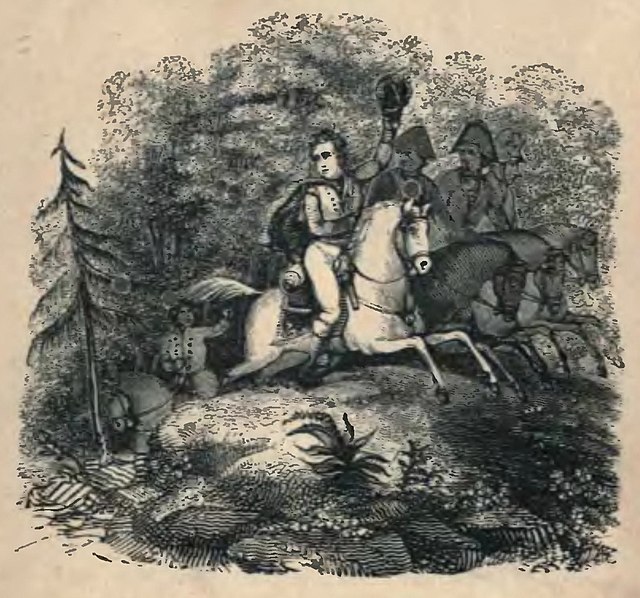
Title Image: “Life of Francis Marion,” Source: Wikimedia Commons.

Further Readings:
Scott D. Aiken, The Swamp Fox: Lessons in Leadership from the Partisan Campaigns of Francis Marion (Annapolis, Md.: Naval Institute Press, 2012).
John Oller, The Swamp Fox: How Francis Marion Saved the American Revolution (Boston: DaCapo, 2016).
Steven D. Smith, Francis Marion and the Snow’s Island Community: Myth, History, and Archaeology (Asheville, N.C.: United Writers, 2021).
Andrew Waters’ Backcountry War: The Rise of Francis Marion, Benastre Tarleton, and Thomas Sumter (Yardley, Pa.: Westholme, 2024).
Endnotes:
[1] Sydney G. Fisher, “The Legendary and Myth-Making Process in Histories of the American Revolution,” Proceedings of the American Philosophical Society 51 (1912), 55.
[2] The literature on the American Revolution is vast, but readers may want to start with the essays in Jack P. Greene and J. R. Pole, eds., A Companion to the American Revolution (Malden, Mass.: Wiley, 2000) and Gwenda Morgan’s, The Debate on the American Revolution (New York: Manchester University Press, 2007). For broad-based texts, readers may wish to consult Gordon S. Wood, The Creation of the American Republic, 1776-1787 (Chapel Hill: University of North Carolina Press, 1998); Alan Taylor, American Revolutions: A Continental History (New York: Norton, 2016); and Woody Holton, Liberty is Sweet: The Hidden History of the American Revolution (New York: Simon and Schuster, 2022).
[3] Andrew M. Schocket, Fighting over the Founders: How We Remember the American Revolution (New York: New York University Press, 2015), 78.
[4] The Internet Movie Database lists more than 70 movies and TV shows on the Revolution, with the earliest, The Hessian Renegades, appearing in 1909. See https://www.imdb.com/list/ls539939632/.
[5] For more on this subject, see for example, Schocket, Fighting over the Founders, chap. 4; Leigh Ehlers Telotte, George Washington on Screen (Jefferson, N.C.: McFarland, 2023); Cotten Seiler, “The American Revolution,” in The Columbia Companion to American History on Film: How the Movies Have Portrayed the American Past, ed. Peter C. Rollins (New York: Columbia University Press, 2003): 49-57; Nancy L. Rhoden, “Patriots, Villains, and the Quest for Liberty: How American Film Has Depicted the American Revolution,” Canadian Review of American Studies 37 (2007): 205-38; Kylie A. Hulbert, “History, Sir, Will Tell Lies as Usual: Founders, Patriots, and the War for Independence on Film,” in Material Culture, Silver Screen: War Movies and the Construction of American Identity, eds. Matthew Christopher Hulbert and Matthew E. Stanley (Baton Rouge: Louisiana State University Press, 2020): 21-46;and Melvyn Stokes, American History through Hollywood Film: From the Revolution to the 1960s (London: Bloomsbury, 2014), chap. 1.
[6] Cary Funk, Jeffrey Gottfried, and Amy Mitchell, “Most Americans See Science-Related Entertainment Show and Movies in Either a Neutral or Positive Light,” Pew Research Center, 20 September 2017, https://www.pewresearch.org/journalism/2017/09/20/most-americans-see-science-related-entertainment-shows-and-movies-in-either-a-neutral-or-positive-light/.
[7] E. F. Loftus, “Reactions to Blatantly Contradictory Information,” Memory and Cognition 7 (1979): 368-74; Rachel O’Donnell and Jason C. Chan, “Does Blatantly Contradictory Information Reduce the Misinformation Effect?: A Registered Report Replication of Loftus (1979),” Legal and Criminological Psychology 30 (2023): 3-26; Andrew C. Butler, Franklin M. Zaromb, Keith B. Lyle, and Henry L. Roediger III, “Using Popular Films to Enhance Classroom Learning,” Psychological Science 20 (2009): 1161-68.
[8] John Oller, The Swamp Fox: How Francis Marion Saved the American Revolution (Boston: DaCapo, 2016).
[9] Steven D. Smith, Francis Marion and the Snow’s Island Community: Myth, History, and Archaeology (Asheville, N.C.: United Writers, 2021), 241.
[10] Simon P. Newman, “Disney’s American Revolution,” Journal of American Studies 52 (2018): 684.
[11] Beryl Epstein, Francis Marion: Swamp Fox of the Revolution (New York: Messner, 1956); Robert D. Bass, Swamp Fox: The Life and Campaigns of General Francis Marion (New York: Holt, 1959); and Hugh F. Rankin, Francis Marion: The Swamp Fox (New York: Crowell, 1973).
[12] Newman, “Disney’s American Revolution,” 686, 687.
[13] Schocket, Fighting over the Founders, 136.
[14] Steven Battaglio, “Bill O’Reilly to Produce ‘Legends and Lies” Docu-Series for Fox News,” Los Angeles Times, January 14, 2015, https://www.latimes.com/entertainment/tv/showtracker/la-et-st-bill-oreilly-legends-lies-20150114-story.html.
[15] W. Gilmore Simms, The Life of Francis Marion (New York: Henry G. Langley, 1845), 121; Christopher Miskimon, “Franics Marion: The Swamp Fox,” Warfare History Network, 13 August 2020, https://www.realclearhistory.com/2020/08/13/francis_marion_the_swamp_fox_501648.html.
[16] Timothy Eric Hart, Backstage, n.d., https://www.backstage.com/u/timothy-eric-hart/.
[17] Joseph Ellis, His Excellency: George Washington (New York: Vintage, 2004), 12.
[18] Ron Chernow, Washington: A Life (New York: Penguin, 2010), 30.
[19] Oller, Swamp Fox, 20-22.
[20] Oller, Swamp Fox, 25-26, 29-30, 33, 137.
[21] Douglas Brode, Multiculturalism and the Mouse: Race and Sex in Disney Entertainment (Austin: University of Texas Press, 2005), 69.; Rhoden, “Patriots, Villains, and the Quest for Liberty,” 225; Newman, “Disney’s American Revolution,” 685, 699, 701-2.
[22] John Adams, The Works of John Adams, Second President, of the United States, vol. X (Boston: Little, Brown, 1856),110.
[23] On this score, see John S. Pancake, This Destructive War: The British Campaign in the Carolinas, 1780-1782 (Tuscaloosa: University of Alabama Press, 2003), esp. chap. 5.
[24] Robert Middlekauff, The Glorious Cause: The American Revolution, 1763-1789, rev. and expanded ed. (New York: Oxford University Press, 2005), 547; “Loyalists,” South Carolina Encyclopedia, n.d., https://www.scencyclopedia.org/sce/entries/loyalists/; John Richard Alden, History of the South, vol. III: The South in Revolution, 1763-1789 (Baton Route: Louisiana State University Press, 1957), 162, 179
[25] Rankin, Francis Marion, 44-45.
[26] For more on this period of Marion’s military career and his impact on British military strategy, see Oller, Swamp Fox, chaps. 54-108.
[27] Scott D. Aiken, The Swamp Fox: Lessons in Leadership from the Partisan Campaigns of Francis Marion (Annapolis, Md.: Naval Institute Press, 2012), 46-47.
[28] Conner Runyan, “We Have Sacrificed Our All,” Journal of the American Revolution, May 25, 2017, https://allthingsliberty.com/2017/05/we-have-sacrificed-our-all/.
[29] For more on this subject, see Smith, Francis Marion and the Snow’s Island Community, 242-44.
[30] Newman, “Disney’s American Revolution,” 705. Newman incorrectly describes Mary as a “fictional” character.
[31] See for instance, Rankin, Francis Marion, 293-94; Oller, Swamp Fox, 240-1; andBass, Swamp Fox,242.
[32] Smith, Francis Marion and the Snow’s Island Community, 236-42.The earliest, published in 1809, was M. L. Weems’ The life of Gen. Francis Marion, a Celebrated Partizan Officer in the Revolutionary War, Against the British and Tories in South-Carolina and Georgia. Peter Horry, who had fought under Marion, had given his notes to Weems, expecting Weems to publish an accurate account of Marion and his brigade. Instead, Weems infuriated Horry by sensationalizing much of what happened.
[33] In addition to the works by Oller, Rankin, and Smith, readers may want to read Andrew Waters’ Backcountry War: The Rise of Francis Marion, Benastre Tarleton, and Thomas Sumter (Yardley, Pa.: Westholme, 2024).
Leave a Reply