By Claudia Suárez
In the early morning of December 3, 2007, President Hugo Chávez addressed the Venezuelan nation in a joint broadcast after his first electoral defeat. It was the culmination of an anxious election day in Venezuela, where voters decided on a referendum that proposed sixty-nine amendments to the Constitution of 1999. The president accepted his defeat but also issued a warning to the opposition: “You should know how to manage your victory. Do not go wild now. We are made for a long battle.”[1] This failed 2007 Constitutional Reform was one of the many attempts Chávez made at manipulating the constitutional law of Venezuela, a strategy he used since his first presidential campaign in 1998. Seeking an electoral mandate from the “people” every year, either for constitutional referendums or candidate elections, was a specific strategy of the “Bolivarian Revolution.”[2] Despite the 2007 defeat, Chávez’s constitutional changes in his first ten years in power were successful in implementing a hidden dictatorial agenda because the changes were attractive and radically different enough from the 1961 constitutional order, which Chávez identified as oligarchical in nature. Chávez’s new “Bolivarian Revolution” transformed the legacies of Simón Bolívar into a new, left-wing nationalism that allows indefinite reelections.
After the end of the Marcos Pérez Jiménez dictatorship in 1958, representatives of the three main political parties—Partido Social Cristiano (COPEI), Unión Republicana Democrática (URD), and Acción Democrática (AD)—signed the Punto Fijo Pact.[3] This agreement sponsored “the union of all citizen forces in the effort to achieve the organization of the Venezuelan nation.”[4] In practical terms, the pact endorsed proportional representation in the cabinet and equal representation of the three political parties in presidential elections. In a Cold War scenario, the architects of Puntofijismo decided to stay friendly with the United States (a key to Chávez’s criticism of imperialism) and excluded any leftist movements. The Constitution of 1961 brought legitimacy to Puntofijismo and jumpstarted the next four-decade period of republicanism in Venezuela by declaring that the Legislative power would ensure the equality of political parties under the law.[5] However, the exclusion of leftist parties would prove, according to young Chávez, a sign of oligarchical dominance.
A combination of such leftist exclusion and the legacies of the 1973 oil crisis brought economic turmoil to President Carlos Andrés Pérez’s (AD) second term. Pérez’s late 1980s economic policies caused an instant increase in prices of common goods, transportation fares, and gasoline by up to 100 percent. In response, there was a massive two-day civil protest, El Caracazo, in February 1989, followed by intense military repression.[6] Some of the same military personnel who pursued such repression were part of a secret rebel group within the Venezuelan army corps, the “Bolivarian Revolutionary Movement” or MBR-200, led by none other than young Colonel Hugo Chávez. The group attempted a coup d’état on February 4, 1992. When caught, Chávez famously warned the Venezuelan public that they had failed “for now.”[7] When given amnesty by President Rafael Caldera (COPEI) shortly after, Chávez strengthened MBR-200, officialized it as a political party, and ran for president. He toured Latin America, during which he met Fidel Castro, and started to promote the “Bolivarian Revolution” as a leftist take on Simón Bolívar’s legacies (Bolívar was a famed 19th-century Venezuelan independence leader for several South American nations). Bolivarian sentiment pushed for an anti-imperialist coalition against the United States, economic self-sufficiency, and inter-American cooperation.[8] Scholar Lionel Muñoz Paz argues that Chávez’s original goal of the 1992 coup was to establish a new constitutional order. The consequent Bolivarian Revolution, therefore, would eradicate the “oligarchical” Puntofijismo, permit the inclusion of the leftist movements, and move away from that which Chávez called a “false democracy.”[9]
After gaining popularity in the mid-to late-1990s and running a presidential campaign in 1998, Chávez won with 56.20 percent of the national popular vote. He took the oath in early 1999 calling the Constitution of 1961 “moribund.”[10] In his first presidential speech, he called Venezuela a country “wounded at the heart” after forty years of a “crisis” led by a “conservative oligarchy.” He also set his first goal: to re-make a new constitution as soon as possible.[11] A combination of his new “Bolivarian” agenda and a critique of the old constitutional order were attractive and radical enough for Venezuelans who lived through Puntofijismo and its boiling point, El Caracazo. Scholar Carlos De la Torre explains that Bolivarianism built “leftist and nationalist portrayals of Simón Bolívar as an antiimperialist hero.” The new Venezuela would enter the 21st century rejecting neoliberal policies, especially the surrendering of national sovereignty to US-controlled organizations like the IMF, and the appropriation of democracy by foreign oriented elites.[12] He sponsored an inter-American coalition as an homage to Bolívar’s 19th-century Panhispanism and his antiimperialist Gran Colombia (post-independence Colombia, 1819–1831, which included parts of present-day Panama, Colombia, Venezuela, Ecuador, Peru, and Brazil). Chávez’s version of Gran Colombia was called the Alianza Bolivariana para los Pueblos de Nuestra América or ALBA (Bolivarian Alliance for the Peoples of Our America). His befriending Bolivia’s Evo Morales, Ecuador’s Rafael Correa, Brazil’s Lula Da Silva, and of course, Cuba’s Fidel Castro, was key to the later economic and political alliance of ALBA.[13]

Figure 1: President-Elect Hugo Chávez being sworn in under the Constitution of 1961, February 1999. Source: Prodavinci, https://prodavinci.com/que-ocurrio-el-2-de-febrero-de-1999/
But the proponents of the newly proposed Constitution of 1999 planned to dismantle the existing checks and balances, as well as legalize a hidden dictatorial agenda. To do this, Chávez proposed a change to the separation of powers. It first created a new “Citizens’ Branch” (Poder Moral) to promote a leftist ideology by “giving power to the people.” It also attached the National Electoral Council (Centro Nacional Electoral, or CNE) to the powers’ group (the Electoral Branch), which slowly permitted the entity to favor the Executive when supervising electoral procedures.[14] This move, Chávez claimed, was an homage to Bolívar’s 1826 Constitución Política de Bolivia, which also included the electoral branch in the government.[15] As for the Legislative, the constitution converted the bicameral Congress into a unicameral one, weakening the legislature to favor the Executive if the Executive’s political party had the majority of Congress’ seats. Lastly, Chávez changed the presidential term limit to six years with one permitted reelection, rather than the existing five-year term with one permitted reelection ten years after the first one.[16]
Over the course of the regime, Chávez overused the Ley Habilitante (Enabling Law), which declares a state of emergency and gives the Executive the power to act by decree for a limited time. He used it for the first time to create his constitutional referendum “right away” in 1999. Declaring a “national emergency” and dismantling Congress, Chávez called the referendum to design a constituent assembly, which ended up holding more than 90 percent of the seats in his favor, established a left-wing leader as its president, and made its deputies work around the clock.[17] Chávez kept extending the Enabling Law’s terms by declaring an emergency a few times, arguing that “it was not enough time” to complete the project.[18] After the successful referendum and the enactment of the new constitution on December 15, 1999, Chávez held yet another “mega election” to choose governors, mayors, deputies of the legislature, and of course, a president. The Bolivarian Republic of Venezuela was born with the new millennia and Chávez winning, again.
In 2007, Chávez attempted to change the constitution again. His 2006 reelection campaign promoted the idea of “Socialism of the 21st Century” by first centralizing the existing left-wing parties into the Partido Socialista Unido de Venezuela (PSUV, United Socialist Party of Venezuela). The proposed sixty-nine amendments introduced socialist principles by creating “Communes,” extending the Citizens’ Branch, and establishing a system of “Missions” to construct socialism. Most importantly, an amendment to Article 230 (the one establishing presidential term limits) would extend the president’s term limits to be indefinite: “The presidential term is seven years. The President of the Republic can be re-elected.”[19] Indefinite reelections, Chávez argued, would render the Bolivarian Revolution permanent, an inspiration from Leon Trotsky’s “permanent revolution.”[20]

Figure 2: Venezuelan newspaper, El Nacional, reporting the referendum’s results on December 3, 2007. Source: Flickr, https://www.flickr.com/photos/29596200@N00/3261004115
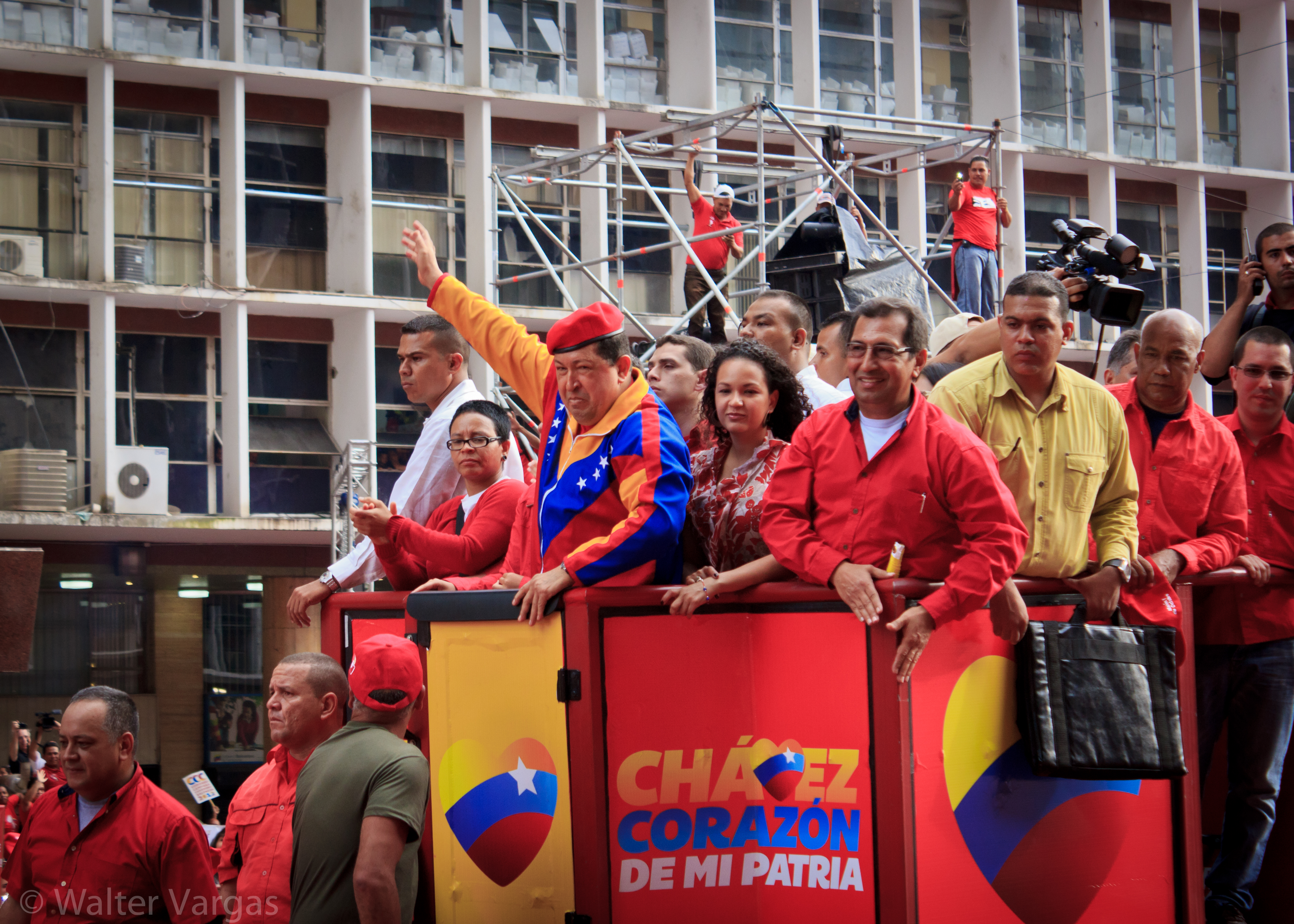
Chávez lost the referendum.[21] However, in 2009, he revisited the possibility of reelection, with a twist. The 2009 referendum proposed to amend Articles 160, 162, 174, 192, and, of course, 230, permitting indefinite reelections for not only the president, but for governors, legislative deputies, and mayors. This strategy obscured the amendment’s dictatorial nature by distributing the removal of term limits to lower-level officials as well.[22] When announcing the amendment referendum proposal in 2008, his audience started to shout the later popular Chavista slogan “Chávez is not leaving!” (“¡Uh! ¡Ah! ¡Chávez no se va!”)[23] The referendum succeeded with 54.84 percent of the popular vote.[24] Allan Brewer Carias, a legal professor and former Venezuelan opposition legislator, told the New York Times a few days after the referendum results that the key to the success of the referendum was in the language of the question: “He didn’t ask the people, ‘Do you want all elected officials to be elected in a continuous, indefinite, and permanent way?’ (…) the question was, ‘Do you want to expand the political right of the citizens as a whole?’”[25] The referendum was successful for Chávez, and to this day, the 2009 Amendment remains as the only change to the Constitution of 1999, showcasing a hidden dictatorial agenda that permits indefinite reelections for any existing officials or candidates.
The Constitution of 1999 represented a radical change from the “oligarchal” Puntofijismo of late 20th-century Venezuela. Chávez’s “Bolivarian Revolution” rhetoric seemed to invite massive participation of the Venezuelan people. With it, constitutional law proved malleable. Chávez failed to implement rapid socialist principles in 2007, but by 2009, he convinced more than half of voting Venezuelans that unlimited term limits for not only the president, but lower-level officials, was necessary for the success of the Bolivarian Revolution. Chávez’s death from colorectal cancer in 2013 caused enough empathy from his supporters to vote for his vice-president, Nicolás Maduro Moros, that same year. Maduro led a constitutional crisis in 2017 and won reelection in the elections of 2019 and 2024, the latter of which was contested globally for fraud, doubtlessly due to the National Electoral Council’s inclusion in the government’s structure.[26] The legitimation of an indefinite reelection in constitutional law opened the doors to a dictatorial regime. Indeed, after a quarter century, Chavismo is alive and well even when its leader is dead and his successor is in U.S. custody. As long as the Constitution of 1999 and 2009 Amendment remain, any Chávez successor could be reelected indefinitely.

Figure 3 “¡Uh! ¡Ah! ¡Chávez no se va!” Slogan (Uh! Ah! Chávez is Not Leaving!) towards the 2009 referendum. Source: Havana Times, https://havanatimes.org/photo-feature/pro-chavez-caracas-rally-in-pictures/
Claudia Suárez is a History PhD Student History at the University of Florida under the guidance of Dr. Lillian Guerra and Dr. Seth Bernstein studying Latin American and Soviet Histories. Her research focuses on ballet history during the Cold War.
Further Readings:
Cannon, Barry. Hugo Chávez and the Bolivarian Revolution: Populism and Democracy in a Globalised Age. Manchester City Press, 2009.
Caroll, Rory. Comandante: Hugo Chávez’s Venezuela. The Penguin Press, 2013.
De la Torre, Carlos. “Hugo Chávez and the diffusion of Bolivarianism.” Democratization 24, no. 7 (2017): 1271–1288.
Garcia-Serra, Mario J. “The ‘Enabling Law’: The Demise of the Separation of Powers in Hugo Chavez’s Venezuela.” The University of Miami Inter-American Law Review 32, no. 2 (2001): 265–93.
Gonzalez, Mike. Hugo Chávez: Socialist for the Twenty-First Century. Pluto Press, 2014.
Gott, Richard. Hugo Chávez and the Bolivarian Revolution. Verso, 2005.
Endnotes:
[1] Hugo Chávez Frías, “Alocución de Chávez 03 de Dic 2007 sobre La Reforma, después de los Resultados del CNE” by Chávez, Su Legado y su Historiografía, YouTube, 44:22, https://www.youtube.com/watch?v=8w51LUQayyg
[2] Raanan Rein, “From Juan Perón to Hugo Chávez and Back: Populism Reconsidered,” in Shifting Frontiers of Citizenship: The Latin American Experience, ed. Mario Sznajder, Luis Roniger and Carlos Forment (Brill, 2013), 302–303.
[3] “¡Así se fraguó la Revolución!” Momento, January 31st, 1958, Biblioteca Digital Rafael Caldera, accessed February 15, 2026, https://rafaelcaldera.com/dossier-puntofijo-revista-sic-2024/; and “Firmas del Pacto de Puntofijo, tomado de la Revista Élite, número 1.728, del 8 de noviembre de 1958,” in “Debemos volver a la interpretación justa y cabal del Pacto de Puntofijo,” Biblioteca Digital Rafael Caldera, accessed February 15, 2026, https://rafaelcaldera.com/puntofijo/
[4] BitBlioteca, “Pacto de ‘Punto Fijo’, 1958.” Web Archive, accessed January 24, 2026. https://web.archive.org/web/20051224171045/http://www.analitica.com/bitblioteca/venezuela/punto_fijo.asp
[5] “Constitución de la República de Venezuela de 1961. 23 de enero de 1961,” Artículos 113 y 114, accessed on February 15, 2026, https://data.globalcit.eu/NationalDB/docs/Venezuela_Constitution%201961.pdf ; and Lionel Muñoz Paz, “Destellos y Penumbras de la Democracia Representativa, 1958–1998,” in Chavismo: Entre la Utopía y la Pesadilla, ed. Alejandro Cardozo Uzcátegui (Editorial Nuevos Aires, 2012), 85.
[6] José Rodríguez Iturbe, “El Nudo Gordiano del Chavismo,” in Chavismo: Entre la Utopía y la Pesadilla, 61; and Barry Cannon, Hugo Chávez and the Bolivarian Revolution: Populism and Democracy in a Globalised Age (Manchester City Press, 2009), 37.
[7] “Venezuela Crushes Army Coup Attempt,” New York Times, February 5, 1992; and Hugo Chávez Frías, “Intento fallido de golpe de estado de Hugo Chávez en 1992,” published January 2, 2013 by RTVE, YouTube, 0:16. https://www.youtube.com/watch?v=d6jMP_TYgS8
[8] Carlos De la Torre, “Hugo Chávez and the diffusion of Bolivarianism,” Democratization 24, no. 7 (2017): 1272; and Kristina Marcano and Alberto Barrera Tyszka, Hugo Chávez: The Definitive Biography of Venezuela’s Controversial President (Random House, 2007), 214–215.
[9] Muñoz Paz, “Destellos y Penumbras,” 19–20.
[10] Hugo Chávez Frías, “Juramentación de Hugo Chávez como Presidente el 2 de Febrero de 1999,” published February 1, 2017 by Radio Nacional de Venezuela, YouTube, 3:08, https://www.youtube.com/watch?v=Osy78SQ7Zug. For the electoral statistics, see Richard Gott, Hugo Chávez and the Bolivarian Revolution (Verso, 2005), 139.
[11] Hugo Chávez Frías, “Discurso del Presidente Constitucional de Venezuela, Comandante Hugo Chávez Frías en el Acto de Toma de Posesión en el Congreso Nacional de la República, el día 2 de Febrero de 1999,” in Seis Discursos del Presidente Constitucional de Venezuela Hugo Chávez Frías (Ediciones de la Presidencia de la República, 2000), 7–20.
[12] De la Torre, “Hugo Chávez and the diffusion of Bolivarianism,” 1273.
[13] De la Torre, “Hugo Chávez and the diffusion of Bolivarianism,” 1272; and “‘Penitencia sobre la Integración Latinoamericana y Caribeña: Alternativa Bolivariana para Las Américas (ALBA)’ Desde el Palacio Legislativo Bicameral, Asunción, Paraguay, 20 de junio de 2005” in Hugo Chávez Frías, La Unidad Latinoamericana, edited by Sergio Rinaldi (Ocean Sur: 2006), 119–127.
[14] Gobierno Bolivariano de Venezuela, Constitución de la República Bolivariana de Venezuela 1999, Título V, Capítulo IV y Capítulo V, 97–105.
[15] “Constitución Política de la República Bolivia del 06 de Noviembre de 1826,” Tribunal Constitucional Plurinacional, accessed February 15, 2026, http://www.dircost.unito.it/cs/docs/Bolivia%201826.htm.
[16] “Constitución de la República de Venezuela de 1961. 23 de enero de 1961”, Artículos 135 y 185,; and Gobierno Bolivariano de Venezuela, Constitución de la República Bolivariana de Venezuela 1999, Artículo 230.
[17] Hugo Chávez Frías, “Discurso con motivo del reconocimiento del Ejecutivo Nacional al carácter originario de la Asamblea Nacional Constituyente y entrega de Propuestas para la nueva Constitución, 5 de Agosto del 1999,” in Hugo Chávez: La Construcción del Socialismo del Siglo XXI: Discursos del comandante supremo ante la Asamblea Nacional, 1999-2012, vol. I, ed. Karen Quintero Franquiz (Fondo Editorial de la Asamblea Nacional Willian Lara, 2013), 57. See also Hugo Chávez Frías, “Discurso del Presidente Constitucional de Venezuela (…) el día 2 de Febrero de 1999,” 13 and 17.
[18] Larry Rohter, “Venezuela’s New Leader: Democrat or Dictator?” New York Times, April 10, 1999.
[19] Asamblea Nacional de la República Bolivariana de Venezuela, “Reforma de la Constitución de la República Bolivariana de Venezuela” November 2, 2007; Proposed revision to Article 230, Web Archive (Consejo Nacional Electoral), accessed on February 15, 2026, https://web.archive.org/web/20080216050740/http://www.cne.gov.ve/elecciones/referendo_constitucional2007/documentos/Reforma.pdf
[20] Cannon, Hugo Chávez and the Bolivarian Revolution, 59 and 255.
[21] Political Database of the Americas, “Bolivarian Republic of Venezuela: Electoral Results, ‘Constitutional Reform Referendum Results, December 2, 2007,’” accessed February 21, 2026, https://pdba.georgetown.edu/Elecdata/Venezuela/ref07.html
[22] Asamblea Nacional de la República Bolivariana de Venezuela, “Enmienda N. 1 de la Constitución de la República Bolivariana de Venezuela,” Feb. 15, 2009. Revision of Articles 160, 162, 174, 192, and 230.
[23] Hugo Chávez Frías, 2008 Year of Revision, Rectification and Re-Impulse of the Bolivarian Revolution, 113.
[24] Political Database of the Americas, “Bolivarian Republic of Venezuela: Electoral Results, ‘Constitutional Amendment Referendum Results, February 15, 2009,’” accessed February 21, 2026, https://pdba.georgetown.edu/Elecdata/Venezuela/ref09.html
[25] Allan Brewer Carias in Bernard Gewrtzman, “Interview: Referendum in Venezuela Hardens Chavez’s ‘Authoritarian Regime,’” New York Times, February 18, 2009, https://archive.nytimes.com/www.nytimes.com/cfr/world/slot2_20090217.html
[26] Catherine E. Shoichet, “Hugo Chavez’s political heir Nicolas Maduro named Venezuela’s president-elect,” CNN, April 16, 2013, https://www.cnn.com/2013/04/15/world/americas/venezuela-elections ; “Venezuela’s Descent Into Dictatorship,” New York Times, March 31, 2017; Rafael Romo, “Venezuela’s high court dissolves National Assembly,” CNN, March 30, 2017, https://edition.cnn.com/2017/03/30/americas/venezuela-dissolves-national-assembly/ ; José Ignacio Hernández G., “Venezuela’s Presidential Crisis and the Transition to Democracy,” Center for Strategic and International Studies (CSIS), 2019; Congressional Research Service, “Venezuela’s 2024 Presidential Election,” August, 2, 2024, https://www.congress.gov/crs_external_products/IN/PDF/IN12354/IN12354.2.pdf
Leave a Reply