By Aran MacKinnon
Anyone interested in broadening the scope of teaching about the Age of Revolutions should explore the compelling stories of state formations in southern African history and historiography. Among these, perhaps the best known are the narratives about the formation and expansion of polities and identities commonly associated with the Xhosa chiefdoms of the eastern Cape and the rise of the Zulu kingdom and its founder, Shaka kaSenzangakhona. Despite seeming to appear on the fringes of the late eighteenth and early nineteenth-century Atlantic world, southern Africa and the Zulu kingdom provide a unique opportunity to expand the geographic framing of the revolutionary era. They also allow a critical examination of the discourses that shaped the way Europeans and Africans saw themselves and each other during this period. By including Southern Africa in teaching the era, we can illustrate how European political and religious practices as well philosophical ideals were refracted through imperial encounters and colonial projects. This yields a more inclusive curriculum of how revolutionary ideas worked across the fault lines of race, class and ethnicity beyond Europe.

Sketch of King Shaka (1781 – 1828). Attributed to James King, it appeared in Nathanial Isaacs’ “Travels and Adventures in Eastern Africa” (1836).
The European gaze and epistemologies that shaped historical identities throughout the Atlantic world also impinged on southern African states and societies albeit in unexpected ways. Through missionary endeavors, settler farmers and post-enlightenment evangelicals had a profound impact on the ways white people in the metropoles perceived Africans, and how Africans came to see themselves. Thus, teaching about the era from perspectives that may have appeared in Europe to be on the periphery of the major historical impulses of the times also allows students to grapple with the unevenness of the spread of revolutionary ideas and the inconsistencies of historical change. As Africa and Africans looked back at and responded to European intrusions and ideals, they shaped the era and Europe.
Untethering the revolutionary era from the north Atlantic allows for an analysis of the ideals of democracy and inclusion so often associated with the privileged domains of western Europe and its allied cultures. By teaching about African identities during this period, we can better problematize the dominant narratives that persist in crude, reductionist and essentializing perspectives held captive by the terms such as “slave” and “tribe” and show how race and racism became defining features of the colonial projects with the expansion of revolutionary-era imperialist merchant and industrial capitalism.

Map of Zululand, Source: britishempire.co.uk
South Africa was an important part of the Atlantic world through the Age of Revolutions. By the mid-17th Century, the Dutch East India Company claimed an entrepot in Table Bay and penetrated the South African interior through the 1700s from their fort in Cape Town. Hailed as the “Tavern of the Seas,” Cape Town hosted successive waves of Europeans as they mixed with, and in turn came to rely on, dominate and then exploit indigenous societies.[1] Calvinist Dutch and Huguenot refugee settlers imposed a hierarchal and segregated society based on religious and racial categories and introduced slavery as with other colonies in the Atlantic world while whalers began plundering the southern oceans from bases in the Cape. Then, the shockwave of revolutions in France and Haiti reached South Africa. Following Napoleon Bonaparte’s defeat, the allied Dutch lost the Cape to Britain by 1805, and the rising tide of abolition, evangelical Christian missions, and British settlers swept onto the shores of South Africa.
In this context, five major developments illuminate the revolutionary era. First, the complex processes of state formation in southern Africa, centered on the Zulu kingdom, illustrate a fascinating interplay of external forces such as trade and military conflict alongside internal dynamics related to social stratification and the consolidation of ethnic identities. Second, situating the processes of abolition, environmental impacts, migration, and European settlement in the wider context that includes South Africa enhances our understanding of the continuities and contrasts of the era through diverse places and peoples. Third, the changing strategies of military conflict among Europeans and Africans shaped emergent polities and their legacies in a world so terribly defined by race and class. Next, debates about essentialized identities in South Africa resonate with wider Atlantic world tensions over settler colonialism and perceptions of Blacks in the African diaspora. Finally, critical features of revolutionary-era monarchy and nationalism in South Africa provided powerful legacies for later political projects associated with the modern nation state. Some of the highlights follow here.
Perhaps no story about a historical figure better illustrates the value of looking to southern Africa than those of Shaka. He has been credited not only with the founding the Zulu (The People of Heaven) kingdom but also, in a deeply problematized historiography, as the “Napoleon” of Africa, a clearly familiar revolutionary-era identity. Indeed, historians have shown that the cultivation of legends associated with Shaka’s strategic genius and Zulu martial culture by settlers, colonial administrators and Zulu leaders themselves stoked a paranoid imagination that associated Africans with violence and helped justify colonial conquest and segregation.[2] The legends manufactured variously by missionaries, imperial politicians, historians, and Zulu nationalists of Shaka’s military and political prowess are comparable to similar cases in the Atlantic world including Bonaparte, Simon Bolivar and George Washington. As a legendary figure, Shaka’s story fits well with the revolutionary ideals associated with heroic men who forged nations.
Although often described as a tyrannical king, Shaka had to rule with both consent and coercion. Historians have shown that, as with other African leaders, in a context where land was abundant and people were fewer than in more densely packed Europe, holding onto labor was more consequential for African leaders and so, in ways comparable to emergent democracies, inclusive processes of governance tended to prevail. Shaka and the Zulu also illustrate a significant historiographical debate about the making of African identities in a colonial context and the ways in which European perceptions of African political power and the use of military violence came to be associated with white fears of Black societies. By tracing the historiography surrounding the series of events and processes associated with the concept Mfecane (a contested term of uncertain origin often transliterated as “the crushing’), we can see how the post-colonial historian, John Omer-Cooper, sought to celebrate the military and political genius of Africa’s “Napoleon.” He credited Shaka with driving conflicts that set the foundation for most of the major states that emerged in southern Africa in the first half of the 19th century. This narrative, intended as a celebration of African agency, was an important counterweight to the dominant Euro-centric views of Africa encapsulated by Hugh Trevor Roper’s myopic claim that “Africa had no history.” Julian Cobbing then offered a scathing indictment of the Mfecane arguing it was a colonist-driven cover-up of settler violence, and he compelled a reappraisal of African and settler agency in revolutionary era state-making culminating in The Mfecane Aftermath.[3]
South Africa hosted various revolutionary-era religions and their syncretic offshoots, generating fascinating paradoxes like the Americas. Among these were European religious justifications for inherently coercive and extractive forms of settler colonialism. These were forged by the emergent Calvinist settlers, and their decidedly hostile views of the French, Haitian and American revolutions. Despite his republican rhetoric, Piet Retief, who led a large party of these Dutch-descended settlers into the interior to escape British rule and abolition, made it clear the loss of slavery was especially vexatious.[4] It was these self-styled republican “Afrikaners” who held counter-revolutionary perspectives that worked against building an egalitarian society. Similarly, the advent of evangelical mission Christianity across the Atlantic had a profound impact on African societies. The missionary enterprise provoked mixed responses from African societies. Some embraced new opportunities to engage codified literacy and print culture through evangelical Christianity, and these later spawned African writing and newspapers. Africans also re-worked features of Christianity into their own beliefs and created millenarian responses to the pressures of settler colonialism comparable to indigenous responses to revolutionary era Christianity in the Americas. Just after the rise of the Zulu kingdom, for example, led by the young prophetess Nongqawuse who invoked a Christian influenced irredentist vision of a restored pre-colonial society, Xhosa chiefdoms in the Eastern Cape succumbed to a calamitous purge of diseased cattle in an ill-fated millenarian movement.[5]
For military historians, the projection of power through violence in this era and the rise of southern African states intertwined with settler colonialism provide rich material. As with elsewhere in the Atlantic world, dominant groups such as Dutch-descended settlers who after the 1820s fled British rule into the interior, still used coerced labor in various forms in post-slavery South Africa, adding to a violent and unsettled hinterland. Africans responded often with militarized social formations that demonstrated the importance organized armies played in fostering belonging and citizenship. Access to revolutionary-era technologies such as firearms, moreover, enabled Africans and settlers alike to wield power, to connect to global trade, and to forge defensive social formations such as military states.

Reception of the Zooloos for Chaka. Nathaniel Isaacs, Travels and Adventures in Eastern Africa (E. Churton Publishers, 1836).
Although previously credited to Shaka alone, military innovations among many southern African leaders show how transformations in their strategy, tactics, use of weapons and the incorporation of vanquished groups all played important parts in the establishment of new states. Following the rise of the Zulu state, contemporary African leaders such as Moshoeshoe (“The Cattle Razor”) developed similar cattle raiding tactics to consolidate the Sotho kingdom, and Mzilikazi embarked on a courageous odyssey to evade fronter violence to establish the Ndebele state. Following these developments, Afrikaner settlers with firearms trekked into the hinterland. They invoked a familiar revolutionary era manifest destiny that combined divine conviction with claims to “empty lands” and a military tactic, the defensive laager (a form of circled wagons). This proved especially effective against the military strategies of African leaders who sought to forestall the colonial incursions.
While Jacob Ivey has shown in this journal the importance of the Shaka’s infamous iklwa, stabbing spear, cowhide shield and pincer formations for the Zulu, these could not meet the technological challenges of the revolutionary era.[6] In patterns similar to Native American adaptations of firearms, across the porous South African frontier, African and multiethnic militia groups such as the Bergenaars dominated the unsettled interior through their use of guns.[7] Although Shaka’s successor, Dingane, had hoped to fend off the Afrikaners who arrived in his midst by murdering Piet Retief and his party, the Zulu were undone by other settlers in 1838 at the Battle of Blood/Ncome River. There, a tiny party of some four hundred trekkers exacted heavy casualties of some three thousand warriors and dispatched a Zulu army of possibly ten thousand or more from behind a laager with canon and muskets.[8]

Unknown artist’s impression, ‘The Battle of Blood River,” (c. 1838)
In a more macabre dimension, violent conflicts in southern Africa echoed the triumphalist trophy-taking cultures of European revolutionary-era military men who excised body parts -ears, heads, genitalia- and absconded with them as talismans of victory and power. As in the Americas, combatants on all sides sought advantage by appropriating disembodied symbols to bolster themselves and demoralize adversaries.[9] From the taking of the Xhosa chief Hintsa’s head in 1835, through the evisceration of Zulu rebels to Lord Baden Powell’s adoption of Zulu iziqu beads as a feature of the Boy Scout uniform, the British especially persisted in revolutionary era appropriations of indigenous symbols of power.[10] By considering these practices in South Africa, we can question the motives behind them, and the extent to which the repatriation of such trophies could serve as a form of restorative justice.
Southern African history thus provides an exceptionally well-developed range of stories and resources related to the revolutionary era that can significantly add to the field of study. There is a robust historiography that encompasses the entire period from post-enlightenment European expansion in the Atlantic world through the rise of empires to emergence of post-enlightenment and revolutionary era state formation and religious syncretism. All worth a look.
Aran S. MacKinnon is a professor of history, and former chair of the Department of History and Geography at Georgia College. He is the author of Nelson Mandela. A Reference Guide to His Life and Works (Rowman and Littlefield, 2020), The Making of South Africa. Culture and Politics (Pearson 2004, Second Edition, 2012), co-editor with Elaine MacKinnon of Places of Encounter, Time, Place and Connectivity in World History, Volumes 1 and 2 (Westview, 2012) and co-author of An Introduction to Global Studies (Wiley-Blackwell, 2010) as well as numerous articles on South African history in various scholarly journals.
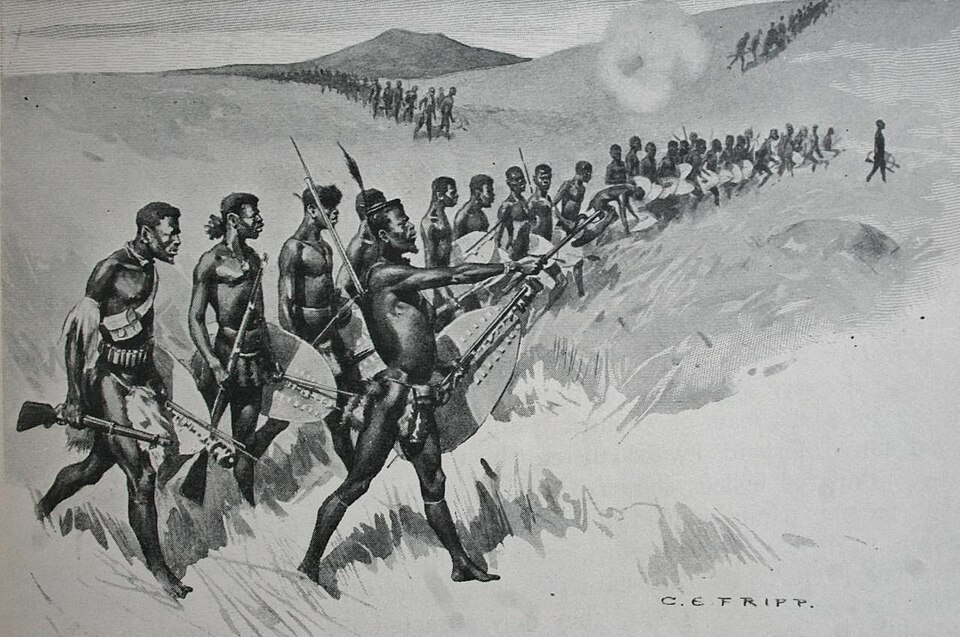
Title Image: Zulu régiment in attack formation at Isandlwana. By Charles Edwin Fripp.

Further Readings:
Carton, B, Laband, J. and J. Sithole. Zulu Identities. Being Zulu, Past and Present. Hurst, 2008.
Eldredge, E. The Creation of the Zulu Kingdom, 1815-1828: War, Shaka, and the Consolidation of Power. Cambridge University Press, 2014.
Elphick, R. and Davenport, R, Christianity in South Africa: A Political, Social, and Cultural History. University of California Press, 1997.
Etherington, N. The Great Treks. The Transformation of Southern Africa, 1815-1854. Longman, 2001.
Hamilton, C. Terrific Majesty. The Powers of Shaka Zulu and the Limits of Historical Invention. Harvard University Press, 1998.
MacKinnon, A. The Making of South Africa. Culture and Politics. 2nd Edition. Pearson, 2012.
Endnotes:
[1] Aran MacKinnon,‘”Cape Town: At the Cross-Currents of the Atlantic and Indian Ocean Worlds (1500-1800)” in Aran Mackinnon and Elaine McClarnand MacKinnon, Places of Encounter, Volume 2. Time, Place, and Connectivity in World History, Volume Two: Since 1500 (Routledge, 2012), 1-17
[2] See variously, J.D. Omer-Cooper, The Zulu Aftermath. A Nineteenth-Century Revolution in Bantu Africa, (Northwestern University Press, 1966); Julian Cobbing, “The Mfecane as Alibi: Thoughts on Dithakong and Mbolompo,” The Journal of African History 29, no. 3 (1988): 487–519; and C. Hamilton et al, The Mfecane Aftermath: Reconstructive Debates in Southern African (Wits University Press, 1995)
[3] Hugh Trevor Roper, The Rise of Christian Europe, (Harcourt, Brace and World, 1965); History (New York University Press, 1995), 14.
[4] Piet Retief, Manifesto of the Emigrant Farmers, 1837. https://sahistory.org.za/archive/manifesto-emigrant-farmers-piet-retief-1837
[5] See Jeffery B. Peires The dead will arise: Nongqawuse and the great Xhosa cattle-killing movement of 1856-7. Indiana University Press, 1989. and Sheila B. Davies, “Raising the dead: the Xhosa cattle-killing and the Mhlakaza-Goliat delusion.” Journal of Southern African Studies 33, no. 1 (2007): 19-41.
[6] Jacob Ivey, “Born out of Shaka’s spear’: The Zulu Iklwa and Perceptions of Military Revolution in the Nineteenth Century,” Selected Papers of the Consortium on the Revolutionary Era (2020). https://www.revolutionaryera.org/2020-selected- papers-of-the-consortium-on-the-revolutionary-era-17501850
[7] See William Storey’s insightful Guns Race and Power in Colonial South Africa (Cambridge University Press 2012)
[8] Clinton D. van der Merwe, “Contested Heritage (s)–The Case (s) of the Battle of Blood River (December 16 th, 1838), Dundee and Nquthu, South Africa.” Modern Geográfia 19, no. 2 (2024).
[9] Richard J. Chacon and David H. Dye, “Introduction to Human Trophy Taking: An Ancient and Widespread Practice,” In The Taking and Displaying of Human Body Parts as Trophies by Amerindians (Boston: Springer US, 2007), 5-31.
[10]See S. Shula Marks, “Rewriting South African History or the Search for Hintsa’s Head,” 7th Annual Bindoff Lecture, (University of London Publications, 1996); D.A. Webb, War, Racism, and The Taking Of Heads: Revisiting Military Conflict in the Cape Colony and Western Xhosaland in the Nineteenth Century,’ The Journal of African History, 56, no. 1 (2015): 37-55; J.J. Guy, “Imperial Appropriations – The Dynamic History of iziqu,” Natal Museum Journal of Humanities, 11, (Dec. 1999): 23-42; and Simon J. Harrison, “Skulls and Scientific Collecting in the Victorian Military: Keeping the Enemy Dead in British Frontier Warfare.” Comparative Studies in Society and History 50, no. 1 (2008): 285-303.
Leave a Reply