By Charles Edward Andrew Lincoln IV
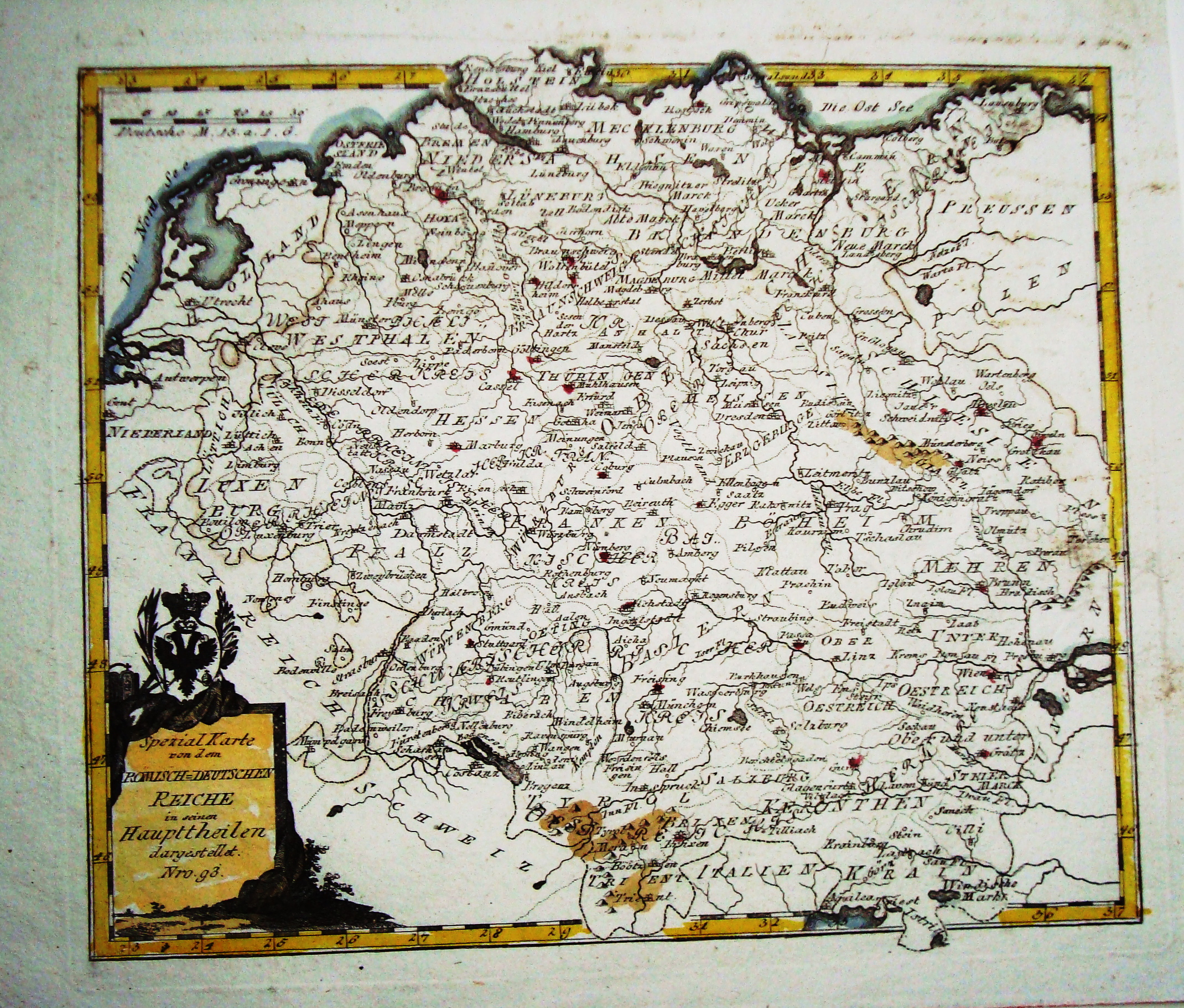
A map of the Holy Roman Empire near the end of the eighteenth century does not resemble a modern national map of Europe. Its surface breaks into electorates, duchies, bishoprics, counties, free cities, and other territories. Rivers cross the colored boundaries with deceptive ease. A merchant or boatman could follow the water, but the journey carried him through a succession of governments, toll stations, market rules, and local privileges. For American constitution-makers, this fragmented landscape offered evidence rather than a blueprint. Alexander Hamilton and James Madison reasoned comparatively from historical experience. European constitutions showed how divided authority had operated in practice without supplying models for American imitation.
This was the Europe that Hamilton and Madison asked Americans to imagine during the debate over the Constitution. Their references to Germany, which are essentially references to the Holy Roman Empire, and the Netherlands in The Federalist were not ornamental displays of learning. They were warnings drawn from the political history of composite states. The American Revolution had secured independence from Britain, but independence alone did not answer a harder question. How could thirteen states preserve their local authority without turning their borders into instruments against one another? Under the Articles of Confederation, Congress possessed no effective general power to regulate commerce. States could pursue their own policies, and neighboring governments could retaliate.
The urgency was visible before the Philadelphia Convention met. In 1786, commissioners gathered at Annapolis to consider whether a uniform system of commercial regulation was necessary for the states’ common interest and permanent harmony. Only five states sent delegates, so the meeting produced no commercial settlement. It did, however, help set the next convention in motion. By invoking the states’ “common interest and permanent harmony,” the commissioners framed commercial regulation as a condition of political union, not merely as a question of revenue. It had become a question about whether the union formed during the war could survive the peace.2
Americans had rebelled against an empire that taxed and regulated them from across the Atlantic Ocean. Their demand for stronger federal authority over commerce did not abandon that revolutionary objection, but it rested on a different source of legitimacy. In The Federalist No. 39, Madison explained that the Constitution would be founded on “the assent and ratification of the people of America,” with the assent of each state derived from “the authority of the people themselves.” The proposed federal government would exercise authority conferred by the people of the states, not authority imposed by a distant imperial legislature. The danger in 1787 was not only that government might become too powerful. It was also that public power would remain so divided that every state could impose costs on its neighbors while denying responsibility for the whole.

Alexander Hamilton and James Madison, National Review
Hamilton gave this danger a European geography. In The Federalist No. 22, he pointed to the Holy Roman Empire, where commerce remained in “continual trammels” because princes and states imposed duties on merchandise crossing their territories. Its rivers connected distant places, but the authorities positioned along them repeatedly interrupted that connection. Hamilton warned that, without national control, conflicts among American state regulations might eventually cause the citizens of each state to be treated by the others as “foreigners and aliens.”
Seen from the river, political fragmentation became tangible. A boat could remain on the same waterway while passing through a succession of territories, each possessing its own toll rights, limited added tolls on goods passing from one canton to another. Imperial law in Germany required common approval before princes and states placed tolls on bridges, rivers, or passages. The Union of the Netherlands restrained members from imposing charges harmful to their neighbors without general permission.3

The Union of Utrecht in 1579. Illustration by J.H. Eichman & H. Altmann, 1856
The Dutch example deserves closer attention. Madison was referring to the Union of Utrecht, the compact of 1579 that helped bind together provinces in revolt against Spanish rule. The Union preserved provincial rights and privileges, but Article XVIII placed a limit on fiscal self-interest. No province, town, or member could introduce taxes or convoy charges that injured the others without common agreement. It also stated that allies could not be taxed more heavily than a province’s own inhabitants.4
This was not a modern constitution for a unitary state. The Dutch Republic remained a negotiated association of provinces, cities, institutions, and privileges. That is precisely why the provision mattered. Its members were not equal in practical influence. Holland possessed disproportionate commercial and financial weight within the Union. Article XVIII mattered because provincial independence could become economic leverage. A member controlling important routes, ports, or markets could use its fiscal powers to extract advantages from its allies. Political union therefore required more than military cooperation. It also required restraints preventing internal boundaries from becoming instruments of provincial power.5
The Dutch case also widened the historical horizon of the American debate. The usual Atlantic story links the United States to Britain, France, and the classical republics. Madison’s citation points toward an older northern European revolt and a confederation born two centuries before Philadelphia. He treated that experience as available political knowledge. The revolutionary past was not a sequence of isolated national stories. It was an archive of experiments in resistance, union, and the division of power.
Article XVIII was also a product of revolution. The provinces that entered the Union of Utrecht were defending inherited liberties against a ruler they believed had violated them. Yet their own freedom created a new problem. Once authority was dispersed, each member possessed opportunities to exploit routes, ports, and markets needed by its allies. Article XVIII joined two commitments that were not always easy to reconcile. It protected local rights while insisting that local power could not be exercised in a way that prejudiced fellow members.
The German evidence behind Hamilton and Madison’s warning is equally revealing. The Holy Roman Empire was not a single national government. It contained many kinds of political communities whose powers overlapped and varied. A traveler might pass from a prince’s territory into an imperial city, cross a bridge subject to one charge, enter a market governed by another rule, and encounter a river toll claimed under an old privilege.
Imperial law repeatedly attempted to control these exactions. The electoral capitulation accepted by Joseph II in 1764 devoted extensive attention to tolls and trade. It addressed charges at gates, bridges, roads, markets, warehouses, and river passages. It condemned unauthorized tolls that injured neighboring territories, their subjects, and their merchants. The detail of the rule is itself evidence of the problem. Governments do not draft elaborate restrictions for an abuse that no one encounters.6
Administrative records make the human traffic behind these constitutional complaints visible. Toll books from stations along the Rhine and Waal recorded vessels, cargoes, direction of travel, payments, and sometimes the names and residences of skippers. One route between the German lands and Dordrecht could expose a timber shipment to a long succession of tolls. These records concern goods, but cargo did not move alone. Boatmen, haulers, merchants, agents, inspectors, and crews carried it through the jurisdictions marked on the map.7
Work also crossed boundaries. The Imperial Craft Ordinance of 1731 regulated journeymen who traveled in search of employment. A journeyman carried certified credentials, presented them to a guild in the next town, deposited his papers when hired, and recovered them when he prepared to travel again. The ordinance was disciplinary as much as protective. It did not create a free labor market. Still, it assumed that workers would move from one locality to another and that different legal systems needed rules for recognizing their status.8
This world helps explain what Hamilton and Madison believed was at stake in 1787 and 1788. They were not copying a European constitution. The Holy Roman Empire appeared chiefly as a warning, while the Dutch rule appeared as an imperfect effort to prevent confederates from using taxes against one another. Europe supplied a storehouse of constitutional experience.
That comparative, experience-based use of history was characteristic of the revolutionary era.9 Constitution makers did not reason only from abstract first principles. They compared republics, confederacies, empires, ancient examples, and recent failures. Political revolution opened a field of institutional choice, and historical comparison helped define the dangers within it. The Federalist invited its readers to see the proposed Constitution not simply as a new American mechanism, but as an answer to recurring problems of union.10

The Federalist, Library of Congress
The comparison also clarifies an often-overlooked consequence of American independence. The American Revolution removed the colonies from the British imperial system, but it also elevated former colonial boundaries into the boundaries of states. The same victory that freed Americans from imperial regulation risked multiplying internal points of obstruction. The Commerce Clause responded to that paradox. A union of republics needed enough common authority to keep republican independence from hardening into commercial estrangement.
These examples reveal how the constitutional generation understood economic life. Rivers, roads, labor, and markets crossed political lines, while governments situated along those lines could convert passage into advantage. Their European examples do not by themselves establish the later dormant Commerce Clause or decide any present case. Their narrower historical point is more secure. The constitutional generation did not imagine economic life as naturally confined within separate jurisdictions. It knew that rivers, roads, labor, and markets crossed political lines, and that governments situated along those lines could convert passage into advantage.
Return to the old map of Germany and its many borders. Madison saw more than a crowded arrangement of colors. He saw bridges, rivers, markets, toll houses, and travelers. He also saw a warning for a revolution that had won independence but had not yet secured union.
Charles Edward Andrew Lincoln IV is a PhD candidate in international tax law at the University of Groningen and a United States tax attorney. His research examines constitutional history, federalism, mobility, cross-border taxation, and the European sources of American constitutional thought. He is the author of Gods, Judges, and Presidents: Trifunctional Archetypes in American Law and Government (Bloomsbury Academic, 2026).
Title Image: Map of the Holy Roman Empire by Franz Johann Joseph von Reilly, 1791. Public domain via Wikimedia Commons.

Further Readings:
Jonathan I. Israel, The Dutch Republic: Its Rise, Greatness, and Fall, 1477–1806 (Oxford University Press, 1995).
Jack N. Rakove, Original Meanings: Politics and Ideas in the Making of the Constitution (Alfred A. Knopf, 1996).
Peter H. Wilson, Heart of Europe: A History of the Holy Roman Empire (Belknap Press of Harvard University Press, 2016).
E. H. Kossmann and A. F. Mellink, eds., Texts Concerning the Revolt of the Netherlands (Cambridge University Press, 1974).
Joseph J. Ellis, The Quartet: Orchestrating the Second American Revolution, 1783–1789 (Alfred A. Knopf, 2015).
Barbara W. Tuchman, The First Salute: A View of the American Revolution (Alfred A. Knopf, 1988).
Thomas E. Ricks, First Principles: What America’s Founders Learned from the Greeks and Romans and How That Shaped Our Country (Harper, 2020).
Endnotes:
1. Alexander Hamilton, The Federalist No. 22, December 14, 1787, Founders Online, National Archives.
2. Address of the Annapolis Convention, September 14, 1786, Founders Online, National Archives.
3. James Madison, The Federalist No. 42, January 22, 1788, Founders Online, National Archives.
4. Union of Utrecht, article XVIII, January 23, 1579, in E. H. Kossmann and A. F. Mellink, eds., Texts Concerning the Revolt of the Netherlands (Cambridge University Press, 1974), 171.
5. Jonathan I. Israel, The Dutch Republic (Oxford University Press, 1995), 276-306.
6. Wahlkapitulation Josephs II, article VIII, March 27, 1764, in Wolfgang Burgdorf, ed., Die Wahlkapitulationen der römisch deutschen Könige und Kaiser 1519 bis 1792 (Vandenhoeck and Ruprecht, 2015), 575-583.
7. Leendert van Prooije, Toll Stations Along the Great Rivers, Viabundus Blog, https://www.landesgeschichte.uni-goettingen.de/roads/viabundus/toll-stations-along-the-great-rivers/, October 25, 2020. See also Utrechts Archief, 221 Kapittel van Sint Marie te Utrecht, inventory entry 1666, toll registers from Schenkenschans, 1630 and 1631.
8. Imperial Craft Ordinance[Reichshandwerksordnung], part II, August 16, 1731, translated by Insa Kummer in German History in Documents and Images, https://germanhistorydocs.org/en/the-holy-roman-empire-1648-1815/ghdi:document-3604.
9. Jack N. Rakove, email to author (Aug. 12, 2023) (on file with author) (describing many eighteenth-century figures as “deeply empirical thinkers”).
10. Jack N. Rakove, Original Meanings (Alfred A. Knopf, 1996).
Leave a Reply