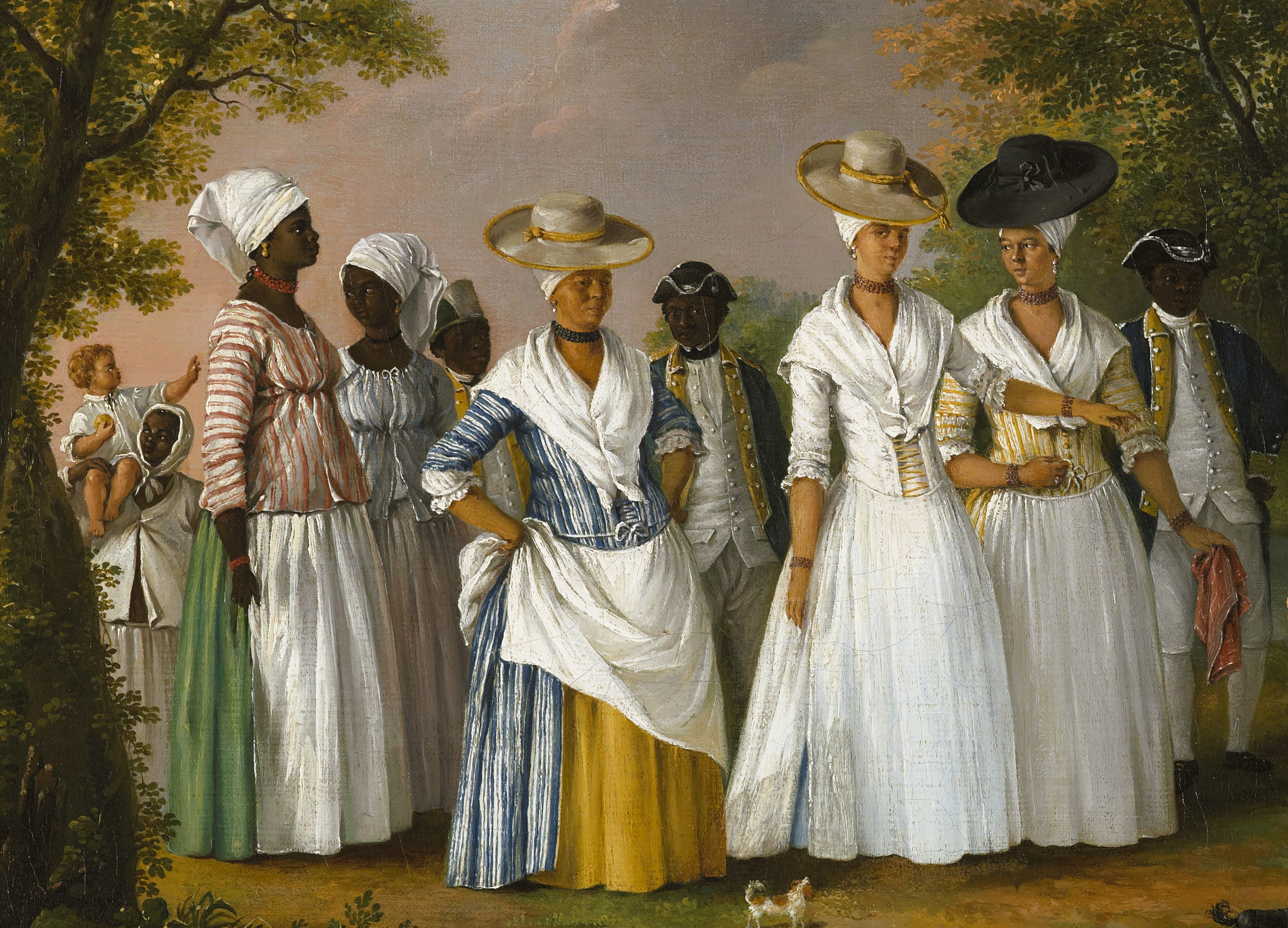
By Robert D. Taber
Dress and grooming standards are often political. In the contemporary United States, this ranges from Sikhs in the US military advocating to wear turbans as part of their uniform to efforts to pass the Creating a Respectful and Open World for Natural Hair (CROWN) Act to ban discrimination against natural hair styles.[1] A recent social media firestorm over Tuskegee University’s new dress code prohibiting students from wearing bonnets or do-rags in the cafeteria and classrooms raised reminders of Spanish Louisiana’s 1786 Tignon Law, which required Black and mixed-race women to cover their hair.[2]
While it is unclear whether colonial Haiti (French Saint-Domingue) had a similar law, white colonists, administrators, and commentators tried to control what women and men of color wore.[3] These efforts formed part of legal and cultural initiatives to sharpen the boundaries between whiteness and enslaveability, to insist to free people of color that their legal status was contingent on white good will, and to reinforce slavery.[4] Particularly at issue was the method women used to obtain fancy clothing, including the mouchoirs or tignons—their headwraps—which were particularly prominent in an era hair where volume and height was a marker of status.[5] Historians have previously offered two explanations; this essay draws on notarized wills to provide a third, in turn highlighting networks that existed among women of color in colonial Haiti, including across the legal boundary between slavery and freedom. The legal savvy they exhibit underscore Black and mixed-race women’s capacity to navigate the public sphere in the years before the Haitian Revolution.
Much of the controversy for elite white men in colonial Haiti was their assumption that women of color gained these headwraps and other fineries through illicit or deceitful means, with the implied use of sex to gain fancy attire.[6] A Swiss naturalist remarked in 1773, “there is nothing more common and to which one pays less attention than the debauchery that subsists between whites and women of color.”[7] After a 1779 sumptuary law went into effect for the entire colony, prohibiting men and women of color from wearing certain types of clothing popular among wealthy whites, the playwright and colonial postman Pierre Ulric Dubuisson criticized the government’s failure to enforce the law, lamenting that young white men had to pay “the insane expenses expected of them by insatiable girls . . . who seek, through their finery, to enhance the darkened charms of their picturesque faces.”[8] Such a depiction presented free women of color as disruptors of colonial order and, as Yvonne Fabella puts it, “fleecers of white men.”[9]
The question of origins and legitimacy matters because of the emphasis the French colonial state placed on the “orderly” family, meaning the patriarchal household. Julien Raimond, a free man of color from colonial Haiti, famously turned this sumptuary law against the administration by attesting that colonial officials grabbed free women of color as they left church, stripping them of their clothing and leaving them almost naked in the town square—an example likely chosen by Raimond because it could draw on ideas of sentimentality and need for protection that white French men held toward elite white women.[10] The Abbé Henri Grégoire picked up this story for a pamphlet he published in support of rights for free people of color in late 1789, playing into patriarchal norms to shock the conscience of the French public.[11]
Enslaver and jurist Médéric Louis Élie Moreau de Saint-Méry similarly described how enslaved women of color put “all of their glory and joy” into having lots of clothing, especially headwraps. In an extended passage, he detailed how enslaved women would lend clothes to one another, convince gullible men to purchase fancy cloth for them, and take great joy in wearing matching (fancier) outfits while attending festive occasions.[12] He observed how these friendships were unstable, a fact he did not blame on race or condition of servitude, but rather on how “women’s friendship is like water in a basket.”[13]
In contrast to these colonial commentators, Haitian historian Jean Fouchard, writing in the mid-20th century about enslaved women, argued that anything above “tatters and rags” were purchased after selling foodstuffs, baskets, or cords enslaved women had sacrificed sleep to produce themselves.[14] The ownership of finer pieces of clothing was therefore legitimate because it came from the dint of one’s agricultural or textile labor.
This article draws on analysis of over 2,000 notarial records from colonial Haiti’s West Province to point to a third way free andenslaved women received clothing: as part of an inheritance. Examining wills highlights the networks between women of color, belying Moreau de Saint-Méry’s dismissal of women’s friendships.[15]


Clarite, a young free woman of color living in 1770s Léogane, Saint-Domingue’s former capital, got to know Françoise Calar. Calar was a fixture in Léogane’s free community of color, matriarch of the free Black Brioché family.[16] When asked by the notary, Calar explained that she had been born to free Black parents on St. Croix years before and she was now 90 years old. Calar trusted implicitly François, a man forty years her junior, and appreciated the work he had performed while enslaved to her, enough that she wanted him freed. But she had also saved some money and had taken a liking to Clarite. And so Clarite not only received a mahogany bureau and a large enough share in Calar’s estate to purchase a 12-year-old boy or girl (about 1,200 livres de Saint-Domingue), but also all Calar’s headwraps. By contrast, Calar gave her own brother only 100 livres.[17] We do not know if Clarite ever donned Calar’s headwraps, or thought of her stories when she did so, but it is likely that seeing them invoked some memories.
Headwraps also passed from free women of color to enslaved women and girls. Such was the case for two seven-year-old girls, growing up bound to Anne Marie de Louches, a mixed-race woman who was the widow of a white enslaver and landowner. They were now going to be enslaved to Anne Marie’s son François. François knew that a few years in, once the girls reached puberty, he was to present each of them with a mare of their choice from his mother’s estate, along with one dozen headwraps each.[18]
As both Moreau de Saint-Méry and Fouchard acknowledge, enslaved women in the older, more populated parishes of Saint-Domingue were more likely to have at least a few items of clothing in their personal possession considered nicer than the “tattered rages” customarily worn by enslaved people. Such was the case for Louison. Her partner Jean purchased her when her former enslaver passed away. She brought with her thirty-two headwraps and a mahogany armoire in which to keep them.[19]
Sometimes a white lover gave fancy clothes, or as close as legal documents would admit, such as when Claude Coustard bequeathed clothes to Charlotte Laigle, a free woman of mixed-race, in part because of “the care she’s given him.”[20] But property could also flow the other direction. Elisabeth Cléopatre Zabeau, a freed woman of mixed-race living above Saint-Marc gave her clothes to her four sisters, livestock to her children, and anything that remained to Sieur Jean Baptiste Majorel “in recognition of the services he’s provided at all times.” He also served as executor of her estate.[21] Marie Louise Granier, a free woman of mixed race who ranched near Saint-Marc, bequeathed the entirety of her estate, including several animals, to a white male habitant because of their “amitié.”[22] A free woman of mixed race who was 35 and in good health redid her final testament to have a white habitant be her sole heir.[23]
The idea that women of color were economically dependent upon sex—consensual or nonconsensual—or solely dependent on their own agricultural or artisanal production causes a misreading of these women’s lives. While this may have been true for some women, others had their closest economic connections with other women of color, inside and outside of their family, across the boundary between slave and free status, and across generations. Women in the town of Léogane enjoyed some success bringing their partners out of slavery through clever use of the Code Noir (Black Code). These women experienced a myriad of economic relationships with each other, including as rentiers, partners in leases, and marchandes, fulfilling important economic and social roles just as they did in other parts of colonial, revolutionary, and national Haiti.[24]
To be clear, details of bequeathments to enslaved girls and young women involving dozens of headwraps, mahogany armoires, and “mares of their choice” should not be used to mischaracterize the typical experience of enslaved people in colonial Haiti, many of whom were denied the basic clothing allotments the Code Noir said they should have. But when we see engravings of women of color and we discuss their style in the eighteenth century, we also need to think about the social networks that created their wardrobe. Who else had worn that wrap in their hair? Donned that dress for mass? Taken those shoes to the segregated theater? What did it mean to women (and to men) to wear these inherited clothes? What meanings, new and old, did the clothes carry? We should re-examine the sumptuary laws of 1770s as not only constraining the ability of people of color to dress as they pleased, but as a disruption of durable patterns of inheritance.[25]
Additionally, using wills to make these bequests are examples of Haitian women navigating French colonial law to protect and provide for kin and community members. They were not the only women, or women of color, to use European law effectively in the early modern Atlantic, but during the Age of Revolutions and beyond, despite sporting legally-inherited headwraps, they would face assumptions about their civic incapacity and need for guidance from authorities, assumptions that would lead to restrictions on their roles as citizens. As we see in the contemporary US, racialized restrictions on hair and clothing are sometimes more about controlling the person who wears them.
Robert D. Taber is Associate Professor of History at Fayetteville State University. His current book project is The Haitian Revolution and the Making of the Modern World, under contract with Reaktion Books.
Title Image: Free Women of Color with their Children and Servants, oil painting by Agostino Brunias, Dominica, c. 1764–1796

Further Readings:
Jean Fouchard, The Haitian Maroons: Liberty or Death (Edward W. Blyden Press, 1981).
Doris Garraway, The Libertine Colony: Creolization in the Early French Caribbean (Duke University Press, 2005).
John Garrigus, Before Haiti: Race and Citizenship in French Saint-Domingue (Palgrave Macmillan, 2006).
Arlette Gautier, Les sœurs de Solitude: Femmes et esclavage aux Antilles du XVIIe au XIXe siècle (Presses Universitaires de Rennes, 2010).
Jessica Marie Johnson, Wicked Flesh: Black Women, Intimacy, and Freedom in the Atlantic World (University of Pennsylvania Press, 2020).
Sara E. Johnson, Encyclopédie noire: The Making of Moreau de Saint-Méry’s Intellectual World (Omohundro Institute and University of North Carolina Press, 2023).
Mélanie Lamotte, By Flesh and Toil: How Sex, Race, and Labor Shaped the French Empire (Harvard University Press, 2026).
Tiya Miles, All That She Carried: The Journey of Ashley’s Sack, A Black Family Keepsake (Penguin Random House, 2021).
Michelle McKinley, Fractional Freedoms: Slavery, Intimacy, and Legal Mobilization in Colonial Lima, 1600-1700 (Cambridge University Press, 2016).
Jennifer L. Morgan, Reckoning with Slavery: Gender, Kinship, and Capitalism in the Early Black Atlantic (Duke University Press, 2021).
Endnotes:
[1] The Sikh Coalition, “Sikhs in the US Armed Forces” https://www.sikhcoalition.org/our-work/ending-employment-discrimination/sikhs-in-the-u-s-armed-forces/ [Accessed 4 August 2026]; Jasmine Pryce-Patterson, “Half of US States Have Passed the CROWN Act to Ban Hair Discrimination” Economic Policy Institute, 1 July 2024. https://www.epi.org/blog/half-of-u-s-states-have-passed-the-crown-act-to-ban-hair-discrimination/ [Accessed 4 August 2026].
[2] See also, Taylor Adigun, “What Tuskegee’s Ban on Bonnets and Du-Rags Says About the Black College Experience” Ebony. 27 July 2026. https://www.ebony.com/what-tuskegees-ban-on-bonnets-and-du-rags-says-about-the-black-college-experience/ [Accessed 1 August 2026]; For how “respectability” was a deliberately selected tactic to achieve strategic goals, see Brittney C. Cooper, Beyond Respectability: The Intellectual Thought of Race Women (University of Illinois Press, 2017), especially chapter 2.
[3] If French Saint-Domingue had an equivalent, it has not been found beyond a passing reference in Leonora Sansay’s Secret History that referred to women of color not being able to wear silk and having to cover their hair. See Nicole Wilson, “Sartorial Insurgencies: Rebel Women, Headwraps and the Revolutionary Black Atlantic” Atlantic Studies 19:1 (2022), 86–106, especially note 13.
[4] For the debate over the meaning of citizenship in late colonial Haiti and how elite white men viewed women of color as a threat to civic virtue, see John Garrigus, Before Haiti: Race and Citizenship in French Saint-Domingue (New York: Palgrave Macmillan, 2006), 150-152, 231.
[5] Caroline Weber, Queen of Fashion: What Marie Antoinette Wore to the Revolution (New York: Holt, 2006); Angela Rosenthal, “Raising Hair,” Eighteenth-Century Studies 38, no. 1 (2004): 1–16. While it is beyond the scope of this study, in estate inventories in colonial Haiti, attorneys listed enslaved hairdressers and wigmakers as having some of the highest market values.
[6] In contemporary United States politics, this fear is a well-established dog whistle, deployed to provoke racial resentment. The scholarly literature is vast, but includes Premilla Nadasen, “From Widow to ‘Welfare Queen’: Welfare and the Politics of Race.” Black Women, Gender + Families 1, no. 2 (2007): 52–77; and Joshua F.J. Inwood, “Neoliberal Racism: The ‘Southern Strategy’ and the Expanding Geographies of White Supremacy,” Social & Cultural Geography 16 (4) (2015): 407–23.
[7] De Simitière, “De la Ville et du Quartier de Léogane,” quoted in Yvonne Fabella, “Inventing the Creole Citizen: Race, Sexuality and the Colonial Order in Pre-Revolutionary Saint-Domingue” PhD diss., Stony Brook University, 2008, 163.
[8] John Garrigus, Before Haiti, 209. Dubuisson, Nouvelles Considérations sur Saint-Domingue, en Réponse à Celles de M. H. D., 2: 37, quoted in Yvonne Fabella, “Inventing the Creole Citizen,” 245.
[9] Fabella, “Inventing the Creole Citizen,” 245. For more on the tropes in travel literature on colonial Haiti, see Doris Garraway, The Libertine Colony: Creolization in the Early French Caribbean (Durham: Duke University Press, 2005), chapters four and five; Marlene Daut, Tropics of Haiti: Race and the Literary History of the Haitian Revolution in the Atlantic World, 1789-1865 (Liverpool: Liverpool University Press, 2015), chapter one.
[10] Garrigus, Before Haiti, 219. Elite white men in France and Saint-Domingue did not uphold these same principles in their personal lives; rather famously, Marie Elisabeth Binau alleged that her husband the Marquis Étienne-Louis Ferronnays “led men into her dressing room to watch her dress, and [made] her promise to receive them.” Translated and quoted in Paul Cheney, Cul de Sac: Patrimony, Capitalism, and Slavery in French Saint-Domingue (Chicago: University of Chicago Press, 2017), 137.
[11] Garrigus, Before Haiti, 219, 241.
[12] These descriptions come from a section of Moreau de Saint-Méry’s Description on enslaved people who were born in colonial Haiti. Médéric Louis Élie Moreau de Saint-Méry, Description topographique, physique, civile, politique et historique de la partie française de l’isle Saint Domingue, eds. Blanche Maurel et Etienne Taillemite (1797; Société de l’histoire des colonies françaises, 1958), 1:77. For more on Moreau de Saint-Méry’s views of women of color, including those in his household, see Sara E. Johnson, Encyclopédie noire: The Making of Moreau de Saint-Méry’s Intellectual World (Omohundro Institute and University of North Carolina Press, 2023).
[13] Moreau de Saint-Méry, Description, 77.
[14] Jean Fouchard, The Haitian Maroons: Liberty or Death (New York: Edward W. Blyden Press, 1981), 42-43.
[15] “Amitié de femmes, de l’eau dans un panier,” in Moreau de Saint-Méry, Description topographique, 77.
[16] Robert D. Taber, “‘The Issue of the Their Union’: Family, Law, and Politics in Western Saint-Domingue,” PhD diss., University of Florida, 2015, 237. Such was Calar’s status that Jean-Louis Labbé, the wealthiest free man of color in Léogane, served as witness to her last testament alongside a white man. When a free Black great-granddaughter of Calar’s—not Clarite—married at around age 15 in 1784, neither the great-granddaughter, her grandfather and guardian, nor the free Black man she married knew how to sign their names. See SDOM 1530, 9 February 1784.
[17] Centre d’Archives d’Outre-Mer, dépôt des papiers publics des colonies, notariat, Saint-Domingue (hereafter SDOM), 395, 2 June 1777.
[18] SDOM 396, 8 January 1779.
[19] SDOM 1530, 28 April 1785. For more on how women of African descent cared for their hair in the Americas in the 18th and 19th centuries, see Tiya Miles, All That She Carried: The Journey of Ashley’s Sack: A Black Family Keepsake (Penguin Random House, 2021), especially chapter three, “Packing the Sack.”
[20] SDOM 396, 23 March 1780.
[21] SDOM 1520, 5 May 1788.
[22] Amitié = literally translated as friendship, but also the noun used by white men giving large wedding presents to Haitian women of mixed race to whom they have no other declared connection. SDOM 1517, 23 March 1778. Habitant(e) has different meanings in different French colonial contexts. In Saint-Domingue in the second half of the eighteenth century, it generally meant that the bearer of the title was a white colonist who had enough property or social status to be above the level of the petits blancs, or poorer whites, but not necessarily an enslaver or landowner.
[23] SDOM 1518, 2 July 1780.
[24] Dominique Rogers, “Les libres de couleur dans les capitales de Saint-Domingue:
Fortune, mentalités et intégration à la fin de l’Ancien Régime (1776-1789).” Ph.D. diss.,
Bordeaux III, 1999; Dominique Rogers and Stewart King, “Housekeepers, Merchants, Rentières: Free Women of Color in the Port Cities of Colonial Saint-Domingue, 1750-1789,” in D. Catterall and J. Campell, eds., Women in Port: Gendering Communities, Economies, and Social Networks in Atlantic Port Cities, 1500-1800. Leiden: Brill (2012): 357-397; Johnhenry Gonzalez, Maroon Nation: A History of Revolutionary Haiti (New Haven: Yale University Press, 2019); Carolle Charles, “Reflections on Being Machann Ak Machandiz,” Meridians 11, no. 1 (2011): 118–23.
[25] Rosemary A. Joyce and Susan D. Gillespie, Things in Motion: Object Itineraries in Anthropological Practice (School for Advanced Research, 2015).
Leave a Reply