By Xavier Marechaux
This post is a part of the 2026 Selected Papers of the Consortium on the Revolutionary Era, which were edited and compiled by members of the CRE’s board alongside editors at Age of Revolutions.
This article also forms part of a broader book project on the military Vendée, examining the region involved in the guerres de Vendée (Vendée, Loire-Atlantique, Deux-Sèvres, Maine-et-Loire)[1]. It investigates how and why this western region of France remained in opposition to the French government from 1795 to 1848, apart from the reign of Charles X (1824–1830).
The religious dimension of this opposition, rooted in the refusal of segments of the clergy to accept the reorganization of the Catholic Church under the Concordat of 1801, gave rise to a schism known as the Petite Église. This schism is well known and has been studied in detail by earlier historians.[2] While the schism existed in several parts of France and Belgium, the most important and well organized group of followers was in the Deux-Sèvres, where opposition to Napoléon and its reorganized catholic Church constituted the core belief of the schism.
Drawing on extensive analysis of the F7 archives at the Archives Nationales (AN) in Pierrefitte (which cover Police Générale records from 1789 to 1985), this article demonstrates that the extent and duration of repression were far greater than previously understood. Despite this, its effects remained limited, as the religious schism was supported by a significant portion of the population. Remarkably, the Petite Église still survives today in Deux-Sèvres.
I. Explaining the Schism of the Petite Église in the Vendée
The large number of priests in the Vendée who refused to take the oath required by the Concordat in April 1802 came as a surprise to the government, though it should not have.
Mgr. de Coucy, former bishop of La Rochelle, whose diocese included northeastern Charente-Inférieure, eastern Vendée, western Deux-Sèvres, and southern Maine-et-Loire, was among the most fervent opponents of both the Concordat and Bonaparte. From his refuge in the Dominican monastery in Guadalajara, northeast of Madrid, he published letters condemning the Concordat and fueling the schism. He became one of the principal leaders of the Petite Église.
The newly appointed bishop, Mgr. Luc-Jean-Baptiste Bailly, died on April 8, 1804 before reorganizing his diocese, leaving many anti-Concordat priests in charge of their parishes. Some of these priests had played important roles during the wars of the Vendée, particularly as chaplains to the Chouans. One such figure was Pierre Texier, curé of Courlay since 1795. For these priests and their parishioners, the Concordat of 1801 was the same as the Civil Constitution of the Clergy, whose threat to the monarchy and the Ancien Régime church spurred the Vendean Wars
Unsurprisingly, when the préfet of Deux-Sèvres required clergy in his département to take the oath, only 3 of the 73 priests in the arrondissement of Bressuire complied.[3]
The core of the schism thus centered on the Bressuire region, where approximately 15,000 followers, around two-thirds of the population, supported the movement.[4] Faced with this widespread rejection of its authority, the government responded swiftly and harshly.
II. Repression During the Consulate and Empire
On May 24, 1804, the Grand Juge (Minister of Justice), at the request of military authorities in Deux-Sèvres, issued 13 arrest warrants for priests accused of “disrupting Church and State through their maneuvers.” However, on June 14, the gendarmerie failed to apprehend the leaders. Another priest, Brunet, curé of Les Aubiers, was freed by women from his parish after being arrested. Four days later, those women were themselves arrested and imprisoned in Niort.
Nine additional women had already been detained a month earlier for sheltering schismatic priests and distributing anti-government pamphlets. Transferred to Limoges, their potential release in 1806 was blocked by the préfet of Deux-Sèvres.[5]
In an attempt to defuse tensions, Portalis, conseiller d’État in charge of religious affairs, sent Louis Mathias de Barral, newly appointed bishop of Meaux, to temporarily administer the diocese of La Rochelle. Barral, one of the few Ancien Régime bishops to return from exile in London after resigning in 1802, arrived in Poitiers on June 6, 1804.
After several months of outreach, only 24 priests continued to refuse recognition of the Concordat. On August 2, Barral invited them to an “amicable conference,” but only two attended.[6] In his report to Portalis on August 24, Barral recommended suspending all dissenting priests and replacing them with clergy from Normandy, preferably former refractory priests who had also been deported, offering them a 500-franc bonus.[7]
On September 10, 1804, Barral was appointed bishop of Tours, ending his mission in the Vendée. Repression nevertheless continued against approximately 20 remaining schismatic priests. In the Bressuire region, the gendarmerie conducted frequent searches and even spent nights listening at doors where priests were suspected of hiding.
After Napoleon’s coronation, efforts intensified, but the priests, well protected by their parishioners, remained difficult to capture. The arrest of Barbarin, former curé of Nueil-sous-les Aubiers, on June 23, 1805, illustrates the lengths authorities went to:
The house where this priest had taken refuge was identified by the consumption of butcher’s meat. The gendarmes presented themselves at the door, which was opened only after sufficient delay to allow the man to dress and hide. He was found beneath a staircase, concealed behind newly nailed planks.
Despite such efforts, only five priests were arrested between June 1805 and March 1808. Most were placed under house arrest outside Deux-Sèvres unless deemed a threat to public order, while those sheltering them typically received one-month prison sentences. Only one priest was sent to the fortress of Ham, where he died.[8]
After 1807, with the rise of conscription, priorities shifted toward pursuing deserters and insoumis (those who refused their enrolment in the army) and no further arrests of dissident priests occurred after March 1808.
Following the excommunication of Napoleon by Pius VII in June 1809, tensions increased. Despite censorship, news spread in the Vendée, and copies of the papal bull were posted publicly, though investigations failed to identify those responsible.[9]
III. The Petite Église During the Restoration
The Restoration marked a revival for the dissidents. With Napoleon’s fall, they were able to practice openly. In May 1814, the Marquis de La Rochejaquelein arrived in the Bocage as “Extraordinary Commissioner of the King” and encouraged dissident priests to resume public worship.
Nevertheless, the Petite Église remained unrecognized, only tolerated, by the new government that nevertheless protect them from the overreach of the catholic authorities. Mgr. Paillou, bishop of La Rochelle since 1805, failed to secure the suspension of these priests.
On August 17, 1814, three representatives of the Petite Église met Mgr. de Coucy, recently returned from Spain. The bishop planned to accept the Concordat and refused to provide guidance, urging them instead to “follow their conscience.”[10] Disappointed, they joined seven colleagues waiting at Montigny. Their leader, abbé Texier, declared that “he will never surrender,” a stance echoed by the others.
This episode, known as the “Montigny oath,” is considered the founding act of the Petite Église. During the Hundred Days, schismatic clergy once again went into hiding.
The failed attempt to replace the Concordat in 1817 left the Petite Église clergy deeply disappointed. Tensions rose further in July 1820 when the newly appointed Bishop of Poitiers, Mgr. de Bouillé, barred nine dissenting priests from practicing. Although Pope Pius VII formally declared the Petite Église a schism in his September 1820 brief, Magnum nobis dolorem, the préfet refused to enforce the bishop’s suspensions. Ultimately, Louis XVIII invoked his prerogatives under the 1801 Concordat to suppress the publication of both the papal brief and the bishop’s decree.
Therefore, supported by the local population, authorities, and nobility, the schismatic priests continued to practice openly. Intervention by préfets occurred only when they disrupted official religious services.
In November 1817, abbé Lebreton of Clazay refused to bury a purchaser of biens nationaux, with the support of the mayor and municipal council. The sous-préfet intervened with the gendarmerie, the curé of Bressuire, and the royal prosecutor to conduct the burial. Lebreton was sentenced in absentia to three years in prison but remained in hiding until his death in 1830, despite support from the Marquise de La Rochejaquelein.[11]
By the 1830s, the dissident clergy were aging. Abbé Texier died on March 15, 1826, at age 68; approximately 4,000 people attended his funeral.[12] The government tolerated priests who had served since the Revolution but opposed the recruitment of new clergy.
Alarm arose in January 1830 when a new priest from Paris, abbé Mathieu Letellier, began conducting schismatic services in a private house in Beaulieu. Ordained in 1826 in Meaux, he had been hired by Dame La Haye-Montbault, chatelaine of Beaulieu and leader of the local Petite Église.
An investigation by the préfet de Police of Paris revealed that Letellier was involved in criminal activities, using prostitutes to blackmail clients connected to government ministries and the royal court. Armed with this information, the royal prosecutor of Bressuire summoned him in March. Despite threats, Letellier refused to cease his activities.
Despite the Minister of religious affairs’ concerns about scandal, the Minister of Justice pursued the case. After a public trial, Letellier was fined 60 francs, and gatherings at Dame La Haye-Montbault’s residence were prohibited.[13]
IV. Conclusion
Despite the decline in clergy, the Petite Église endured. The Texier family constructed a church on their land in Courlay, which became a central site for the dissident movement.
With the deaths of the remaining priests in the 1840s, the Petite Église became a church without clergy. Nevertheless, it has survived into the present day and still counts approximately 3,000 members.[14]
In an area where the souvenir of the guerres de Vendée and the attachment to the monarchy is still present, anger against the Concordat still survives. The town of Mauléon, (which consolidated several villages, among them Saint-Aubin de Baubigné, the family seat of the La Rochejaquelein family) refused until recently to celebrate the July 14th and the Fall of the Bastille. Here also, the adepts of the Petite Église decided ironically to support republican institutions and send their children to public schools. It was the only way to avoid the Catholic schools that have been founded under the Church born from the 1801 Concordat.
Xavier Marechaux is Professor and Chair of Adolescence Education at SUNY Old Westbury, where he also serves as Social Studies Coordinator and teaches in the Department of History & Philosophy. He earned his PhD in French history at Université Paris I and studies the French Revolution, the First Empire, and the history of the Catholic Church in the eighteenth and nineteenth centuries. His books include Noces révolutionnaires (2017), a study of priests who married in France between 1789 and 1815; Pie VII, le pape qui défia Napoléon (2024), on the pope who stood up to Napoleon; and Les prêtres réfractaires, on the clergy who resisted the Revolution and Empire.
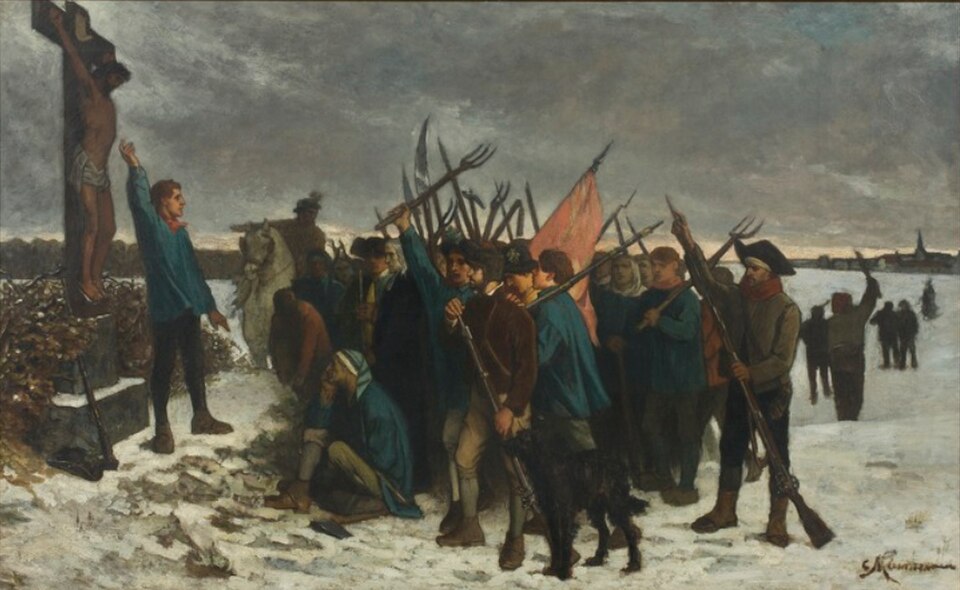
Title Image: Episode from the War in the Vendée. Source: Wikimedia Commons.

Endnotes:
[1] La Vendée du Directoire à Louis-Philippe (1795-1848), la lutte continue, Paris, Passés- Composés, to be published in 2027.
[2] Billaud, Auguste, La Petite Église dans la Vendée et les Deux-Sèvres (1800-1830), Paris,
Nouvelles Éditions Latines, 1962.
[3] AN, F/7/8070B, Niort, February 7, 1804, letter from the préfet of Deux-Sèvres to the conseiller d’État Portalis.
[4] Auguste Billaud, op. cit., pp. 234-235.
[5] AN, F/7/8070B
[6] AN, F/7/8070B, document 316.
[7] AN, F/7/8070B, document 310.
[8] AN, F/7/8070B, all the documents about the arrestations of the schismatic priests come from the same carton, without any document number.
[9] AN, F/7/8071.
[10] Guy Coutant, La Petite Église du bocage vendéen, Maulévrier, Éditions Hérault, 1987, p. 57. Mgr de Coucy will reconcile with Rome by writing a letter on June 20, 1819 condemning the Petite Église, Auguste Billaud, op. cit., p. 484-485.
[11] Auguste Billaud, op. cit., pp. 472-476.
[12] Ibid., p. 557.
[13] AN, F/7/9767.
[14] Guy Coutant, op. cit., p. 69.
Leave a Reply