By Lynn Hunt
This post is a part of the 2026 Selected Papers of the Consortium on the Revolutionary Era, which were edited and compiled by members of the CRE’s board alongside editors at Age of Revolutions.
Napoleon Bonaparte invented modern authoritarianism, though he did not know he was doing so at the time. His form of rule included some features that were hardly new: concentration of authority in a supreme ruler, lack of accountability, and the claim to be restoring social and political order. What made Bonaparte’s version modern was its rejection of democracy even while claiming popular support.
Modern authoritarianism uses the tools of democracy to undo democratic practices. As a form of regime, therefore, it only became possible once the ideals of representative government, popular sovereignty, and freedom of expression took root. Modern authoritarianism emerged first in France because the French Revolution of 1789 pushed democratic political participation further than anyone could have imagined at the time. The Revolution also uncorked a potent mix of radical egalitarianism and political violence that terrified wealthy property owners and the aristocratic leaders of neighboring countries. The stage was set for the emergence of a political alternative that was neither monarchical nor democratic but rather a hybrid – some would say bastardization – of the two.
At the beginning, that is, at the end of 1799 and early in 1800, no one, not even Bonaparte, could have imagined just how far this creation of a political alternative could go. Bonaparte was not the first choice of a general for those plotting the coup, and the plotters did not want one man to have all the power. Bonaparte himself had no clear plan, but he did instinctively grasp the requirements of the situation. In his first proclamation after gaining his new position he claimed that “conservative, tutelary and liberal ideas have recovered their rights thanks to the dispersion of the factious who were oppressing the Councils.” In other words, divisive politicians had created the problem which he would solve by enabling members of the current legislative bodies to write a new constitution that would replace those legislative bodies. His list of “ideas” left nothing out and deliberately gave no hint about the path that he envisaged. Ideas might recover their rights, as he put it, but political rights would appear nowhere in the Napoleonic system. His use of “tutelary” [tutélaire] in between conservative and liberal is significant, too; Bonaparte was positioning himself as the guardian angel or protective Roman god of the nation, a “soldier of liberty” and still “a devoted citizen of the Republic,” as he called himself, but someone already removed from the level of the ordinary.[1] He pledged to recover and restore; everything would change, and nothing would be too different. Freedom and the Republic would be saved. France would be great again.
There was no essential ideological foundation for what developed as authoritarianism, except that it offered an evolving combination of the traditional and the modern. Social order was the traditional part, but it would now be achieved through modern means: manipulation of the media, policies without politics, elections without meaningful participation, and the ruler as celebrity. Celebrity is key; Bonaparte got top billing because he had managed to get himself talked about incessantly ever since his surprise victories in Italy in 1796-97. Celebrity filled the void left by the collapse of divine right monarchy. It was a void that republican and representative governments had difficulty filling. Bonaparte became a charismatic figure, but not all at once and not for everyone. It might even be argued that he acted as if he was charismatic even before his supporters felt its force. He was not tall, elegant, sophisticated or at ease in company but while remaining distant he encouraged adulation, and no one overlooked the fierceness of his ambition or the intensity of his determination.
Bonaparte’s administration was civilian, not a military dictatorship, and though he re-established relations with the Catholic church, his regime did not depend on a religious justification. His self-coronation as emperor in 1804 made clear that he had become emperor by his own actions, and he took an oath at the time to uphold the gains of the Revolution of 1789, including the sale of lands confiscated from the Catholic church. He sustained his version of social order by invoking nationalism and his personal popularity and by maintaining tight control over the civilian bureaucracy, especially the police, and over the press and all forms of publication and performance. He did not, for the most part, rely on terror or public execution.
In the space between divine right monarchy, on the one hand, and democracy, on the other, Bonaparte carved a new path. He gestured toward religion without relying upon it for other than an additional guarantee of social order and simultaneously gestured toward popular or national sovereignty by holding plebiscites with only the option of yes or no votes that would be registered in public before local officials. Direct elections largely disappeared, most important officials were appointed, and the new legislative bodies could only approve or disapprove, not initiate. The gesturing in both directions – toward religion and democracy – was essential because Bonaparte had to plant his standard midway between the traditional and the modern.
He promised to reconcile the French with their tumultuous past and enable them to move forward with renewed energy into the future. This future orientation is crucial; authoritarianism is not a simple return to the traditional past. It is a way to use recovery of some elements of the past to forge a new route to the future that eliminated the uncertainties of democratic participation. As Pierre Cabanis, a leading medical scientist explained, the new system of representation “purges” democracy of all its “inconveniences”: “Everything is done for the people and in its name; nothing is done by the people or under the influence of its irrational dictates.”[2] Cabanis had been a deputy in the Council of Five Hundred and was a member of the new constitutional commission. He specifically argued against government by hereditary monarchy or aristocratic domination, but he also railed against democracy, which “put the wisest and most virtuous men at the mercy of the most absurd rabble.”[3]
The upheavals of the French Revolution, 1789-1799, had cleared a path for Bonaparte. The move from a traditional order based not only on religion but also on natural inequality and the force of centuries of habit to a secular order grounded on the people’s will, rights and equality had proved to be both elating and terrifying, like traveling into completely unmapped territory. Elections provided a fragile foundation for republican legitimacy. Because the republic was founded in 1792 on the shattered debris of the monarchy, the idea of a loyal opposition was almost impossible to countenance. It became all too easy to imagine that anyone disputing the authority of the government was a potential traitor and enemy. The alternation of power thus became nearly unimaginable. Bonaparte and his fellow plotters could pledge an end to divisiveness, to politics, and to the excesses of democracy and egalitarianism. For them, the sacrifice of individual and political rights was a small price to pay for the return of order.
While those who supported Bonaparte at the beginning generally admitted the principle of popular sovereignty – that government in some sense rested on the will of the people, which could be determined in a one-time vote on a new constitution – they did not endorse frequent or even meaningful elections, the possibility of alternation of those in power, or direct elections for administrative offices. Bonaparte aimed to recalibrate by offering elements of both monarchical tradition and revolutionary republicanism: on the one hand, a restored Catholic church, patriarchalism in the workplace and family, and a revival of social distinctions; and on the other hand, voting, where allowed, was open to a broad male public, equality under the law was guaranteed, and social distinctions would be based on merit rather than birth.
Authoritarianism was not a preordained outcome. Although the weaknesses of the preceding republican government opened a path, no one saw just where that path might lead. The coup of 18 Brumaire almost failed, as many of its plotters feared it might, and once it succeeded, ambiguity only increased, for no one, certainly not Bonaparte himself, had prepared a new constitution. It was only in the negotiations over the new constitution, in discussions that went on for weeks, that the outlines of a new regime began to emerge. In the provisional government charged with writing a new constitution, Bonaparte was only one of three consuls and did not have supreme authority.
An editorial in the Times of London dated November 16 captures the stupefaction and uncertainty: “No event in the whole series and career of the Revolution can more justly astonish and confound us. We find the immense and long-established fabric of the tyranny of BARRAS overthrown, we know not how, and by persons who have hitherto supported and defended it. We find the Legislature withdrawn from the Capital, and the Capital in perfect tranquility. We find BARRAS and BUONPARTE upon different sides in the present Revolution.” (Barras was the longest serving Director and a patron of Bonaparte, but he was unwilling to side with the plotters.) The editorial named abbé Emmanuel Sieyès as the central co-conspirator and predicted that Bonaparte “seems destined to found and to consummate the military despotism towards which the mis-shapen chaos of the Republic has so long tended.” But the paper was unsure about what would happen next: “He may retire from policy and for a time; he may also be displaced by the superior cunning and treachery of SYEYES.”[4]
Everyone considered Sieyès a major instigator and therefore a potential obstacle to Bonaparte’s ambitions. Sieyès was seconded by a small group of deputies who considered themselves moderates, disdaining both royalists and “demagogues” (Jacobins).[5] They aimed to correct the defects of the Directory government by essentially inverting the expression of popular sovereignty. As Sieyès most memorably put it, “No one should be named functionary by those who would be under his authority.”[6] Among the Brumairians were Pierre Roederer, Antoine Boulay, and of course, the ubiquitous Talleyrand. All had ties to Sieyès and long experience in the revolutionary years. After weeks of back and forth negotiations, they all ended up agreeing to Bonaparte taking the role of First Consul with supreme authority. Bonaparte himself said later that his reign began when as First Consul he gained supreme power as “a true president of America.”[7] He had no interest, however, in a similar system of checks and balances. He compared himself to the American president because there were no other models to cite. Bonaparte would develop a new, hybrid form of rule.
Bonaparte was not elected First Consul; the constitution of the year VIII named him First Consul and laid out his authority. Therefore, it is the authors of that constitution who set in motion the move toward authoritarianism. We do not know much about the private thoughts of these men. Boulay, at the time a 38-year-old lawyer and spokesman for the constitutional commissions, agreed to write an introduction to the new constitution but found that though he could readily explain why a new constitution was necessary he could not bring himself to defend the one drafted because he disagreed with many of its provisions.[8] But he only revealed this years later, and he did not stand in the way and in fact was one of the main negotiators between Sieyès and Bonaparte and therefore responsible for the general acceptance by the members of the legislative commissions of Bonaparte as First Consul with supreme authority. He explained the willingness to give up Sieyès’s plan that would limit Bonaparte’s role: “it sufficed that it was rejected by Bonaparte…. It was all too clear that it was Bonaparte who was called by the nation to be head, and that it was necessary to invest him with sufficient power so that he could employ, without obstacle or difficulty, his ascendancy, his activity and his genius in the service of the country.”[9] In other words, Bonaparte’s celebrity, the people’s attraction to his image, made him indispensable in a way that Sieyès was not. As Lucien said of his own inability to gauge his brother’s new standing, “my lack of experience did not allow me to assess to its full extent the new power of opinion that had just revealed itself.”[10] This “new power of opinion” would work through image-making rather than elections.
Image-making would depend on the preclusion of anything negative and the manufacture of positive images. Bonaparte did not delude himself about the unanimity of opinion about him. When the draft of the constitution became public, the newspapers were less than entirely favorable. As the police reported, the writing was considered “weak” and “a bit hasty”; it lacked “grand conceptions,” and people were surprised to see such an important document reduced to 95 articles that were essentially regulations.[11] On January 17, 1800, even before final approval of the constitution, Bonaparte ordered that only 13 newspapers could appear in Paris (with an exception for journals that made no reference to politics), and his government chose which ones, while also confirming the continuing supervision of the minister of police. Even the slightest criticism could get a newspaper’s issue banned from circulation.[12] Departmental prefects and police commissioners were established in February, and Joseph Fouché, confirmed as Minister of Police, promptly set up a secret police office for security that employed some 300 informers in Paris.
The journals that were permitted to continue were closely monitored. An English radical and man of letters who spent two years in France, Thomas Holcroft, commented extensively on the treatment meted out to the editor of Journal des hommes libres [Journal of Free Men]. The government seized one of its issues: “It may well be supposed it contained none of the base flatteries with which other journals were filled; and this was its perdition. At certain epochs, it is not enough that governors are not criticized: if the grossest praise be not heaped upon them, it is construed into open revolt.”[13] He also commented on the government’s use of publicity about its actions. The walls of Paris were papered with announcements of them. “To the eye, nothing can be more public, and undesigning: in fact, nothing can be more cautious, concealed, and artful….as almost every day produces a new decree, or a revival or alteration of the old, no one attends to them: it is too much for human industry.”[14] People could not keep up with the flurry of decrees whose sheer number was designed to impress them with the energy of the new regime and whose public posting was meant to convey their inherent legitimacy.
Given the persistence of rumors that Bonaparte had fainted during the scuffle in the Council of Five Hundred on the crucial second day of the coup, everything had to be done to burnish the First Consul’s image. Using the newspapers, he encouraged the minutest attention to his person, whether it was his temporary indispositions, his liking for coffee, his disdain for magnificent costumes (that was then, in 1799-1800), or his appetite for work. From the first days of the new government, the newspapers treated him as “the hero of Egypt and Italy,” “the hero of France,” even within months, “the savior of France.”[15] Soon to come would be his commission of paintings of himself, one of the first and most famous being Jacques-Louis David’s Bonaparte Crossing the Alps. Bonaparte came to David’s studio to request the painting, and he asked the artist what he was working on at that moment; David responded with the battle at Thermopylae pass, in which the Greeks held off the Persians in a famous last stand. Bonaparte responded, “Too bad; you are wrong, David, to wear yourself out painting the losers [vaincus].”[16]
George Washington, first president of the United States, died on December 14, 1799, and news of the death arrived in France weeks later, just when Bonaparte was moving to suppress dissent and enhance his image. The First Consul seized the occasion to make a point. Was he not the French Washington, a great general who would lead a republic, and in his case, save it? Bonaparte decided to organize a double ceremony on February 9, 1800 honoring Washington alongside the presentation of the trophies taken in the conquest of Egypt. He wanted to feature his accomplishments alongside those of Washington but he had not yet reached the stage of making himself the only center of attention at every opportunity. Looking back after Waterloo years later, he explained why he could not be the French Washington and walk away from power: “Once I arrived in power, some would have wanted me to be a Washington; words cost nothing and surely those who said it with such facility did so without knowledge of the times, the places, the men and the things. If I had been in America, I would have willingly been another Washington…But if he had found himself in France, with dissolution inside and invasion from the outside, I would have defied him to be what he was…For myself, I could only be a crowned Washington.”[17] In early 1800, the crowning was still a long ways off, but in this phrase, Bonaparte captured the reality, the ambiguity, and the anxiety of his situation throughout his rule. This hybrid form I am calling authoritarianism has a problem with both the past and the future; the authoritarian may rule for many years, but he (usually he) cannot establish a succession. Cromwell, Napoleon, Franco, the list is long but the end result is always the same; failed succession. There is hope yet.
Lynn Hunt is one of the most influential scholars of the French Revolution and a leading voice in cultural history. She taught at UC Berkeley (1974–1987) and the University of Pennsylvania (1987–1998) before joining UCLA as Eugen Weber Professor of Modern European History (1998–2013), where she is now a Distinguished Research Professor and Eugen Weber Professor Emerita. Her books include Politics, Culture, and Class in the French Revolution (1984), The Family Romance of the French Revolution (1992), Inventing Human Rights (2007) and The Revolutionary Self (2025), along with History: Why It Matters (2018) and the co-authored Telling the Truth about History.
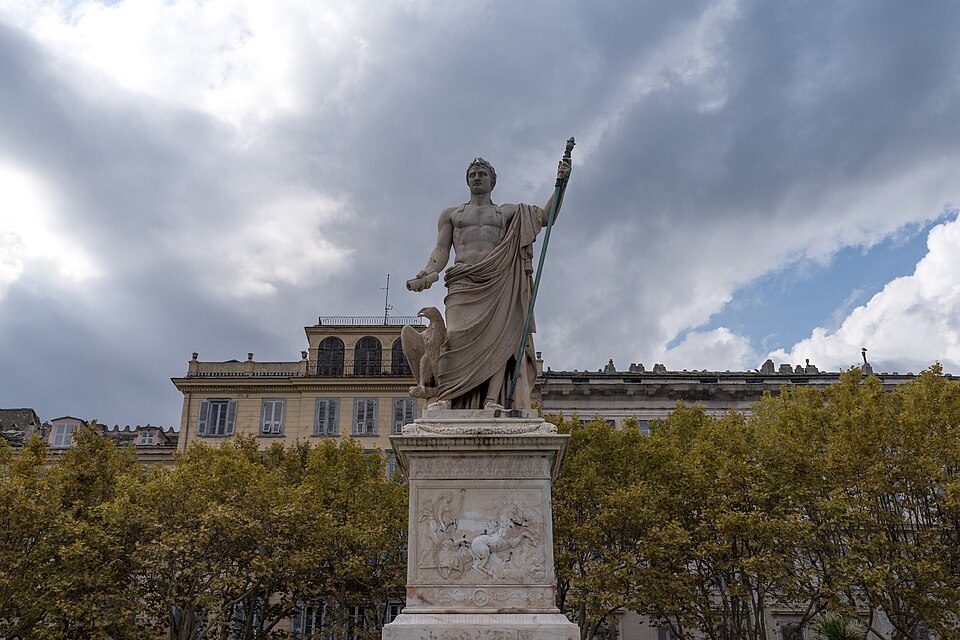
Title Image: Statue of Napoleon in the classical style, Bastia, Corsica. Source: Wikimedia Commons.

Endnotes:
[2] Jean-Baptiste Say gave an account of Cabanis’s views with some direct quotation in La Décade philosophique, littéraire et politique : par une société de gens de lettres, no. 10 (Dec. 31, 1799), 11 and 13. The journal was a vital source for the intellectual developments of the period. Michael Sonenscher, “The Moment of Social Science”: The Décade philosophique and late Eighteenth-Century French Thought,” Modern Intellectual History, 6, no. 1 (2009): 121–146, https://doi.org/10.1017/S1479244308001960.
[3] Pierre-Jean-Georges Cabanis, Quelques considérations sur l’organisation sociale en général, et particulièrement sur la nouvelle constitution (L’Imprimerie nationale, Frimaire an VIII [December 1799]), 23, BNF Gallica.
[4] The punctuation and spelling given was in the original. Gale Primary Sources: The Times Digital Archive.
[5] Pierre Serna identifies them as part of an “extreme center” that has bedeviled French politics for centuries, leading right up to President Macron. Although his analysis offers many arresting insights he does not adequately explain why this particular group had to turn to a general and took so long to do so. L’Extrême centre ou le poison français, 1789-2019 (Éditions Champs Vallon, 2019).
[6] As recounted in Antoine Boulay de la Meurthe, Théorie constitutionelle de Sieyès: Constitution de l’an VIII (Paul Renouard, 1836), 10, BNF Gallica.
[7] Emmanuel de Las Cases, Mémorial de Sainte-Hélène, ou Journal où se trouve consigné, jour par jour, ce qu’a dit et fait Napoléon durant dix-huit mois, 8 vols. (Dépôt du Mémorial, 1823-1824), 5: 22, HathiTrust.
[8] Boulay de la Meurthe, Théorie constitutionelle de Sieyès: Constitution de l’an VIII, 72 (in the section on constitution of year VIII).
[9] Boulay de la Meurthe, Théorie constitutionelle de Sieyès: Constitution de l’an VIII, 71.
[10] Théodore Jung, Lucien Bonaparte et ses mémoires, 1775-1840: d’après les papiers déposés aux archives étrangères et d’autres documents inédits, 3 vols. (Charpentier, 1882-1883), 1: 265.
[11] Alphonse Aulard, Paris sous le Consulat: Recueil de documents pour l’histoire de l’esprit public à Paris, 4 vols. (L. Cerf, 1903-1909), 1; 55-56.
[12] The decree can be found at Gustave Le Poittevin, La liberté de la presse depuis la Révolution, 1789-1815 (A. Rousseau, 1901), 128-129.
[13] Thomas Holcroft, Travels from Hamburg, through Westphalia, Holland, and the Netherlands, to Paris, 2 vols. (Richard Phillips, 1804), 2: 523, HathiTrust.
[14] Holcroft , Travels, 1: 190.
[15] “Sauveur” was the term reported by the police on October 23, 1800, Aulard, Paris sous le Consulat, 1: 744.
[16] Etienne Jean Delécluze, Louis David: son école et son temps : souvenirs (Didier, 1855), 231, HathiTrust.
[17] Las Cases, Mémorial de Sainte-Hélène, 2: 29-30 (italicization in text).
Leave a Reply