By Rosemarie Zagarri
This post is a part of the 2026 Selected Papers of the Consortium on the Revolutionary Era, which were edited and compiled by members of the CRE’s board alongside editors at Age of Revolutions.
Throughout his life, George Washington projected an image of himself as a model republican leader, first as Commander-in-Chief of the Continental Army, and then as the first president of the newly reconstituted United States of America. In some ways, Washington was inventing the role from scratch; in other ways, he drew on classical models of antiquity, especially those from ancient Greece and Rome, in fashioning his self-image. Three issues, however, came over time to taint his unblemished image as a model republican: his association with the Society of the Cincinnati; his unretirement from public service; and the question of slavery.
Like many other Virginia gentlemen at the time, Washington received an education at the hands of a private tutor. Unlike many of the other Founders, however, Washington never attended college–though he did train to be a land surveyor. To make up for his lack of formal education, Washington became an avid reader. He particularly gravitated toward the history and philosophy of ancient Greece and Rome. He found the Stoics, with their emphasis on moderation, frugality, temperance and honor, especially appealing.[1]
Like many others of the founding generation, Washington viewed the conflict with Great Britain through the lens of classical republicanism. In this view, the battle for liberty stretched back to the ancient world. Tyranny constantly threatened liberty, virtue vied with corruption, and freedom was liable to devolve into oppression. While self-governing republics were one of the highest forms of government, this kind of polity was especially fragile, constantly subject to the threat of decay, decline, and corruption. Only constant vigilance and virtue could preserve freedom. Only an unceasing willingness to sacrifice for the common good could secure liberty. A failure to defend liberty could be catastrophic, resulting in what classical republican authors called “slavery.” Rather than an allusion to chattel slavery, this condition referred to the loss of control over one’s fate, the complete inability to exercise one’s will. Ironically, classical republican authors paid far more attention to the political status of white males than to that of enslaved Black people.[2]
Washington modelled his own style of leadership on the republicans of the ancient world. One of Washington’s favorite plays was Cato. Written by the radical Whig author Joseph Addison in 1713, the play dramatized the story of Cato the Younger in his resistance in the first century BCE to the tyranny of the Roman dictator Julius Caesar. Washington not only read the play and saw it performed numerous times, he also had it performed for his soldiers during the Revolutionary War. In May 1778, after the hard winter at Valley Forge Washington ordered a performance for his men. He identified with the play’s hero, Cato, a leader who, like himself, was engaged in the fight to defend ageless freedoms from tyranny, even at “the price of so much blood.” He was determined to never be responsible for letting liberty “perish” on his watch.[3]
If Cato served as a positive classical role model for Washington, the play’s tyrant, Caesar, offered a starkly negative referent and provided a thinly veiled allusion to the colonists’ own tyrant, George III. As a young man, Washington had expressed great admiration for certain dictatators, in particular, Alexander the Great and Caesar. He admired the men’s tremendous military prowess, leadership abilities, and world conquest. In 1759, he ordered busts of several great men, including Caesar, to be displayed in his home at Mount Vernon. Yet with the coming of the American Revolution, Washington’s attitude toward Caesar changed. Aware of the dangers of unchecked power, Washington knew he must subordinate his own personal ambitions in order to ensure the triumph of the greater good. Determined to be the anti-Caesar, he had the bust of Caeser removed from his library.
Washington’s rejection of Caesar corresponded with his embrace of another classical republican figure, Cincinnatus. Like Cato, Cincinnatus put the good of his country above his own personal self-interest. According to Livy’s History of Rome (a book that Washington owned), Cincinnatus was a Roman statesman and military leader who lived in the fifth century BCE. Legend had it that he was at work in his fields when word came that the republic was in danger. Dropping his plow, he took up his sword and sped to the field of battle, where he soon led his army to victory. He then put aside his weapons, abandoned the military life, and returned home to his farm. Later, when asked to serve as a temporary leader of the Roman Republic, Cincinnatus once again left his private station and served his country for a short time. When the job was done, he retired back to private life. He never let his own personal ambition supersede the importance of serving the public good.[4]
Like Cincinnatus, Washington consciously chose to make a series of dramatic exits from public life. During the French and Indian War, Washington obtained a commission as a colonel in the colonial regiment and served with the Virginia militia, alongside British regulars, defending the frontier. During this time, Washington became known as a model republican leader, known for his bravery, his integrity, his skill as a horseman, and his personal charisma. After achieving his goals, he resigned his commission in 1759 and returned to private life. In a parting speech to his soldiers, Washington thanked the troops who served under him. Evoking their shared sacrifice, he talked about “the Pangs” he felt “at parting with a Regiment that has shared my toils, and experienced every hardship & danger which I have encountered.” He concluded saying, “If I have acquired any reputation, it is from you I derive it. . . . It is herein, I glory.”[5] Washington then set off to marry a wealthy widow, Martha Custis, who, as much as anything catapulted him into the higher ranks of the Virginia gentry.
Washington repeated this pattern of retiring at other peak moments throughout his public life. At the end of the American Revolution, in a dramatic ceremony in Annapolis on December 23, 1783, Washington handed Congress his resignation as commander in chief of the Continental Army. His immense popularity would have easily made it possible for him to remain in power as a dictator; he chose not to do so. He put republican principles ahead of power. Having heard rumors of Washington’s intended resignation, King George of England purportedly exclaimed, “If he does that, he will be the greatest man in the world.” Washington had fulfilled his youthful ambitions for military glory; he had no desire to seek power for its own sake. Retiring to Mount Vernon, he intended to spend his remaining years on his farm with his wife and family, tending to what he called his vine and fig tree.[6]
For a variety of unforeseen reasons, Washington was soon called back to public life. Reluctantly, he agreed to serve as the first president under the new U.S. Constitution. When certain supporters urged him to stand for a third term, he refused, even though there was no constitutional prohibition against his doing so. Thus in 1796, he left the public stage once again, relinquishing the presidency after two terms in office, setting a precedent that would last for nearly a century and one half after him. He became, as historian Garry Wills has noted, “a virtuoso of exits.”[7] Always aware of his reputation and legacy, Washington, wished to preserve his image as a great republican leader.
If this account seems overly celebratory, or even uncritical, in its assessment of Washington, it is also reflective of the universal esteem in which Washington was held. From time the of Revolution on, Washington was indisputably the most famous and celebrated individual in America, even throughout the western world. It is hard to overstate his popularity. He was the father figure that replaced the deposed King George III in the minds of citizens. A symbol of unity, he helped reconcile divided Americans throughout the new nation. For his part, Washington strove to adhere to the style of leadership inherited from the ancient republicans, a style that emphasized masculine valor and a selfless commitment to public service as well as a calculated aloofness from the tawdry rough-and-tumble of everyday politics.[8]
But cracks in Washington’s armor began to be apparent shortly after the American Revolution, even before he became president. In 1783, former Revolutionary general Henry Knox spearheaded the creation of an organization to honor the great republican hero of antiquity, Cincinnatus. Transatlantic in scope, the Society of the Cincinnati was intended to foster and preserve the bonds of friendship between the allies of the American Revolution, France and America. The organization would provide a space where men could gather to relive their shared sacrifices and recall the heroic exploits of the Revolutionary War. It was also a fraternal society, offering charity and other kinds of financial assistance to members, their widows and children. Yet membership was not open to all those who had fought. Only American officers and their French counterparts, not enlisted men, could join. Membership was also hereditary. After the death of the original officer, membership would pass to the individual’s eldest son.[9]
From the beginning, the Society of the Cincinnati proved to be a lightning rod for controversy. Some Americans, including Thomas Jefferson, objected to its quasi-military membership; others to its exclusionary nature; and still others to its aristocratic pretensions. George Washington was among the Society’s original members, elected its very first president. Yet his association with the Cincinnati soon began to damage his carefully cultivated public reputation. The Society’s values were portrayed as antithethical to the spririt of the Revolution. Mercy Otis Warrn, in her History of the American Revolution, lambasted Washington as well as the Society itself. Instead of imitating “the humble and disinterested virtues of the ancient Roman [Cincinnatus],” after whom the Society was named, the organization “ostentatiously assum[ed] hereditary distinctions, and the insignia of nobility.”[10]
As popular criticism grew, Washington began to reassess his ties to the Cincinnati. He demanded that the group undertake certain reforms, such as abolishing the requirement of hereditary membership, eliminating any discussion of present-day politics, and rejecting foreign donations. At one point, he even threatened to resign if his demands were not met. Yet the Society resisted his proposals for change. By the late 1780s, he decided that he would no longer wear the Society’s distinctive membership badge –a golden eagle–in public. Yet Washington never completely cut his ties with the organization. He remained the Society’s president until his death in 1799. For many Americans, Washington’s membership in the Cincinnati became, as Mercy Warren put it, a enduring “blot” on his character, creating doubts about the true level of his commitment to republican values.[11]
The second event that seriously damaged Washington’s image as a classical republican leader occurred when he agreed to serve as the nation’s first president in 1789. Although Washington had promised to retire permanently at the end of the Revolution, circumstances conspired to drive him back into the public life. The union was on the verge of collapse. When delegates gathered in Philadelphia in the Summer of 1787 to craft a new plan of government, Washington reluctantly agreed to attend the meeting. Despite his reluctance, delegates to the Philadelphia Convention unilaterally assumed that Washington would be the nation’s first president. They even wrote certain provisions regarding the executive branch with Washington in mind. During the ratification period, Washington actually refused to participate in the public debate over the Constitution, fearing that he might be seen as campaigning for the presidency. Once the Constitution was ratified, he was unanimously elected by the Electoral College.[12]
Washington’s classical republican principles were at war within himself. Although he desired to serve the public, he did not want to repudiate his previous decision to retire to private life. He did not want to go back on his word. In addition, he doubted his capacity as a civilian leader. He saw himself as a military man, not a politician. Yet friends, colleagues, and political leaders pressured Washington to accept the new role. Only Washington, they said, could possibly unite the fractious nation and make the new government a success. Despite his grave misgivings, he agreed to take on the new role. Like Cincinnatus, he would come out of retirement and serve his country once again.[13]
Washington’s doubts about assuming the presidency were in some measure proven correct. Despite his many achievements, Washington made a number of serious missteps as president. Throughout his tenure, Washington always insisted that he was a president above party, a leader who made his decisions impartially and in the service of the larger public good. Yet his critics found him lacking. Over time, they noticed that he routinely favored the policies of Alexander Hamilton and the Federalists over Thomas Jefferson and the Democratic-Republicans. These policies included his support for a strong centralized government, a powerful executive branch, and a strong military structure, including a standing army. Washington, critics declared, had betrayed his commitment to classical republican principles and was, in fact, on the path to becoming the kind of tyrant against whom he had once waged war. By the end of his presidency, Washington, though still popular in many circles, was no longer universally admired.[14]
The final issue that eroded Washington’s image as image as a great classical republican hero was the issue of slavery. As is well-known, Washington was a lifelong slaveholder, owning over one hundred slaves himself and managing more than twice that number for his wife’s estate. Much of his family’s wealth derived from the labor of enslaved people. His leisure to participate in public life was purchased at the expense of people held in bondage. Yet the existence of slavery troubled Washington. Over the course of his life, Washington’s ideas about slavery evolved–partly in response to changing economic conditions, partly in response to his own experiences during the Revolution, and partly in response to changing attitudes toward slavery in the country.[15]
During the 1780s, the pressure on Washington to free his slaves intensified. During and after the Revolution, antislavery sentiment began to increase throughout the United States. The first abolitionist societies were founded in Philadelphia and New York. Some states in the North ended slavery, either immediately or gradually over time. Certain southern states, including Virginia, passed laws allowing individual masters to manumit their enslaved people. He started to draw up proposals that charted a path for his enslaved people to move from slavery to freedom. He called his ownership of slaves the “only unavoidable subject of regret” in his life. The Marquis de Lafayette and others encouraged Washington’s nascent abolitionist sentiments.[16]
Washington, however, postponed making a decision. He hesitated partly because his own finances were in terrible shape and partly because he was not certain how his former slaves would support themselves once they were freed. Then, with his election to the presidency, Washington put his plans for manumitting his slaves on hold. Knowing the extreme sensitivity of the subject of slavery, Washington wanted to avoid creating undue controversy or unnecessary turmoil in the fragile new nation. Yet the plight of his enslaved people still pricked his conscience. After he retired, Washington returned to the question of manumission. When he made his will in 1799, he provided that his 123 enslaved people would be freed once his wife died. He made provisions for their education and provided for their support. Yet freedom would come only to the people he owned. Though many of the couple’s slaves had intermarried, he could not legally free the 183 slaves attached to Martha’s estate. The Custis slaves remained enslaved and were passed down to her heirs, separating families.[17]
Washington was among the very few slaveholding Founders to free his enslaved people. Yet critics—both at the time and down to the present day—have often criticized his actions as too little and too late. Certainly, for those he enslaved it must have felt this way. Yet the issue of slavery touched Washington in a way few other controversial issues did. Critics attacked Washington for his ties to the Society of the Cincinnati and for his partisanship as president. He felt bitter, angry, annoyed, or misunderstood. In neither case, however, did Washington fundamentally change his actions or alter his behavior. Until the end of his life, Washington still belonged to the Society of the Cincinnati and was the organization’s president. Until the day he died, Washington never identified himself as a member of the Federalist party and insisted that he had governed as a president above party.
Slavery was different. Washington did fundamentally change his position on slavery. Yet as the historian Philip Morgan has emphasized, Washington experienced no “Damasus-like” conversion to the cause of abolition. His opposition to slavery emerged slowly and gradually over time. Three issues motivated the shift: slavery’s declining profitability; his desire to preserve his image for posterity; and a growing realization of slavery’s incompatibility with liberty and the principles of classical republicanism.[18]
The issue of slavery impinged on Washington’s very sense of himself as a model republican leader. Throughout his career, Washington saw himself as establishing a template for a new kind of leader, a leader particularly suited for a republican form of government. Leading by example, Washington prided himself on supporting liberty against tyranny, civic virtue over self-interestedness, and the collective good over personal ambition. As a good classical republican, Washington could not bear the idea that slavery would taint his image for posterity. After he died, he wanted to be remembered as a republican hero, the leader of a nation founded on liberty, not as the owner of slaves.
In the end, Washington could no longer tolerate the contradiction between slavery for Black people and freedom for whites. While an ancient Roman general might own slaves, a modern republican leader could not. He had to free his slaves.Through this grand gesture, Washington may have hoped that other Americans would follow his lead. They too might free their slaves, moving the country to a fuller embrace of its true republican principles.
Rosemarie Zagarri is Distinguished University Chair of History at George Mason University. received her Ph.D. from Yale University and specializes in Early American history. She has published four books, the most recent of which is Revolutionary Backlash: Women and Politics in the Early American Republic (University of Pennsylvania Press, 2007; paperback, 2008). Her articles have appeared in leading scholarly journals such as the Journal of American History, American Quarterly, Journal of the Early Republic, and William & Mary Quarterly, and in numerous edited collections. Her latest book project is called, “Intimacies and Ambitions: Thomas Law in British India and the Early American Republic.”
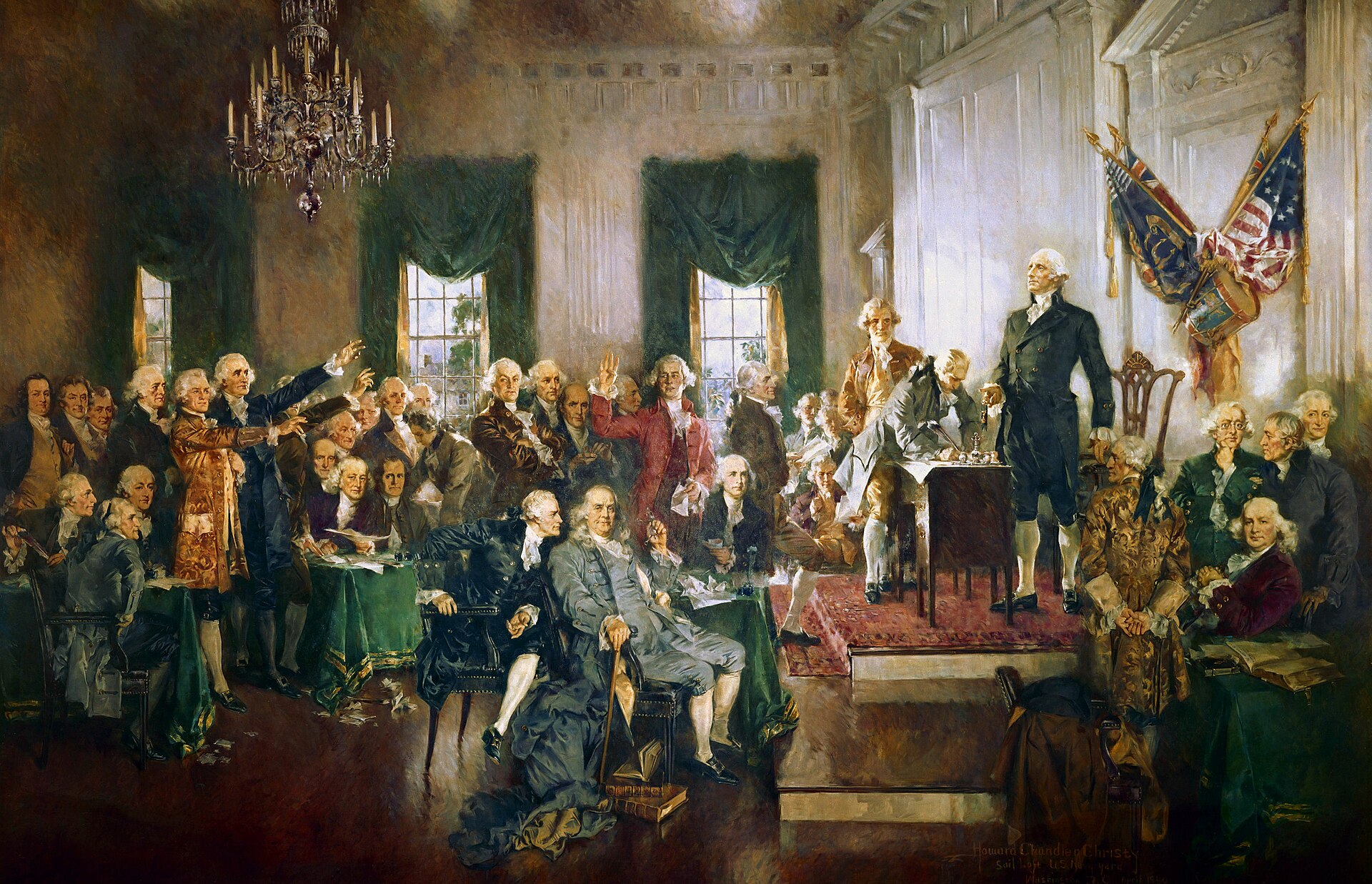
Title Image: Howard Chandler Christy, George Washington presiding the Philadelphia Convention, 1940.
Endnotes:
[1] Douglass Southhall Freeman, Washington (Collier Books, 1968), 10-12; Paul K. Longmore, The Invention of George Washington (University of California Press, 1988), 1-16, 213-26; Kevin J. Hayes, George Washington: A Life in Books (Oxford University Press, 2017), 14, 66-67, 96, 114-15, 176.
[2] J.G.A. Pocock, The Machiavellian Moment: Florentine Political thought and the Atlantic Republican Tradition (Princeton University Press, 1975), 506-52; Gordon S. Wood, Creation of the American Republic (University of North Carolina Press, 1969), 46-124; Eran Shalev, Rome Reborn on Western Shores: Classical Imagination and the Creation of the American Republic (University of Virginia Press, 2009); Carl J. Richard, The Founders and the Classics (Harvard University Press, 1994); Rosemarie Zagarri, “Liberty and Power: The Classical Republicanism of George Washington and Mercy Otis Warren,” in Political Thought and the Origins of the American Presidency, ed. Ben Lowe (University Press of Florida, 2021), 274-300.
[3] Joseph Addison, Cato: A Tragedy, and Selected Essays, ed. Christine Dunn Henderson and Mark Yellin (Liberty Fund, 2004), act. 3, scene V, lines 71-76; Shalev, Rome Reborn, 99-101; Hayes, Washington, 114-15, 208-09; Richard, Founders and the Classics, 58-60.
[4] Hayes, Washington, 66-67; Garry Wills, Cincinnatus: George Washington and the Enlightenment (Doubleday & Co., 1984), 133-3; Shalev, Rome Reborn, 219-22.
[5] Rosemarie Zagarri, ed., Life of General Washington, by David Humphreys, with George Washington’s Remarks (University of Georgia Press, 2006), 69-70.
[6] Wills, Cincinnatus, 1-6, 13-15; Joseph J Ellis, His Excellency: George Washington (Knopf Doubleday, 2004), 39, 145-46, 230-40; Barry Schwartz, George Washington: The Making of an American Symbol (Free Press, 1987),
119-48.
[7] Wills, Cincinnatus, 133-137.
[8] Peter R. Henriques, George Washington: His Quest for Honor and Fame (University of Virginia Press, 2025),
85-90.
[9] Minor J. Myers, Jr., Liberty without Anarchy: A History of the Society of the Cincinnati (University of Virginia Press, 2004); Ellis, His Excellency, 158-60.
[10] Mercy Otis Warren, History of the Rise, Progress and Termination of the American Revolution Interspersed with Biographical, Political and Moral Observations, ed. Lester H. Cohen (Liberty Fund, 1988 [orig. pub. 1805], 2: 618.
[11] Warren, History of the American Revolution 2: 619; Ellis, His Excellency, 158-60.
[12] Henriques, George Washington, 71-88; Glen A. Phelps, George Washington and American Constitutionalism (University Press of Kansas, 1993), 91-120.
[13] Henriques, George Washington, 71-88.
[14] Warren, History of the American Revolution, 2: 662-666; Henriques, George Washington, 102-06.
[15] Philip D. Morgan, “’To Get Quit of Negroes’: George Washington and Slavery,” Journal of American Studies 39:3 (Dec. 2005), 403-29.
[16] Humphreys, Life of General Washington, 78; Mary V. Thompson, “’The Only Unavoidable Subject of Regret’: George Washington, Slavery, and the Enslaved Community at Mount Vernon (University of Virginia Press, 2019), 293-314; Henry Wiencek, An Imperfect God: George Washington, His Slaves, and the Creation of America (Farrar, Straus, & Giroux, 2003), 452-454.
[17] Thompson, ‘Only Unavoidable Subject of Regret,’ 293-314.
[18] Morgan, “’To Get Quit of Negroes’”, 425-29; Bruce A. Ragsdale, Washington at the Plow: The Founding Farmer and the Question of Slavery (Cambridge, MA: 2021), 270-75.
Leave a Reply